
A goat grazed outside a small building in a remote part of southern Zambia. Behind the building’s door waited a lab full of mosquitos, and he would be their dinner.
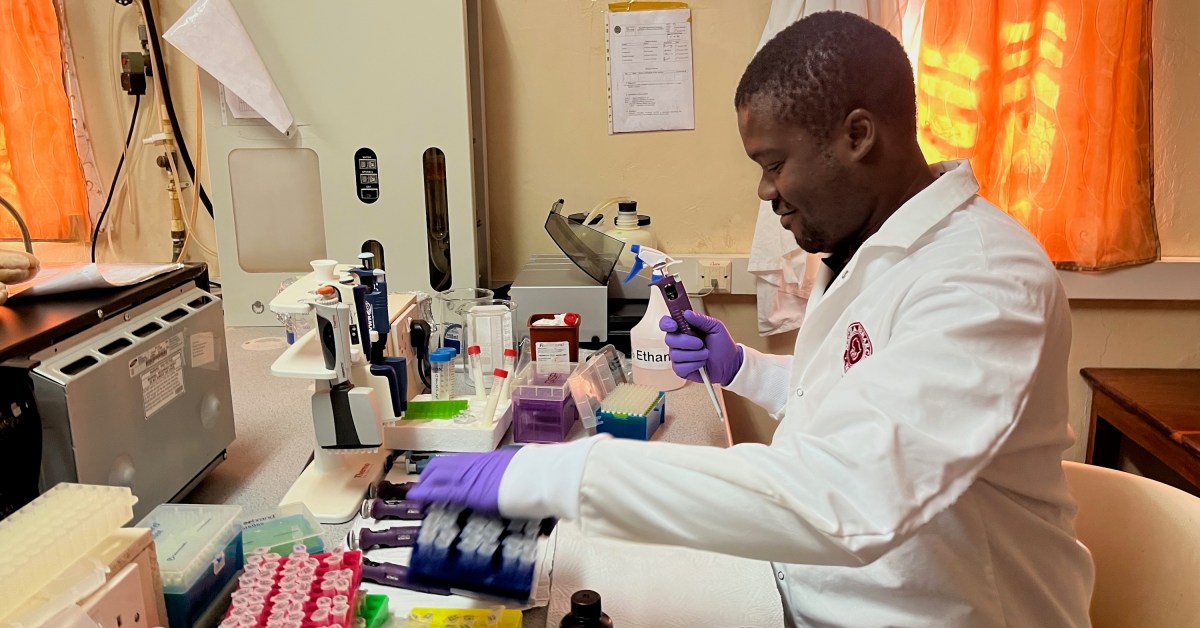
Inside the warm, humid lab, called an insectary, mosquito larvae squirmed in trays of water. Hundreds of grown mosquitos buzzed in mesh boxes. A series of doors secured them from the outside world.
The lab belongs to Macha Research Trust (MRT). It sits on the grounds of a mission hospital and has played a central role in dramatically reducing malaria in this part of Africa. But in the past few weeks, the lab has reduced its staff after unexpected halts in National Institutes of Health funding from the United States—part of the Trump administration’s reshuffling of global health investments.
When CT visited in late June, a skeletal staff had been working since March without information on what would happen with their research. The lab does sometimes have research contracts from private sources or the Zambian government, but the NIH is its big supporter at about $120,000 a year.
By July, the staff had grown more hopeful that some funding would come through, but the leaders may not be able to rehire some staff. Like many US research partners around the world, they’ve had this kind of unpredictability all year.
“We are really not sure how much more MRT can do to keep things running,” said Mukuma Lubinda, one of the lab’s longtime scientists. “We are running at a loss.”
This area of Zambia, mostly inhabited by subsistence farmers, was once malaria-ridden. Now, thanks to Macha’s surveillance, malaria has been reduced by 95 percent, an achievement that mainly benefits babies and children. In a country where malaria is widely prevalent, the area around MRT is a rare bright spot.
“It’s not eradicated, but day-to-day transmission was eliminated,” said Phil Thuma, the American missionary pediatrician who started the research center in 1988 as part of Macha Mission Hospital and is now retired. Thuma grew up at Macha, the son of the doctor who in the 1950s founded the mission hospital, which has 208 beds and is the main health center for this rural area.
A Nobel laureate has complimented the research center’s breakthroughs. Johns Hopkins University has been a regular partner to fund and oversee studies. The lab has implemented major studies on HIV, tuberculosis, and the flu, serving as a field site for researchers from the United States.
On the wall where Lubinda works, map printouts show malaria hotspots over the years—and how they’ve disappeared, red spots shrinking into green. Lubinda wants the green area to keep growing bigger, to cover the whole Southern province. Maybe one day, the nation.
Local medical experts fear that because malaria cases have fallen here, locals’ immunity to malaria has also gone down. So if the disease returns, the damage could be worse.
“Most of the children, especially the ones below 5, actually don’t have any immune response to malaria,” said Ben Katowa, one of the scientists who was working in the lab, bent over mosquito samples.
MRT is a sort of contradiction: In Choma, dirt roads wash out in the rainy season, water can be scarce in the dry season, and night skies dazzle from the lack of street lights. But also, a Zambian entomologist at MRT has tools to analyze the genomes of local mosquitos.
Cataloguing the mosquito species, and the malaria parasite itself, helps scientists know whether a particular malaria case is local—requiring them to track down and eliminate a possible mosquito breeding ground—or if it came from another part of the country. They can also see how mosquito behavior changes over time or if the parasite causing malaria is becoming drug resistant.
The mosquitos might help the research center stay afloat: It can contract them out. Government and private researchers want Macha’s lab mosquitos to test the efficacy of insecticides on certain species, for example. Breeding mosquitos in a lab for study ensures the insects are not carrying malaria. (The goat that provided blood for the bugs’ meal is fine.)
A Johns Hopkins study running at the center now investigates why mosquitos are attracted to some humans more than others. A 10-minute walk from the hospital, a big mosquito house features tubes running out to concrete pads where human test subjects will sleep in tents. A fan blows the sleeping humans’ scents into the mosquito house, and an infrared camera in each tube shows which person draws the most mosquitos. Researchers will analyze common denominators in those who attract or repel mosquitos.
Macha’s mosquito research is “fairly unique in the world,” Thuma said.
Rural malaria research centers are also rare, but they are especially useful in Zambia, where the risk of contracting malaria is 4.5 times higher in rural areas than in urban ones.
“We set out to show that you can control malaria in rural parts of Africa,” Thuma said. “We proved that. It was doable.”
Thuma started the research center with a group of Zambian staff in the late 1980s, when he saw malaria cases skyrocket at the mission hospital. He and other doctors realized the malaria drug chloroquine was no longer working on their patients. They won funding to research new solutions—eventually hosting studies on novel drugs that came into national use, he said.
Johns Hopkins University, where Thuma did his pediatric residency, became a partner in 2000, according to Thuma. Now Macha Research Trust is independent of the hospital, but it still sits on the hospital’s campus and maintains ties with the hospital’s denomination, Brethren in Christ.
“God allowed us to use our research center to show that you can do good quality scientific research even in the remote bush mission hospital,” Thuma said. He saw skepticism at international conferences toward research from a Christian hospital, but he said that shifted over time as the research center proved itself.
To eradicate malaria, Macha uses a rapid testing and tracing program called “1-3-7,” a Chinese strategy instrumental in helping China officially eliminate malaria in 2021. The numbers refer to days: one day to test and report, three days to determine the source of the case, seven days to intervene with additional testing or eliminating mosquito breeding grounds.
Around Macha, when a person contracts malaria, everyone who lives within 140 meters of the person is also tested. The center learned the importance of identifying asymptomatic human carriers of malaria and treating them as well. With locals staffing the lab, people in surrounding villages were more willing to participate in malaria surveillance, Thuma said.
Harry Hamapumbu has worked at the research center for 20 years, running projects for Johns Hopkins and going out into the field. After the cuts, he has been stuck in the lab’s office since there isn’t funding for field work.
With the cuts, “we will see a resurgence of malaria,” he said.
The research center was trying to prepare for the funding loss. Lab staff trained community health workers from eight other health facilities to do testing, surveillance, and mosquito collection. The workers use an app to report cases and document follow-up. But without funding, all of that work becomes voluntary.
“We wanted to have a situation where even if the funding comes to an end, the community can continue doing these things with low-cost tools, which we developed,” Lubinda said. “We don’t want to lose this data we’ve been collecting for almost 20 years.”
Malaria season comes to Zambia with the rains of October. For now, the remaining scientists will keep coming to the lab, analyzing blood samples, and feeding their mosquitos.
