
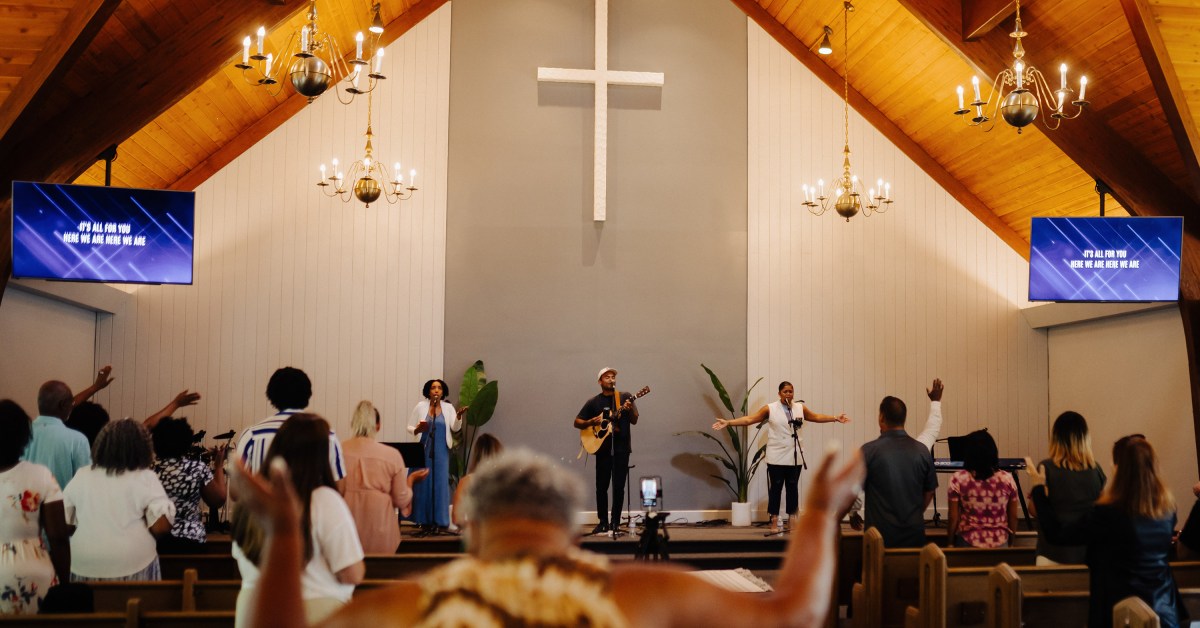
Over the past decade, churchgoers are more likely to see someone of a different ethnicity in their congregation but less likely to hear about racial diversity from the pulpit.
A Lifeway Research study of US Protestant pastors found churches have seemingly grown more diverse, while pastors have grown less likely to see diversity as a goal and to preach about racial reconciliation.
“American congregations have a long history of being comprised of almost entirely one ethnicity. The reasons reflect both social tendencies and historical factors such as repercussions from slavery [and] waves of immigration from specific regions and denominations,” said Scott McConnell, executive director of Lifeway Research.
“While the majority of new churches seek to reach people from multiple ethnicities or cultures, most fall short of sociologists’ multiethnic threshold, which is when the largest ethnic group does not exceed 80 percent,” McConnell said.
Currently, around 3 in 4 pastors (77%) say their church is predominantly one racial or ethnic group—similar to the number who said so in 2021 (76%).
That percentage reflects an overall downward trend, as churches have become more diverse. In 2013, 86 percent of pastors said their church had one primary racial group. That fell to 81 percent in 2017.
“Churches have slowly reflected changes in the US population, but many are decades behind shifts in the size of ethnic groups in their communities,” McConnell said.
White pastors (79%) are the most likely to say their congregations are mostly one ethnic group. Denominationally, mainline pastors are more likely to agree than their evangelical counterparts (83% versus 75%), while Pentecostal pastors (50%) are the least likely to agree.
The study also found that rural pastors and pastors in the Midwest are more likely to lead a church with one predominant racial group than those at urban churches.
Church size also plays a role: Smaller churches are less diverse than larger ones. Roughly 8 in 10 pastors at churches with fewer than 100 attendees said their church is mostly one ethnic group, compared to 7 in 10 pastors with congregations of 250 or more.
Most pastors believe every church should strive to achieve racial diversity, but that number has declined in recent years.
Today, more than 4 in 5 US Protestant pastors (84%) believe racial diversity should be an aim of all congregations. In 2017, 93 percent did.
“2017 stands out as an outlier,” McConnell said. “Some pastors were likely impacted by the violent clashes at the Unite the Right rally in Charlottesville, Virginia, just a couple weeks prior to the survey that year. Still, the typical response of more than 4 in 5 pastors reflects[s] a strong value among Protestant pastors that the fellowship of each local church is to be for people of all ethnicities.”
While evangelical congregations are seemingly more likely to be diverse, mainline pastors are more likely to see diversity as a goal. Almost 9 in 10 mainline ministers (89%) say that should be the case, compared to 79 percent of evangelical pastors.
Almost 3 in 5 (56%) pastors say they preach on racial reconciliation or speak about it in a large group meeting at their church at least once a year, but a growing number say it’s never a sermon topic. A quarter rarely broach the subject in a sermon, and 17 percent say it’s never part of their preaching.
In previous studies, few pastors said they never preached on racial reconciliation—only 4 percent in 2017, for example—before jumping to almost 1 in 5 pastors today. The percentage of pastors who rarely preach on the subject is also at its highest level.
African American pastors are most likely to preach about racial reconciliation regularly. More than 1 in 3 (35%) say they do so once a month or more.
Pastors in urban areas are more likely than those in rural contexts to address racial reconciliation in sermons several times a month (9% versus 3%).
“Since 7 in 10 Americans believe our country still has a long way to go on race relations, it is not for lack of need that pastors are not addressing racial reconciliation,” McConnell said. “The majority of pastors still address racial reconciliation each year, but the rise in pastors who rarely or never address the topic from the pulpit across many demographic groups appears disconnected from this need.”
