
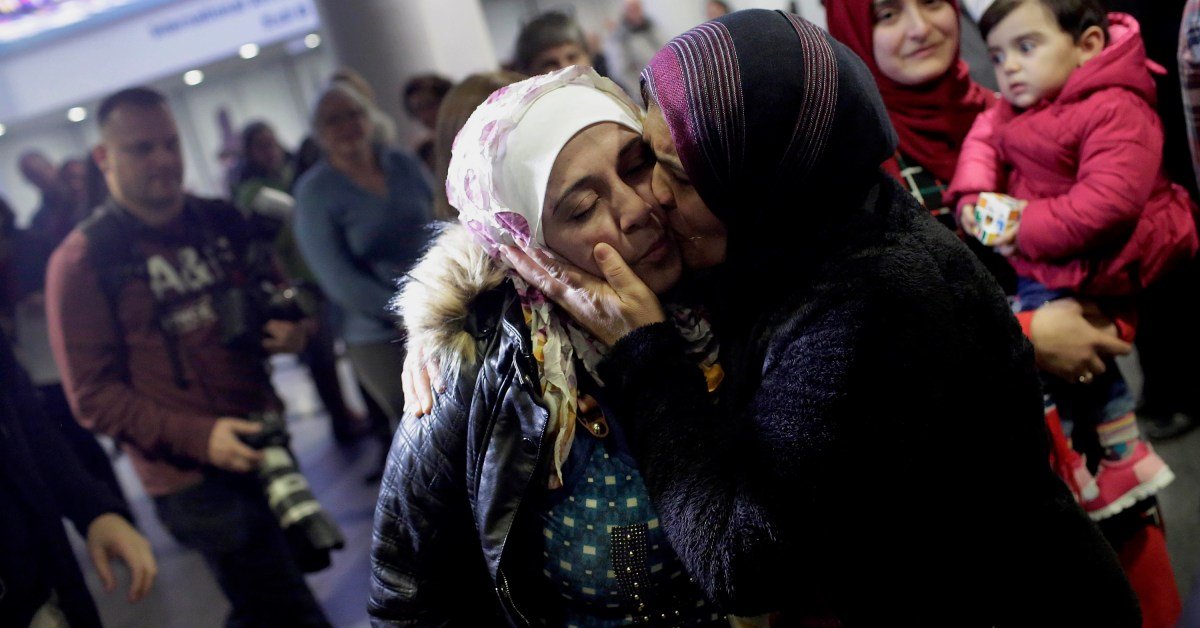
Ruth LePage, director of refugee services at Arrive Ministries, a refugee resettlement agency in Minnesota, said she misses late-night airport welcomes.
In refugee family reunification cases, the normally quiet arrivals hall is filled with family members dressed as if they’re going to a party, holding balloons and welcome banners. Children crane their necks, hoping to be the first to spot their loved one.
“Then it’s that absolute unmitigated joy that erupts out of those doors. It feels like a privilege to witness mothers and fathers coming together and family members coming together. … They will hug for the longest time,” LePage said.
But it’s been over a year and a half since LePage has witnessed a family reunification at the airport, and that appears unlikely to change anytime soon.
Two weeks ago, the US government posted the Presidential Determination on Refugee Admissions for Fiscal Year 2027, setting this fiscal year’s refugee cap at 17,500 slots designated primarily for white South Africans, or Afrikaners. It also specified that the US Refugee Admissions Program (USRAP) remains suspended except in cases of national interest.
“We are very disappointed to see a continuation of the current policy of not just restricting the number of people who can arrive as refugees but restricting the population that has access to that program to just one nationality,” Hannah Daniel, director of government relations at World Relief, told CT.
The designation of refugee admission slots primarily to one nationality excludes not only persecuted religious minorities but also thousands of other individuals fleeing armed conflict, war, and violence, some of whom have been awaiting resettlement for decades.
The Refugee Act of 1980 established that the president, along with Congress, would determine the refugee ceiling every year. When the act was passed, the admission ceiling was set to 231,700. During the Obama administration, the cap averaged at 73,000, and during the Biden administration, the annual ceiling was 125,000. Last year, President Donald Trump initially set the ceiling to 7,500, the lowest since the program’s inception. He later raised that ceiling to 17,500 to allow entry of more Afrikaners he claimed were facing an “unforeseen emergency refugee situation” due to “racially motivated violence.”
Kennji Kizuka, policy director at the International Rescue Committee (IRC), noted that the presidential determination says the slots are designated “primarily” for Afrikaners. He said he is hopeful that citizens can call on their congressmen to petition the president to include individuals from other nationalities.
“That’s a place where faith communities can really play a role, is to lift up those community members who are waiting on refugees who are stranded abroad and ask the administration to take action and to look at them for consideration. The presidential determination allows room for that,” Kizuka said.
In fiscal year 2026 the US admitted zero persecuted Christians, or any religious minority, as detailed in a joint report by World Relief and Open Doors US. Unless something changes, they are on track to do the same in fiscal year 2027.
“We’re very frustrated and upset that those people in particular who are, for many of us in the United States, our brothers and sisters in Christ do not have a pathway to safety in the United States and that we have really closed this door on them,” said World Relief’s Daniel.
Daniel cited the Lautenberg Amendment, a 1990 program created to facilitate resettlement of persecuted religious minorities, as an example of continued bipartisan belief that the US should be a haven for those suffering for their religious beliefs. The program has been renewed by Congress every year since 1989, although under Trump, it has been defunct for the first time due to the suspension of the refugee program.
When the refugee program was suspended in January 2025, the Trump administration canceled over 10,000 flights of refugees who had already passed through the yearslong vetting and approval process.
Arrive Ministries’ LePage said there were 16 individuals with family members in Minnesota who were scheduled to arrive in the US. Their tickets were canceled, and to this day their family members in the US email and call LePage asking when they will be reunited with their loved ones.
“I can’t imagine the heartbreak of having that day on your calendar, thinking about going to the airport to [reunite] with your wife or your mother or your child, and having that taken away from you,” LePage said.
In a press release, the IRC included examples of refugees waiting in the pipeline, including a member of the ethnic Armenian Christian community in Iran who is separated from his fiancée and mother in California, and a Congolese father who resettled in Kentucky in 2024. He has been unable to reunite with his wife and two young children, who are in a Ugandan refugee camp, since the refugee program was suspended.
Daniel said she was visiting World Relief programming in a Burundian refugee camp several months ago when a man, through sobs, asked her, “Why will you no longer accept me? What have I done wrong? Why can I no longer come to the United States?”
The man, who had fled violence in the Democratic Republic of Congo, had a physical disability and was slated to get treatment in the US. Now he is stranded in the refugee camp, unable to receive the treatment he needs. Daniel said he’s not the only one.
“Unfortunately, I don’t think his story is unique,” Daniel said. “There are thousands and thousands of refugees around the world stuck in similar situations where they are unable to move forward as we debate our policies and leave people in limbo.”
