
Mariah was 11 years old when her mother was shot to death in a West Memphis police chase. At 19, she landed her first job out of high school at a local McDonald’s—only to leave it two days later upon news that her father had metastasizing liver cancer. She became his sole home caregiver, losing 80 pounds in her rapidly descending depression.
Her father died within nine months. The bank foreclosed on their home. Heroin promised to make life livable again.
Mariah understands now that she struggles with anxiety after significant childhood instability. “I couldn’t feel my feelings,” she recalls of the time after her father’s death. As her addiction unspooled into homelessness, Mariah moved past heroin to tangle with fentanyl and methamphetamine, the latter of which devoured her teeth by 30.
A 2018 mugshot alloys her warm brown eyes and easy smile with steel: “When I’m addicted, I’m mean.” To this day, she’s grateful for the arrest and subsequent rehab through Tennessee’s “drug courts,” an alternative system of sentencing providing counseling, support groups, and stabilizing resources for nonviolent offenders. (I’m not using her last name and those of some other program participants to protect their future prospects.)
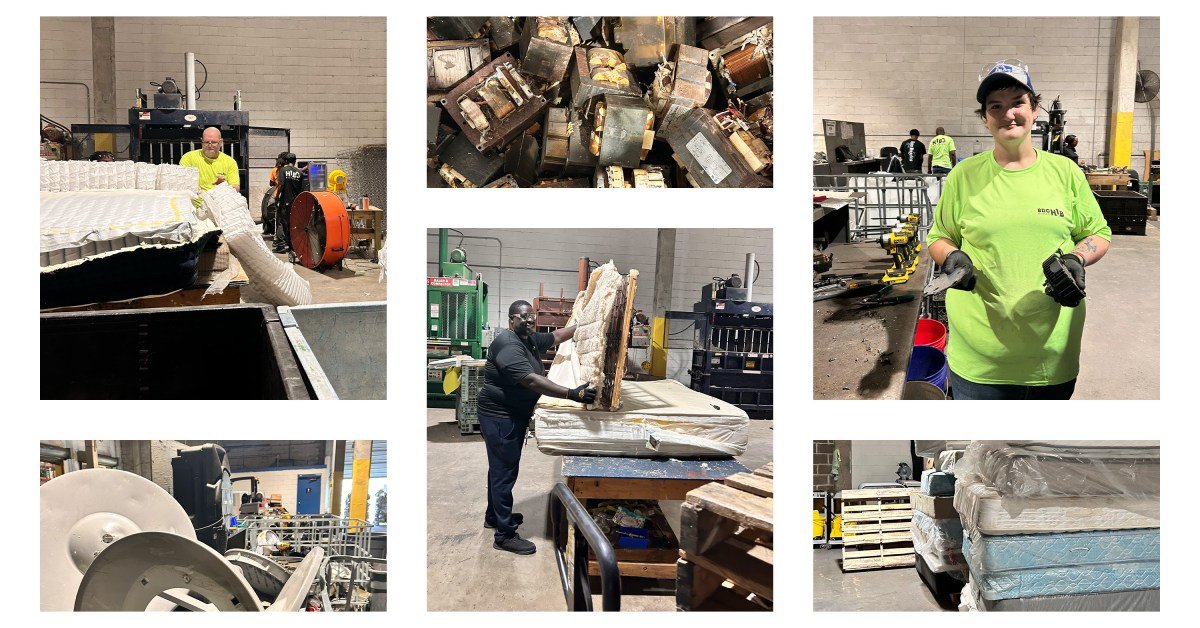
It was through a sober-living facility that Mariah encountered the Business Hub of Binghampton Development Corporation (BDC)—commonly called “the Hub”—a nonprofit founded by Christ Methodist Church of Memphis. The Hub processes extra-large recycling, including city streetlights, mattresses (3,341 in 2025), Styrofoam, and large-item Amazon returns. At any given moment, the warehouse floor may host stair machines, kayaks, mowers, HVAC units, office furniture, and more.
By now, the Hub has employed more than 200 Binghampton residents—even as companies like Cummins and Georgia Pacific have vacated the area, which suffers from “a high concentration of blight, disadvantaged population, depressed housing values, and high unemployment.” But Hub director Andy Kizzee envisions a redemptive future. The Hub has diverted 2,500 tons of material from landfills in 2026 alone. Since 2023, it has processed over 200,000 streetlight fixtures. And employees experience a paid, full-time, 3-to-15-month development program toward a living-wage career.
As I watched her work, Mariah grinned at the challenge of dissembling a fixture. Seizing her black-and-school-bus-yellow drill, she dissected and sorted its parts in less than 60 seconds.
Like Mariah, many Hub employees come from prison, homelessness, addiction recovery, or other circumstances that make employment difficult even at fast-food restaurants or gas stations. A third of Hub employees fail their initial drug test, and 57 percent bring a criminal record. Only 58 percent have a GED or high school diploma, 27 percent a driver’s license (lack of ID closes many paths forward, including legal employment and public assistance), and 37 percent a personal vehicle.
The Hub is only five years old, but finding dignified work is not a new struggle in Memphis. In February 1968, a sanitation workers’ strike drew Martin Luther King Jr. to the city. The strike trailed the crushing to death of two Black men by one of many trucks known to be malfunctioning.
“You are demanding that this city will respect the dignity of labor,” King intoned to protesters. “Whenever you are engaged in work that serves humanity and is for the building of humanity, it has dignity, and it has worth. … The person who picks up our garbage, in the final analysis, is as significant as the physician, for if he doesn’t do his job, diseases are rampant. All labor has dignity.”
Just two weeks past these words, King was assassinated on the balcony of Memphis’s Lorraine Motel.
This is the city in which BDC director of impact Antwoine Clark—his easy smile deserving of its own ZIP code—and Kizzee have invested half a decade testing how meaningful employment can create disciples and renew a neighborhood. Touring the Hub reminded me of God’s promise in Isaiah: “Your people will rebuild the ancient ruins and will raise up the age-old foundations; you will be called Repairer of Broken Walls, Restorer of Streets with Dwellings” (58:12).
Kizzee came to Memphis after six years with Engineering Ministries International in Delhi. There, he had witnessed the power of employment to unlock education, medical care, and housing—not to mention dignity and hope—for entire families. At first, he said, he wasn’t sure how to bring that experience to bear in a city with the nation’s highest violent crime rate—464 percent higher than the national average.
He hit on the idea of a work-centered program after considering Old Testament laws forbidding farmers to harvest to the edge of their fields (Lev. 19:9–10; 23:22). This allowed the poor and foreigners to glean for their own livelihoods, embracing the God-given dignity of good work, rather than forcing them to rely on direct charitable support. At the Hub, I often heard employees describe a sense of empowerment as they acquired skills and certifications for future employment.
Also like the gleaning system, the Hub’s model relies on generosity. The organization’s 82,000-square-foot warehouse was a donation. An engineering firm, Path Company, listed the Hub as the sole streetlight recycler in a contract with the local power utility. Other companies send discarded materials to the Hub for processing instead of taking the easier option of throwing them away.
The next phase for the Hub, Kizzee hopes, is construction-material recycling in another impoverished Memphis neighborhood. Multiple locations are necessary, he explained, to make the work accessible for people without transportation. That kind of pragmatism shapes the Hub’s programming, which Kizzee aims to design around what people troubleshooting their next meal have the bandwidth to do. For example, rather than asking people to set aside employment opportunities to plan for a distant-feeling future, Clark and Kizzee determined on-the-job training is crucial.
Yet they continue to refine their application process. Applicants must show up on time for an interview one week out and pass a test for hard drug use. Success on both counts is a good indicator of sufficient stability to succeed in at least the Hub’s shortest program.
Likewise, warehouse supervisor Erby Price instituted a point system for workplace attendance, along with additional accountability to equip employees for life outside the Hub. “If you can’t make it with the training wheels,” Price reasons, “you’re not going to make it on a different bike.”
As for the work itself, some of the Hub’s projects move full circle. Used tires are collected from Memphis streets, and Hub employees cut them to build safety barriers for the city’s bike lanes.
Some employees come full circle too—like Shemika, who after repeatedly suffering childhood sexual and physical abuse was addicted to crack cocaine for 26 years and turned to sex work. Thanks to God’s intervention, four years of sobriety, and a steady job at the Hub, she said, she’s reconnected with her mother and children. Her grandchildren have dubbed her “the best grandma ever,” and off the clock, Shemika brings addicted women to a local drop-in center.
Justin Frakes, too, has become part of his neighborhood’s solution. Following the deaths his wife and 8-year-old daughter in an auto accident, Frakes quit work and soon became homeless. “I gave up on life,” he said with a shrug. But after finding a job at the Hub, he settled into an apartment within two weeks. He’s now a warehouse manager and volunteers for “Men’s Night” at a drop-in shelter that provides supplies and showers.
Frakes’s co-supervisor, Gary Henderson, endured a stroke after discovering his brother’s body following suicide. PTSD and depression paved the way to alcoholism. Now sober, he hones his leadership skills as a manager at the Hub and is one of its longest employees.
For these three and many more, the Hub has offered far more than transitional employment and training. Much-loved case manager Catherine Akridge—unmissable with her purple-sparkling nails, tattoos, and oversize green glasses—totes in cake for each employee’s 90-day celebration. She uses her own van to transport employees to complicated record-expungement and driver’s license processes. She rushes to find temporary housing whenever an employee receives word of an in-process eviction.
A veritable Wendy to the Hub’s lost boys and girls, Akridge has decorated her desk with a sticker that reads, “Jesus loves felons, drunks, prisoners, and addicts.” She does too.
Working alongside her, pastor and psychologist Daniel Henley meets at least monthly with every employee. Clark partners with Akridge to teach weekly classes on work life and the Chalmers Center’s Faith and Finances course. Outside organizations provide literacy support. And employees gather on Monday mornings to share prayer requests and praises with each other. At the Hub, Jesus comes to them.
That’s not to say they’re ready to receive him at first. When Moses reported to the Israelites God’s explicit promise of deliverance, they didn’t listen, Exodus says, “because of their discouragement and harsh labor” (6:9). Likewise, for many whose lives have been distorted by poverty and trauma, the door at which Jesus knocks may swing on hinges of sufficient calories, shelter, and stability.
Results at the Hub have been hard-won—sometimes even discouraging. Five-year data indicates 45 percent of Hub employees reach the program’s goal of moving from societal exclusion to personal autonomy. Destitution, addiction, incarceration, and losses in the “ZIP code lottery” rarely yield to simple solutions.
Akridge has seen evidence of one program graduate’s continued violence to a girlfriend. Kizzee spoke to me about other graduates’ reincarceration. And following a breakup, Mariah lapsed in recovery and lost her position until she’d repeated rehab.
After that, the Hub welcomed her back. “They understood,” she reflected, “and they gave me another chance.”
