
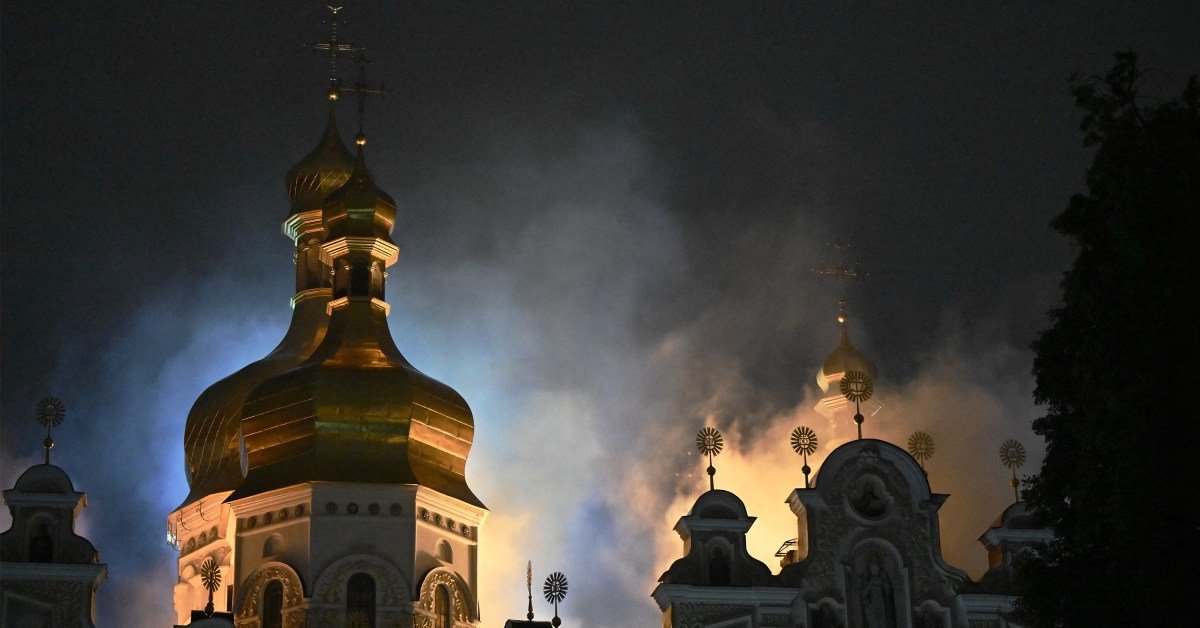
More than four years into Russia’s full-scale invasion of Ukraine, Orthodox communities in the United States are issuing competing claims about religious freedom in the battle-weary country.
Last month, St. Nicholas Greek Orthodox Church and National Shrine in New York City awarded Ukrainian president Volodymyr Zelensky its 2026 Beacon of Hope Award. The shrine—built next to the ruins of the World Trade Center after the original parish was destroyed on 9/11—chose to honor the Ukrainian people and Zelensky because of their resilience, said George Gigicos, a Greek Orthodox lay leader who organizes events for St. Nicholas.
“St. Nicholas itself was destroyed through an act of terror, and looking at who we should honor, we look at people that … go through the same things that we went through,” Gigicos said. “[St. Nicholas] is a symbol of light over darkness and good over evil. … We wanted to honor the heroism of the Ukrainian people and President Zelensky, who is also finding himself in the darkness.”
Some Orthodox Christians contested the award. Three days before the event, Orthodox Reflections, a US-focused commentary and advocacy website, called on Orthodox communities to protest outside the ceremony, claiming the Ukrainian Orthodox Church is “being severely persecuted by its own government led by Zelensky.”
Its website leveled serious charges: “Churches are being seized, people beaten, bogus criminal charges are being filed, priests are being forcibly mobilized into the army, monks are being murdered.”
The competing views of Zelensky and his government mirror a larger divide among political conservatives as well as Christians in the United States. Some Christians who once supported Ukraine have grown increasingly skeptical of continued US security assistance, while conservative media outlets have amplified allegations that Ukraine is persecuting Orthodox Christians.
Anton Kaluzhny, a lay leader at Kyiv’s New Life Church, said American support for New Life—where his father is the head pastor—has plummeted since the last election. While sitting at a Kyiv café in August, he described the impact on the local church. “I think Ukrainian evangelical believers feel very lonely,” he said.
Vice President JD Vance has said Ukraine “is doing some pretty bad stuff” and referenced an “assault on traditional Christian communities.” Kaluzhny said he often hears American evangelicals repeat claims that Ukraine’s laws unfairly target Orthodox Christians.
Those who accuse Zelensky of persecuting Christians point to a law Ukraine’s Parliament passed in 2024 that charts a legal path to the closure of religious organizations affiliated with the Russian Orthodox Church (ROC). Kyiv claims the Ukrainian Orthodox Church of the Moscow Patriarchate (UOC-MP) is an instrument of Russia’s war machine.
Ukrainian officials have launched more than 200 criminal proceedings against UOC-MP leaders since 2022 and have convicted at least 40 of its clergy members for crimes ranging from treason to disseminating Russian propaganda justifying the war. (Some of the convictions were for crimes unrelated to the war.)
In one example, Ukrainian courts in 2023 convicted a UOC-MP archpriest of treason and sentenced him to 15 years in prison after investigators found evidence he had shared photos and locations of Ukrainian soldiers with a handler from the Federal Security Service (FSB), Russia’s domestic intelligence agency. He had also shared the names of those in his community who were vocally against the Kremlin’s war and might resist occupation.
Now Ukraine is requiring all parishes to cut ties with the ROC.
Forum 18, a Norway-based human rights organization, is concerned that the 2024 law doesn’t require Ukraine to prove that a particular UOC-MP church or individual has violated Ukrainian law. Instead, the church’s affiliation with the ROC is sufficient grounds for revoking its legal status. Forum 18 concluded the law “does not comply with international standards of freedom of religion or belief.”
International human rights lawyer Lauren Homer disagrees. While she usually agrees with Forum 18’s work, she believes their conclusion about the Ukrainian law is faulty.
“The overriding international law issue is, can a government ever interfere with the internal operations of a church?” Homer said. “And the answer is yes, when it’s a question of national security, and this is very much a question of national security because the whole ideology coming from the Moscow Patriarchate is to destroy Ukraine, destroy its government, and eliminate it from the family of nations.”
Patriarch Kirill, the head of the ROC, has vocally supported the war and has said Russian soldiers who die in battle will have their sins absolved. The ROC has defrocked or suspended dozens of Russian priests for opposing the Kremlin’s war in Ukraine, and its clerics have blessed weapons intended for Ukraine.
“The general protections that are applicable to normal religious organizations going about normal business just don’t apply in this situation,” Homer said.
Viktor Yelensky, head of Ukraine’s State Service for Ethnopolitics and Freedom of Conscience, told Christianity Today that the majority of clerics connected to the UOC-MP are loyal citizens. A small percentage, he noted, have collaborated with Russian occupiers.
“We kindly ask them to sever links, not to change their liturgical language,” he said, as most UOC-MP parishes conduct services in Church Slavonic. Under the law, churches found to have ties to Moscow are given notice and at least 30 days to take corrective action.
Robert Amsterdam, an American Canadian attorney for the UOC-MP, argued that the church had already cut ties with the ROC in 2022 and has been self-governing since 1990. Yet the Ukrainian government concluded that UOC-MP leaders have not formally withdrawn from ROC governing bodies and that the church has not sought formal independence from other Orthodox churches.
Amsterdam, without providing evidence, has also amplified claims that Kyiv has tortured priests, and he’s attempted to connect the August murder of a monk to the “increasingly hostile environment” surrounding the UOC-MP.
According to The Washington Post, Amsterdam’s claims about Ukraine mirror a propaganda campaign outlined in internal Kremlin documents from 2023 that called for “portraying Ukraine as … ‘an anti-Christian society.’” Vadim Novinsky—a billionaire with ties to Moscow—has financed part of Amsterdam’s work for the UOC-MP.
Olena Kovalska, deputy head of the Office of the President of Ukraine, said American commentators such as Tucker Carlson have also spread these narratives. Carlson has aired at least three interviews with Amsterdam since 2024.
“We can see this is part of a propaganda campaign for our enemy,” Kovalska said of Carlson’s claims. “He doesn’t invite people who understand the situation in Ukraine.” She noted that Russia is responsible for most of the destroyed churches in the war.
Meanwhile, in recent years many Orthodox churches affiliated with Moscow have chosen to “switch sides” and join the independent Orthodox Church of Ukraine (OCU). The OCU didn’t obtain a tomos of autocephaly, or ecclesiastical independence, until 2019. Both the tomos and Russia’s full-scale invasion prompted waves of Ukrainians and Moscow-linked churches to switch their affiliation.
Now, only 3 to 4 percent of Ukrainians identify with the UOC-MP—a decrease from 15 percent six years ago. About half identify with the independent OCU, an increase from 34 percent in 2020, according to a 2025 Kyiv International Institute of Sociology survey.
Since 2019, nearly 1,750 of the UOC-MP’s 11,568 parishes have transferred to the independent Orthodox church, which has close to 8,300 parishes.
Homer is concerned that most American Christians don’t understand the long history of Russian and Soviet empires’ attempts to dominate Ukraine and control its church or the ways in which Moscow attempts to alter perceptions of the war abroad and sow disinformation.
Homer has spent 36 years critiquing Russian laws targeting religious institutions and said the real problem lies with Russian efforts to abolish religious freedom in occupied Ukrainian territory.
“We need more solidarity and empathy from American evangelicals,” Yelensky said. “American Christians need to know that Ukraine is a great Christian nation and the Bible Belt of Europe.”
Back at St. Nicholas Greek Orthodox Church, Gigicos said more than 450 people attended the September ceremony, and although Zelensky canceled his appearance, the Ukrainian leader sent a seven-minute video address. When Gigicos glanced outside during the ceremony, he saw only five protesters, all carrying Russian flags.
Still, he is concerned about the prevalence of Russian propaganda. “It’s Orthodox Christians fighting and killing Orthodox Christians,” Gigicos said about the war. “And when Kirill is blessing the bombs and blessing the soldiers, telling them that this is for the motherland and for the church, what is he doing?”
