
While advising the bishops of the Church of England on the term Christian nationalism earlier this year, Luke Bretherton, regius professor of moral and pastoral theology at the University of Oxford, had a straightforward piece of advice: Don’t use it.
“The term Christian nationalism is not a theological one,” he wrote. “It carries no theological significance whatsoever. When used as Christian talk to describe complex phenomena it is functioning ideologically rather than theologically, and so will misinform and mis-form the faithful.”
In offering this counsel, Bretherton drew on his experience in the United States, where he taught at Duke University prior to taking up his current role. There, he saw the term used to stigmatize and scold people, while others adopted it as a badge of honor.
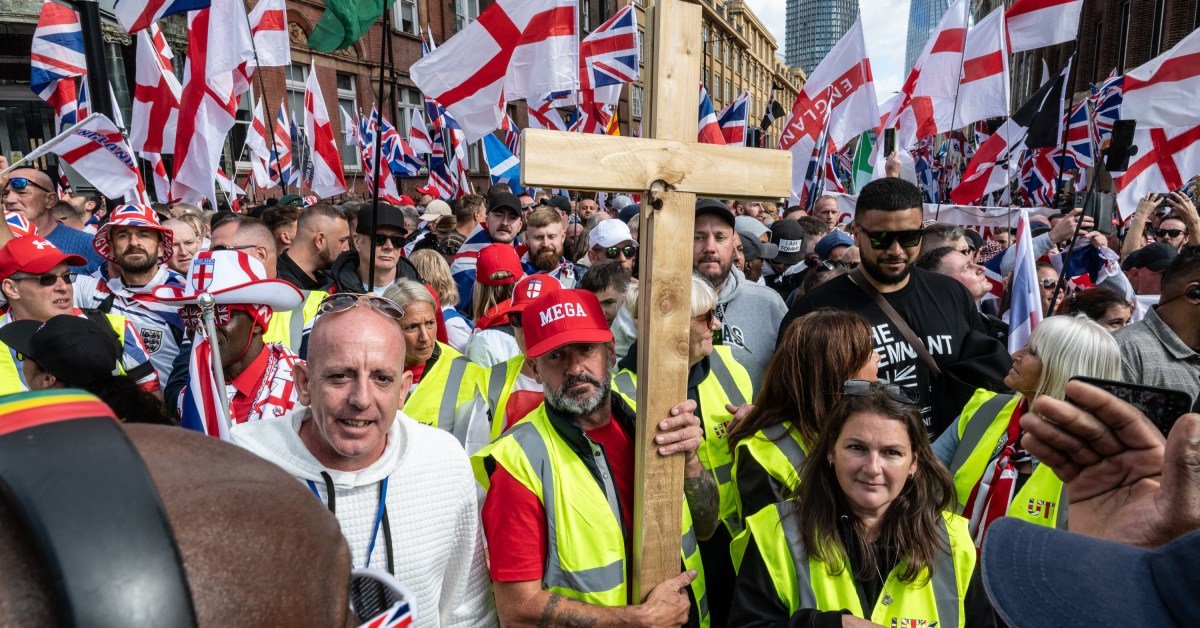
In the past year, the term has become increasingly popular within media and political circles in the UK. Politicians are talking about the need to defend the country’s Christian heritage. Crosses and shouts of “Christ is King” are common at the anti-immigration Unite the Kingdom rallies organized by British far-right activist Stephen Yaxley-Lennon, better known as Tommy Robinson. Yaxley-Lennon said he converted to Christianity while in prison in 2025.
Yet Nick Spencer, senior fellow at the British think tank Theos and the author of a new report on Christian nationalism, agrees with Bretherton that the term is unhelpful. He’s observed that the term has come to encompass “pretty much anything … opposed to a liberal secular worldview.”
He cautions against importing a label developed across the Atlantic, as some of the criteria used to measure Christian nationalism in the US don’t make sense in the UK. In contrast to strict separation of church and state in the US, the Church of England is established by law. The bishops Bretherton was advising sit in the House of Lords as legislators. Legally, state-run schools must offer a collective act of worship that is “wholly or mainly of a broadly Christian character” every day.
Nevertheless, “you start where you are. We are using the term, so we start with the term, qualify, and clarify,” Spencer said.
A recent Theos report surveyed 1,765 UK adults on their attitudes toward Christianity and Britishness and found that 8 percent of respondents strongly agreed with the statement “You need to be Christian to be truly British,” while 9 percent slightly agreed.
The subgroup that best fit the Christian nationalist definition is labeled “Identity Integrationists,” making up 11 percent of the total. They “see Christianity as fundamental to Britishness and want to defend the nation’s Christian heritage from what they see as invasive and threatening influences,” according to the report.
Among Identity Integrationists, 42 percent agreed that a person needed to be white to be truly British (compared with 16 percent of the overall sample) and 45 percent were “very concerned” about the decline of Christianity in Britain. Yet the percentage of this group that attended church weekly was only slightly higher than the overall sample (13 versus 11 percent).
That finding led The Guardian to run an article with the headline: “Christian nationalism in Britain driven by people who seldom go to church, says report.” Yet Spencer gives a more cautionary reading: The subgroup with the highest level of churchgoing at 31 percent, called Belief Integrationists, is characterized in the report by “a similar strong eagerness to see Christianity embedded within British social, political and cultural arrangements, albeit without quite the same intensity as Identity Integrationists.”
“Just because there is another group that is more Christian nationalist than the church-attending group doesn’t mean you can wipe your hands and say ‘Right, nothing to be seen here. This isn’t our problem. It’s all the other guys,’” Spencer said.
For church leaders, this is more than academic. Events such as the Unite the Kingdom marches have seen the media, which is not used to such nationalistic demonstrations of Christianity, to ask church leaders for their takes. Many who responded have warned against the co-option of Christianity for political ends.
At an event exploring now-debunked reports of a Christian revival in the country, Mike Royal, a Pentecostal bishop and the general secretary of the ecumenical group Churches Together in England, observed, “The challenge for the Church is to make sure that this quiet revival is founded on Christ’s saving grace and a personal revelation of Biblical truth, and is not stolen from people by Christian nationalism that is both nominal and at odds with Christ’s twofold message of loving God and loving your neighbour.”
But some clergy believe that the church is in danger of neglecting and demonizing a group with an “inchoate sense of Christianity.” Sam Norton, a rector in the southwest of the country, sees the marchers as “sheep without a shepherd” who need a leader who loves them.
Describing himself as a “civic nationalist,” Norton said he, like the majority of Britons, believes the number of immigrants entering the country is too high and that a “coherent nation” requires “one single publicly supported religion—which for reasons of law, custom, and inheritance needs to be Christianity of a predominantly Anglican form. There then need to be pathways for outsiders to integrate into this in different ways.”
Alicia Edmunds, head of public policy at the Evangelical Alliance, believes that the desire for a “return to Christian faith” reflects a sense that “social and cultural and political narratives of who we are and our place in the world are deteriorating.”
Edmunds believes this creates both an opportunity and a challenge for the church to disciple believers and help them understand “who is Jesus, how faith has shaped our local salvation, our community salvation, and ultimately how does that play out in in the nation.”
Jesus, she added, “crosses every social divide, political divide, every ethnic class divide.”
For many UK churches, such divides are crossed every Sunday. Christians are among the millions who have made their home in the UK in recent years. Other migrants have converted to Christianity after arriving in the country. In the book After Secularisation, Stephen Bullivant notes that around 14 percent of British Catholics were born abroad and that around 9 percent of weekly Mass attendees say they most often attend a service in a modern language other than English.
The Church of England is changing too. When Amanda and Neil Robbie first arrived at Holy Trinity West Bromwich—where Neil is the vicar—the congregation was majority white. The parish is located in England’s “Black Country,” named after the heavy smoke and soot produced in the area during the Industrial Revolution.
Originally a white, working-class area, people from the Caribbean and South Asia came there to work in manufacturing in the wake of WWII. With the industry’s demise, a once-affluent area became destitute. In recent years, newcomers have moved in from Europe and the rest of the world. At the local primary school, students speak 42 different languages.
Amanda Robbie describes the church’s congregation as comprising around 15 different nationalities. Most weeks, the Bible readings are in English, Punjabi, and Farsi.
Her husband is “very much against the homogenous church principle,” she said. “Our higher identity is always in Christ.” Amanda Robbie noted that they first experienced this while working in Malaysia and Singapore—their church community was not with other expats, but with believers from local churches.
At Holy Trinity, Neil Robbie will stop in the middle of his sermon to let people discuss with the person next to them their life experiences in relation to the subject. “We have church lunch most weeks, and there’s this real work towards people actually knowing one anothernot just nodding at each other and thinking, They have an interesting culture, but knowing one another as church family.”
While the Theos report suggested that Integrity Integrationists are “deeply anxious” about the state of the country, Amanda Robbie believes the best response is to preach the gospel.
“Anybody who is anxious about anything, the best thing they need to know is that Jesus loves them, died for them, and wants them to know him and life in all its fulness,” she said. “Everyone must be welcomed into our churches, but that doesn’t mean you agree with everything they say. Nobody would be in church if that was how it happened.”
At Holy Trinity, love grows despite the differences. Amanda Robbie tells the story of a recently widowed woman who met an Iranian refugee at the church’s post-service lunch. When the widow asked him about his family, they both started crying as he talked about his wife and daughters who were left behind. She later gave him all her late husband’s clothes.
“There’s just this real beauty of people who you would not expect to be embracing people who are so different doing that in the most delightful way,” Amanda Robbie said: Love that transcends culture is a reflection of glory.
“We are all going to be there with all the tribes and nations, and that is what our churches should be like every Sunday, all the difference that is in your parish,” she continued. “Learning to love each other as sinners for whom Christ died, as the bride of Christ—there is nothing more beautiful.”
