
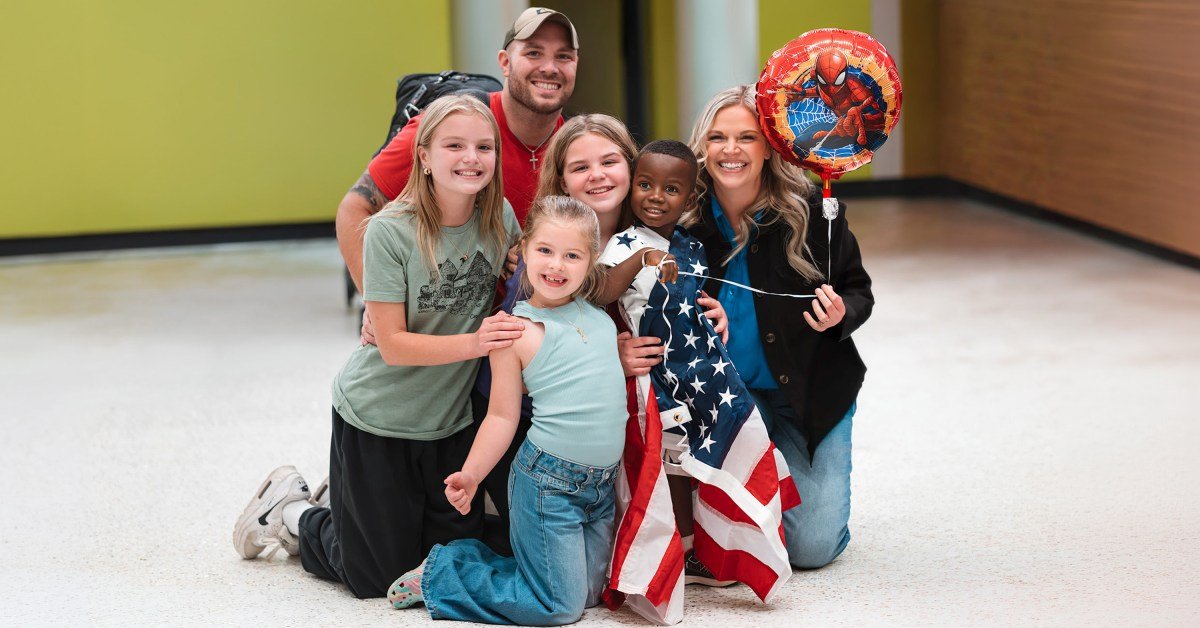
Josh and Katie Derrick are longtime foster parents from Cleveland, Tennessee, who have adopted multiple children domestically. But when family friends adopted from Malawi and they saw images of children there waiting for homes, the Derricks couldn’t stop thinking about it.
“It was something that God laid on our hearts … we couldn’t talk ourselves out of it,” Josh said.
They knew adopting from Malawi would not be an easy process—their friends had encountered plenty of obstacles working with Malawi’s government. But they never expected the slowdowns to come from the US.
In December 2025, President Donald Trump banned travel to the US from 39 countries. Unlike previous travel bans, this one did not exempt adoption visas. The adoption community mobilized, and in late January, the US State Department issued guidance instructing adoptive families to proceed as usual: The affected children would qualify for visas under the ban’s “national interest exception” (NIE) clause and be evaluated on a case-by-case basis. Adoption agencies responded with gratitude but questioned the need for another step in an already thorough and arduous process.
At first, the NIE, which the embassy requests from the State Department after the child’s in-country visa appointment, was causing a few days’ delay. But since August, adoptive families have experienced unexpected lags of weeks or months in the process, often leaving one parent stranded for unknown periods of time overseas with the adopted child, separated from the rest of their family back home.
These parents have had to place their jobs on hold without knowing when they’d be able to return to the US. Additionally, adoption agencies across the country report slowdowns and difficulty communicating with US Citizenship and Immigration Services (USCIS) and the State Department.
On May 21, the Derricks, along with their three oldest children, arrived in Malawi to complete the adoption of their 3-year-old daughter, Beatrice. After the first month—which they spent bonding with Beatrice and dealing with court proceedings—wife Katie and the children returned to the US, expecting to be reunited with Josh and Beatrice a few weeks later. Instead, because of the NIE delay, they were separated for months.
“It was … heartbreaking as a father, that [Beatrice] had made a connection with her mom and siblings and wanted to be with them,” Josh Derrick said. “And we were just waiting on … the United States.”
On August 4, Josh and Beatrice went to their embassy appointment. The consular officer approved their documents and said the last step was NIE approval, which was expected to take a week. Three weeks later, they still hadn’t heard anything. Then, the US canceled all visa appointments worldwide for mandatory training.
“At that point, we were just really frustrated because that had stretched past what we thought was the longest time we would be there and was just becoming a burden on us in a lot of ways, financially and emotionally,” he said.
Despite frequent emails to the embassy, Josh received no explanation of why the NIE was taking so long or when he could expect it to be ready.
Meanwhile, his wife was home with six kids under the age of 13. He had to continue extending his stays at Airbnbs and hotels as well as his car rental, and the family felt the financial strain of maintaining two separate living spaces. Beatrice asked daily where her mom was and when they could go on the airplane to see her.
Finally, on September 14, Josh Derrick received an email that their NIE was approved. Five days later, the family finally reunited.
“There were times where I started to question if this was being made difficult for us on purpose or the United States was stalling for some reason, because it just seemed to drag on,” Derrick said. “We’ve done so many interviews and so much paperwork and already submitted things to USCIS, and you have that visa interview at the embassy and they tell you, ‘It all looks good. We’re submitting it. We just need this signed off on’—and then we spent another almost two months there.”
Before the NIE stipulation, families received a visa the same day as their interview.
The Derricks are not alone in experiencing unexpected and prolonged in-country stays. The Rileys and the Blocks, two families from Community Church in Alma, Michigan, adopted children from Sierra Leone. They waited almost 40 days for their NIE approvals.
The Rileys adopted two teenage sisters who lost their parents to Ebola. Given the girls’ ages—14 and 17—the Rileys wanted to keep them apprised of developments in the adoption process. When the Trump administration issued the travel ban, the Rileys had to tell the girls they didn’t think they would be able to complete the adoption. Then, a month later, the US established the NIE.
“They have been on this roller coaster with us that is just heartbreaking,” Tammy said. “They have strong, strong faith, but my mama-bear heart just hates to watch them go through this.”
USCIS approved their I-600 form, which legally classifies an orphan as the immediate relative of a US citizen, in June 2026, allowing the Rileys to schedule their travel. But as they prepared to leave for Sierra Leone, the State Department canceled visa appointments due to the mandatory training. Again, the Rileys had to inform the girls that their plans had changed. Finally, on September 10, they went to their rescheduled visa appointment and learned the NIE would take two weeks—longer than their agency had prepared them for.
Meanwhile, the Blocks, who were also in Sierra Leone finalizing the adoption of a 3-year-old boy, had their embassy appointment four days later on September 14, when staff told them getting the NIE could take anywhere from “a couple days to a couple months.”
 Photo courtesy of Kaitlyn Block
The couple had three young daughters at home, so Kaitlyn Block made the difficult decision to return home. Her husband, Jordan, stayed with their son in Sierra Leone. (Tammy Riley also returned home to work as her husband, Matt, stayed with their girls.)
The Blocks contacted their congressman, US Rep. John Moolenaar, and nearly 100 community members reached out on their behalf to Christy Kortokrax, senior adviser at the Bureau of Consular Affairs. On Sept. 30, St. Nick’s Kids—the agency handling the Block and Riley adoptions—received a response from Kortokrax, who said the bureau was following both cases closely and “if there is a question as to whether a family should travel with the intent of bringing the adopted child back to the United States, please reach out so that we may provide guidance.” Kortokrax did not respond to a request for comment from CT.
Finally, in mid-October, both families received their NIEs and returned home.
Jill Baker, executive director of Promise Kids A Future, the Christian adoption agency handling the Derricks’ case, said two other agency families just left Malawi as they received their NIE last week. Both families had their initial visa interviews postponed because the embassy was “short-staffed.” Then, they waited on their NIEs for about a month and a half. Daniel Nehrbass, president of Nightlight Christian Adoptions, said one of his agency’s families waited two and a half months for an NIE.
St. Nick’s Kids works with 13 countries affected by the travel ban. Jyotika Acharya, the agency’s executive director, described the redundancy inherent in the NIE process. The State Department and USCIS already conduct extensive investigations certifying all requirements are met by both the child and adoptive parents. There is no need for additional approval, she said.
“This new layer of requirement of a national interest exemption request that needs to be made is, in my view, unnecessary if children that are adopted are exempt,” Acharya said. “Why are we doing another layer of vetting when there is already one?”
Acharya also noted that long processing times and uncertainty harm children who have already experienced trauma and loss.
“In the foreign affairs manual, which … dictates how the Department of State should be processing these cases, it explicitly states in there that they need to prioritize children,” she said. “But the way they are doing their process now doesn’t tell me that they’re prioritizing children.”
In addition to the NIE process, agencies across the country are frustrated with the slow processing times and lack of communication from USCIS and the State Department. Multiple agencies cited State Department staff turnover in early September as contributing to the newly extended NIE wait times.
A State Department spokesman told CT that the administration supports intercountry adoption, adding that the department “processes these cases as expeditiously as possible while taking the time required to ensure full compliance” with federal law.
Additional immigration policy changes have further slowed intercountry adoption. In Africa, the US realigned visa services to regional hubs, meaning embassies in certain countries will no longer process adoption visas. Acharya said this means some families now must travel outside of their child’s country for a visa appointment. She is also unsure which embassies are issuing certain documents and has not received a response to her inquiries. Other embassies are nonresponsive or take months to respond to documentation inquiries or appointment requests.
“It creates an atmosphere of uncertainty” even in unrestricted countries, said Amy Burger, director of international social services at Open Door Adoption Agency.
Valeria Vera, who adopted a 13-year-old boy through Open Door, was stranded in Mexico, which is not included in the travel ban, for two months. When Vera and her husband went to their son’s visa appointment on August 21, they expected to receive the visa that day. Instead, the consular agent told them they were placed under review, “which could take anywhere from 30 minutes to 3 months.” One month later, they were told their review was finished. A month after that, they received the visa.
“We didn’t budget for that,” Vera said. “We had nothing set up for who’s gonna watch our house, our pets. When you start the process, you count the cost of the time and the finances. These extra two months we had not planned for.”
Through the stress, challenges, and uncertainty, stateside churches have stepped up to care for families left in limbo. They’re providing meals to family members back home, calling and praying with the parent waiting in-country, and supporting them financially. Members of Community Church in Alma even traveled to Africa to deliver food and medicine to Jordan Block and Matt Riley.
Multiple families said the faith of their adoptive children has encouraged them.
“They keep our faith more than we keep theirs, probably,” Tammy Riley said of their two daughters. “They are very strong, doing devotional[s] every morning and, and making sure that we know that there is a time and a purpose. But it gets draining and it’s hard on the heart.”
Many families have had to decide how long they are able to stay and wait in their child’s country. In the case of the Rileys, once the girls had been removed from their group home for adoption, it was unsafe to send them back.
“We had to promise them straight out on a video call, ‘We will not leave you.’ And you could just see the relief. … ‘You are ours to protect and we will stay there with you as long as it takes,’” Tammy Riley said. “But it sure would be nice to know how that long that is.”

