
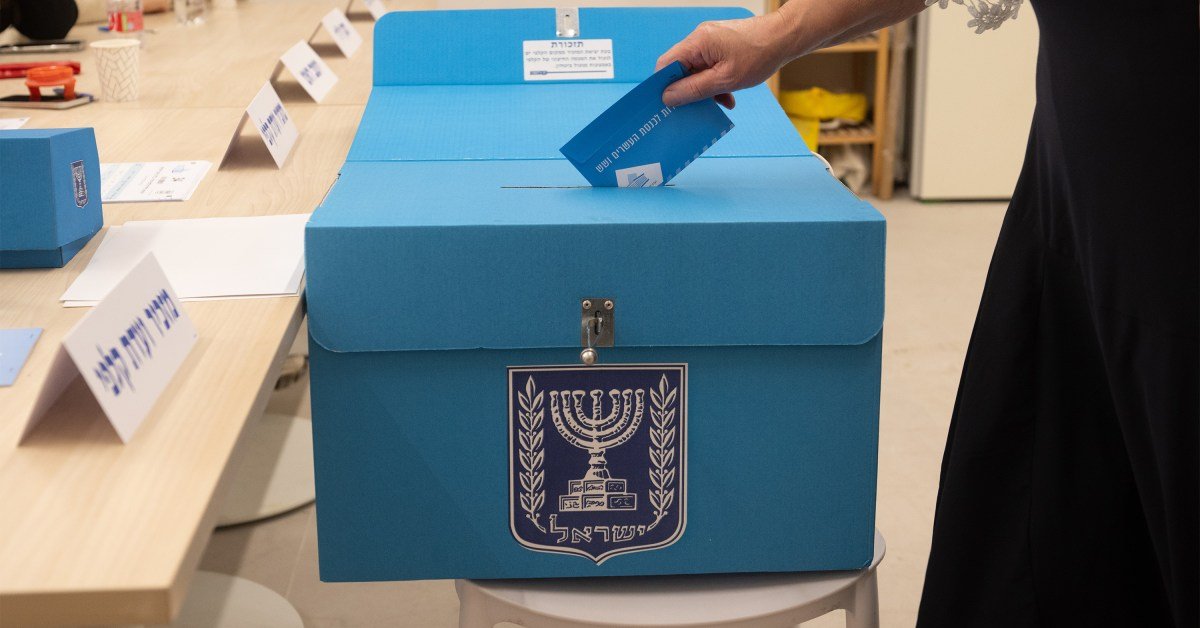
Israelis voted Tuesday in their first national election since Hamas’s October 7, 2023, attacks, with turnout reaching nearly 78 percent—the highest in more than 25 years. Yet no party came ahead as the clear winner, leaving the country in a deadlock that could take weeks to resolve.
“The results so far are super strange: Everyone has both won and lost,” said Calev Myers, an Israeli Christian attorney and chairman of the Judeo-Christian Zionist Congress. “There’s no clear outcome, and it looks like we’re heading for another election.”
With 85 percent of the votes counted, Israeli prime minister Benjamin Netanyahu’s Likud party and its coalition members are likely to take 53 seats in the Knesset— Israel’s parliament—while the bloc led by centrist military chief Gadi Eisenkot’s Yashar party would have 48. Meanwhile, the Arab parties are projected to take 19 seats. No group has the 61 seats required for a majority.
The October 7 attacks and the subsequent war loomed large as voters cast their ballots. Nearly two-thirds of Jewish Israelis said the attacks were a deciding factor when choosing their party, according to an Israel Democracy Institute survey.
In his campaign, Netanyahu presented himself as a bulwark against a nuclear Iran, posting on social media an AI-generated image of a nuclear bomb exploding over Tel Aviv, warning Israelis of a “second Holocaust” if he’s not elected. His supporters credit him for resisting international pressure and leading military campaigns that have degraded Hamas, Hezbollah, and the regime in Tehran.
Meanwhile, Netanyahu’s opponents accused the prime minister of using fear to win votes. Others questioned his decision to run for reelection after the security failures surrounding the October 7 attacks and viewed the election as a referendum on his leadership.
Myers agreed that the Hamas attack profoundly affected his political outlook.
“It constituted the greatest security failure in the history of the state of Israel, and perhaps in the history of the modern Zionist movement,” Myers said. “A prime minister who has dominated Israeli politics for nearly two decades cannot claim credit for the country’s successes while distancing himself from responsibility for its greatest failure.”
Myers has observed considerable support among Christian Israelis in his circles for right-of-center opposition leaders, such as Eisenkot. Others remain loyal to Netanyahu, he said, but he believes they are the minority.
Israel’s president, Isaac Herzog, isn’t required to task the leader of the party who wins the most seats with the job of forming a government. Even though Likud is expected to win more seats, Herzog determines which lawmaker has the best chance of securing a 61-seat majority and could give Eisenkot the mandate.
Eisenkot, 66, is a former military chief known for his direct approach and simple attire. His son, the youngest of his five children, died in a Gaza tunnel explosion two months after the October 7 attacks. Two of his nephews have also been killed on the battlefield.
Unlike Netanyahu, who grew up in elite circles, Eisenkot’s parents were working-class Moroccan immigrants. If he becomes prime minister, Eisenkot would become Israel’s first leader of North African or Middle Eastern descent.
The outcome may not be determined for six weeks or more. After the election results are published, Herzog has seven days to decide which Knesset member will create the governing coalition. The lawmaker he chooses then has 28 days to complete the task, with a possible 14-day extension.
Some potential coalition partners are controversial in Israel. Polls show that most Jewish Israelis have become increasingly disillusioned with the ultra-Orthodox parties that have partnered with Likud. Those parties have fought to maintain exemptions from compulsory military service for ultra-Orthodox men, despite a 2024 Supreme Court ruling ending such exemptions.
Myers said most of the Israeli believers he interacts with are conservative on matters of security and economic policy. At the same time, they are “deeply troubled by the disproportionate political influence of ultra-Orthodox parties that resist military service and by elements of the far right whose anti-Christian rhetoric, racism, and diplomatic provocations undermine Israel’s interests and moral standing.”
Some analysts believe unchecked settler violence in the West Bank has hurt Israel’s international standing. Critics have accused Netanyahu and his far-right coalition partners of failing to rein in the violence. Some members of his coalition have also adopted positions hostile toward Christians and other religious minorities.
Before joining Netanyahu’s coalition government, national security minister Itamar Ben-Gvir defended the practice of spitting near Christians and churches, carried out by some ultra-Orthodox Jews. In 2023, lawmakers from an ultra-Orthodox party proposed criminal penalties for “missionary groups, mainly Christians,” engaged in proselytization. Netanyahu opposed the proposed penalties and has condemned incidents of spitting near Christians.
David Zadok, pastor of Grace and Truth Congregation in Kanot, Israel, shared his concern about the future of religious freedom in Israel. “As a pastor, my hope is that we will continue to enjoy the freedom to preach and share the gospel openly,” he said. “I also hope that we will be able to strengthen the church and establish new congregations without having to appeal to the Supreme Court or resort to other legal measures simply to exercise our basic rights.”
Zadok’s congregation faced a legal battle in 2016 when the Orthodox group Yad L’Achim challenged its plans to build a church. The case reached Israel’s Supreme Court, which ruled in favor of the congregation’s right to build.
The Christians he knows are concerned that after three years of fighting in Gaza, no end is in sight, and Hamas is reconstituting. The same concerns apply to Hezbollah, Iran, and Syria. “We must recognize that we cannot afford to underestimate our enemies,” Zadok said. “We need to pursue peace, but we must also remain realistic about the threats we face and be prepared to defend ourselves.”
Some Israelis have also grown increasingly concerned about including Arab parties in the government since the Hamas attacks. Arab Israelis—who represent one-fifth of the population—voted in record numbers and increased their Knesset seats from 10 to an estimated 19.
The Arab Christian community in Israel is not politically uniform, said Saleem Shalash, the Arab Israeli pastor of Home of Jesus the King Church in Nazareth.
“Some Christians support Arab political parties because they believe these parties represent their identity and concerns about equality,” Shalash said. “Others prefer Jewish or broader Israeli parties because they prioritize national security, economic opportunities, integration, or other issues.”
There are also Arab Christians who feel disappointed with politics altogether, he added.
One of Netanyahu’s campaign slogans warned that an Eisenkot-led government would partner with Arab parties and create a Palestinian state. However, most opposition parties, including Eisenkot’s Yashar, have said they won’t include Arab parties in their coalition. Meanwhile, Eisenkot has not ruled out outside parliamentary support from Arab groups, which could help his bloc garner enough seats to form the government.
Still, he might face resistance from his opposition partners. If the lawmaker tasked with forming a government fails, the president may give another leader the opportunity. If that lawmaker fails, Netanyahu could remain caretaker prime minister until new elections are held.
No matter who ultimately prevails in the weeks and months ahead, Shalash believes that political solutions alone cannot heal the deep wounds in the region.
“We need security and justice, but we also need reconciliation, forgiveness, and a transformation of the human heart,” he said. “This is why I believe the message of Jesus is more relevant than ever.”
