
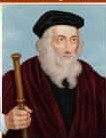
Birth: 1325
Home Calling: 1384
Homeland : England
Place of Vision: England
John Wycliffe was born in Yorkshire and received his formal education at Oxford University. Life as a student was extremely arduous for Wycliff. Despite the meager allowances, he obtained his Bachelor of Divinity in 1369 and his doctorate in 1372. He became one of Oxford’s leading philosophers and theologian. In 1374 he was appointed as the rector of St. Mary’s church at Lutterworth.
Wycliff was an early crusader for Christian reform in England. He condemned the unbiblical beliefs and practices of the church. He opined that the church had sinned and became corrupted by earthly concerns of power and wealth. His criticism against the church carried a mark of earnestness and a true desire for reform. However, his reformative ministry was rebuked by the Pope and he was kept under house arrest. Unaffected by the threats, he continued to teach Biblical doctrine at Oxford until 1381, when he was banished from the university.
Wycliffe firmly advocated that the Bible is the only source of Christian doctrine and that no earthly authority can change what was in the Scriptures. He also believed that every Christian must have access to the Bible since only Latin translations were available at that time. Along with his associates, John Purvey, and Nicholas of Hereford, Wycliffe completed the first English translation of the Bible. Although his followers were derogatorily nicknamed as ‘Lollards,’ they played an important role in reforming the church.
Wycliffe continued to prolifically write until his death in 1384, which laid the foundations for the protestant reformation. Posthumously he was declared a heretic, and his writings were banned by the catholic church. However, Wycliffe’s teachings continued to spread. Hence, in 1428 the church officials exhumed his body, 43 years after his death, and threw the ashes into the River Swift, publicly disowning him. However, seven centuries have passed by, and his teachings continue to reform the lives of many.
