
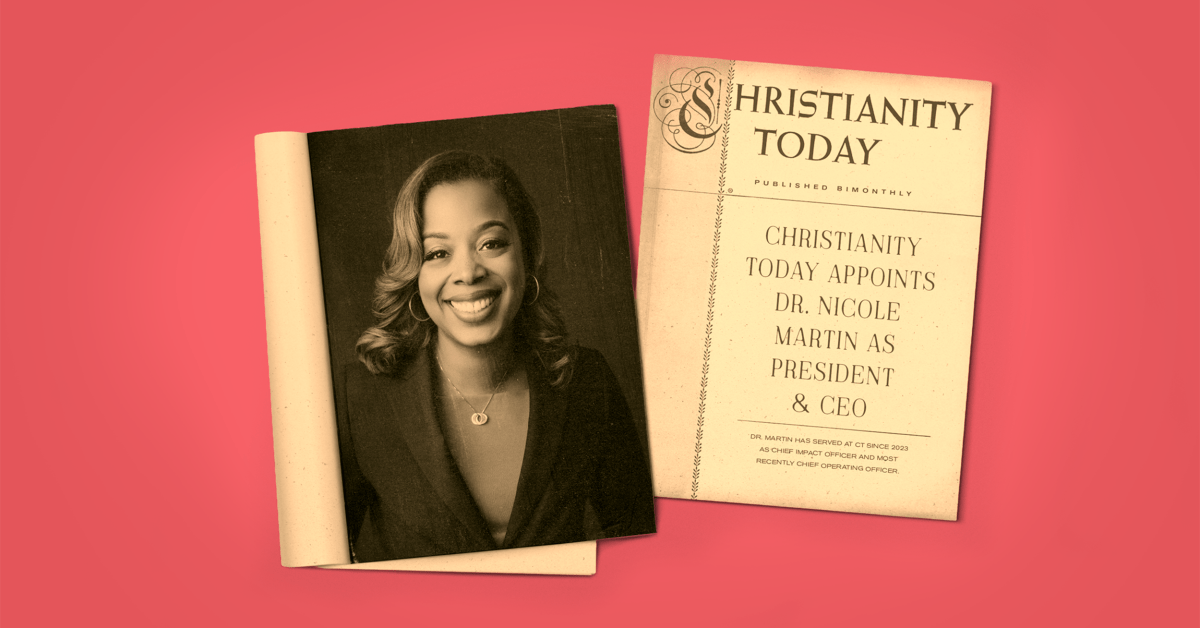
When I was actually teaching in seminary, it was a big deal to be published in CT. It’s always been part of my academic life and my ministerial life as I’ve leaned into what it means to think intellectually and deeply about faith.
Walter Kim: I grew up in an immigrant household that was not churchgoing or deeply faith-formed. When I became a Christian in high school, I discovered a world that I didn’t know existed. I didn’t know Christian colleges or Christian publications existed. I didn’t even know that Christian books were a thing. I spent a lot of my teen and college years imbibing resources that helped me grow in my faith, that helped me make sense of this radical transformation that happened to me as a young teenager.
I was reading about Carl Henry’s vision for creating a space where various views can be shared on one particular topic. I see that playing out now in our Big Tent editorial pieces, where we get differing views on one particular topic. We’re leaning into a future, but we’re anchoring that in a past and a story that Billy Graham himself tried to create.
Kim: I recently returned from the World Evangelical Alliance General Assembly, which was held in Seoul with nearly a thousand delegates from 120 countries around the world. Its location in Seoul was striking because Billy Graham preached there during a set of evangelistic campaigns that had over 1 million people in attendance.
I think about the 120 countries that were represented at the WEA General Assembly. Billy Graham preached in many of those countries. There’s a lineage, a genealogy that you could trace. Christianity Today’s global imprint right now is far greater than ever before, and it matches Billy Graham’s ministry in those early years as he brought the gospel to the world.
What are the stories of CT? Yes, there are cultural engagements on a variety of issues of the moment that we need to address. There’s a global community that we are seeking to speak about, speak from, speak to, speak with together as a community. But at the center is this firm belief that Jesus is the savior of the world. That still beats at the heart of CT. That focus is simple and direct.
We are trying to hold the mystery of faith together—Jesus fully man, fully God—the simplicity of the gospel, coupled with the complexity of its application and all the dimensions of life. CT is seeking to hold those things together, fully committed to the truth, simplicity, and directness of the gospel yet realizing that it becomes incarnate in the complexity of life—global life, national life, the range of issues. That is an extraordinary, God-given, and, hopefully, Spirit-tended mission.
Martin: Billy Graham had a unique capacity to draw together parts of the church that may not have come together outside of him. He demonstrates that the answer to unity within and between denominations isn’t a question of what, it’s a question of who.
As I have wrestled with this, I keep returning to the ways God has allowed me to serve in many different capacities and participate in different networks. I hope this experience allows me to be a “who” that helps to make this big tent evangelicalism possible.
My experience draws on my seminary influences in the Presbyterian church and evangelicalism. I’ve been in spaces where there may be a predominantly white understanding of what it means to be Christian, and I bring that together with my life and work in predominantly Black and Hispanic spaces. God has shaped me not to settle in one space but to branch across many spaces.
Billy Graham’s passion was for Jesus at the core. We know Billy Graham because of his ministry to elevate the name of Jesus Christ, and I can think of no better way to live my whole life than to lift the name of Jesus Christ through the church.
New Testament Scripture tried consistently to address the tensions of division. It’s not like Paul wrote Romans for Martin Luther to discover it 1,500 years later and say, Oh, justification by faith! No, Paul talked about it in Romans because of the division between Jew and Gentiles.
The same thing is true with Ephesians and the “dividing wall of hostility” (2:14). Or Colossians, We’re all one in Christ. There’s not Scythian or Barbarian, on and on (3:11). Almost every epistle drips with this realization that the church was powerfully given this message of redemption and, every step of the way, sin, nature, or Satan would seek to divide.
The work of CT is not unique to this time. We have some unique things about our polarization, but this is actually the work the church has confronted from its birth in Acts 2. Every moment, sin and Satan seek to divide.
The shape of Scripture guides the shape of CT’s ministry. So what does it look like for us to recover a robust understanding of the salvation that we have in Christ that, from its onset, is a message that not only saves individual souls but communities?
How do we do this while we recognize that, every step of the way, our own sin nature, the work of Satan, and the fallenness of the world will consistently chafe against that vision of the message of reconciliation?
We need to pray. We need voices that remind us of the chorus that exists in the church that points to the different facets of this message of reconciliation.
We often think of pro-life as a political term, but the idea of valuing life and humanity is a biblical premise. We can uphold the biblical value of life and do that in a way that extends to the whole life, from the moment of birth to the moment of death. We honor the imago Dei in each person and do so in a way that also understands grace for challenging times.
We often get stuck when we politicize biblical principles, and we demonize those who have to make hard choices. But the gospel is full of grace, and the gospel is full of abundant life. I’m excited to lean into who we’ve always been, who I’ve always been. This is who Billy Graham was. This is who CT is, was, and will be. I’m excited to carry that forward.
Kim: I love how CT has pursued issues in the pro-life movement. My 21-year-old daughter has Down’s syndrome. When I think about the pro-life issue in my daughter’s case, the majority of prenatal diagnoses globally have often been encouraged by the medical community toward abortion. If we’re going to address pro-life issues, we need to have more than just a vision of the unborn baby. We need a vision of the human, of dignity, a transformational vision of life more generally as part of a pro-life agenda.
Kim: It’s not just about CT. It’s about how any faithful ministry seeks a faithful process. We assembled a search committee from within the board that was representative of different streams of evangelicalism, different perspectives, different gifts and life experiences, to ensure that the breadth of evangelicalism was represented.
We retained CarterBaldwin—a humble recognition that sometimes we can’t see what we can’t see. Sometimes we need other people whose expertise we can rely on. They were fantastic in the interviewing process.
Above all, in this moment where we often see crises in leadership, we wanted to find someone who was godly. Someone who had Christlike character, whose relationship with Jesus was marked by the fruit of the Spirit, a humble curiosity, and a deep conviction that held truth and grace together.
We wanted someone with the ability to cast a vision and actually run an organization. Vision casters aren’t always great administrators, and great administrators may not be the most comfortable person up front. We wanted to find someone that actually has both a godly character and a savvy understanding of the developing media ecosystem.
Finally, we looked for someone who didn’t just conceptually understand Christianity as a global phenomenon from its inception to its current state. We wanted a person who could tell this story not as an outside observer but through their own life—journalistic excellence with Christian solidarity and sympathy.
CT is a media company, but it’s also a company that is seeking to form the faith, not just for the present moment but for what God is unfolding in the years to come.
