
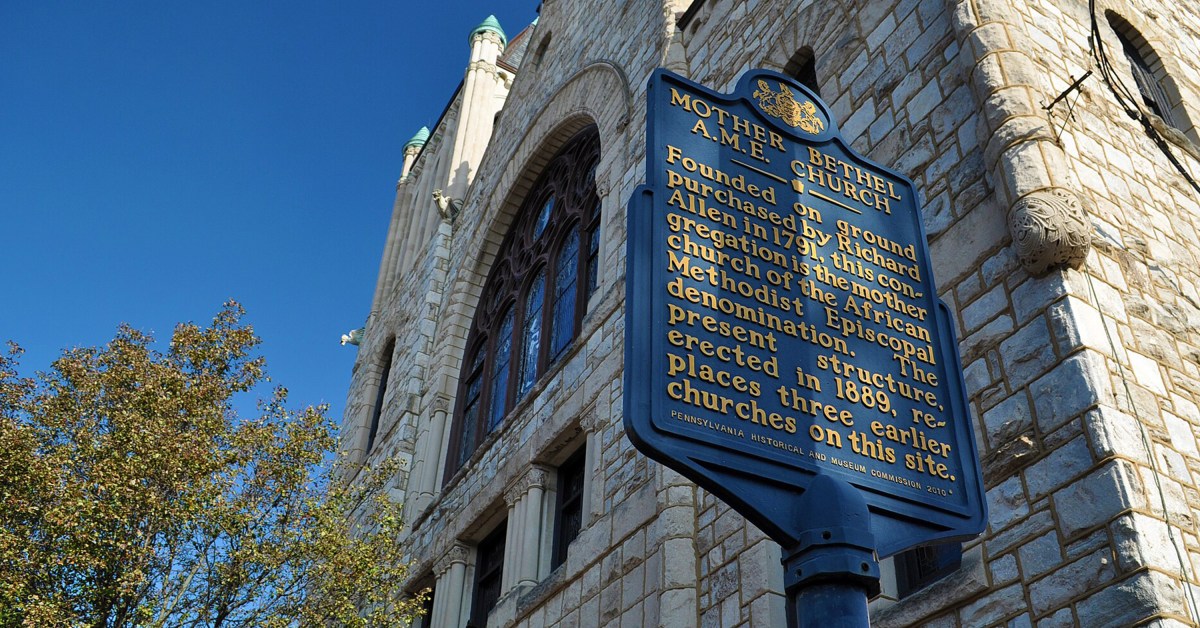
In the days leading up to America’s 250th anniversary, Mother Bethel African Methodist Episcopal (AME) Church is joining the festivities in Philadelphia.
The church, the first-ever AME congregation, which was once a stop along the Underground Railroad, has been welcoming visitors interested in learning about its history and founder, Richard Allen. For the occasion, one congregant designed a three-foot fiberglass bell that bears an illustration of a ship during the transatlantic slave trade and contains the names of Allen, Harriet Tubman, Frederick Douglass, and the 53 people who have pastored the congregation. Members met at the church on Thursday morning to ring bells and sounded tambourines, marking an official start to a day’s full of activities. Some joined hundreds at Independence Mall to create a human outline of the famous Liberty Bell. And the church’s choir performed gospel songs that were aired on a local radio station for its “Red, White & Blue” music series.
“One could make the argument that you shouldn’t participate at all in light of where we are in this country,” said Carolyn Cavaness, the lead pastor at the church. “But then those heroes, those heroines—their names deserved to be called,” she said, referencing figures like Allen, Douglass, and Tubman. “They must be represented.”
Mother Bethel is one of many active Black churches that were part of the Underground Railroad until slavery ended in 1865. The term describes an organized network of houses, churches, abolitionists, and free Black people who developed secret routes that helped slaves escape from the South to freedom in the North and Canada. The cohort of churches is divided on whether to commemorate the semiquincentennial, with Mother Bethel opting to honor Black leaders while others sidestep the celebrations altogether.
Protestant pastors overall are also divided on the topic, and some experts say Black churches in particular will opt out of the festivities due to the country’s racial history and discomfort over the current sociopolitical climate. Instead of planning and joining festivities, some Black pastors say they would rather spend their time focusing on how to reverse their steep membership decline.
Terrance King, the lead pastor at St. James AME Zion Church in Ithaca, New York—one of the last Underground Railroad stations—said his church won’t join in the celebrations. Instead, during his Sunday sermons he plans to incorporate some of his critical views about the country, its past, and dive into what being made in the image of God truly means. Part of the plan, he said, is to “highlight and emphasize how [we] all have value.”
It is unknown exactly how many Black churches in America were Underground Railroad stations. Mother Bethel and more than 30 other churches have received an official designation from the National Park Service. But this number is likely on the lower end of stations that could have existed, because many organizers likely destroyed evidence to avoid punishments in case they were caught, said Gerard Aching, a historian who has done extensive research on the network.
That said, we know Black churches were a fundamental part of the entire operation. “These were the places that afforded people who are running away with the opportunity to disappear into the Black free community,” said Aching, a former professor at Cornell University.
In addition to being a prominent Underground Railroad participant, Mother Bethel holds the title of being the first autonomous and official Black church in the country. The city of Philadelphia, where the Declaration of Independence was signed, honored the church and Richard Allen this year as part of its 52 Weeks of Firsts series for America’s 250th. During the country’s centennial celebration in 1876, Philadelphia also featured a bust of Allen as the only Black fixture included in a display that year.
Allen was born into slavery in Philadelphia in 1760 and sold by his owner to a plantation farmer in Delaware as a child. At the age of 17, he converted to Christianity, became a Methodist, and preached the gospel. He purchased his freedom three years later and began traveling on the Methodist preaching circuits in Delaware and the surrounding states.
Eventually, Allen joined Philadelphia’s St. George’s Methodist Church, where he served as a lay minister for Black parishioners with Absalom Jones, a Black abolitionist and pastor who became a close friend. Black and white congregants worshiped together at the church, but Black parishioners were required to sit in chairs around the walls instead of in the pews.
After white leaders accosted a group of Black parishioners for defying the segregated seating rules one day, Allen left with Jones and others and founded Mother Bethel and, later, the AME denomination. The church has an onsite museum named in his honor.
“Black churches … are the localized repository of the history of Blacks within a particular region or community,” Cavaness said. She wants to make sure Mother Bethel’s congregation and history remain vibrant in the decades to come. But it’s been a challenge. As in many other Black churches, attendance at Mother Bethel has declined significantly. At its peak, in 1830, the church had about 4,100 congregants. Nowadays, it usually sees about 250 people each Sunday.
St. Paul AME Church, another Underground Railroad station in Lexington, Kentucky, has also seen a similar trend. The church opened its hidden room and secret passageways to tours in August to teach more people its history. But its focus has been on growing its Sunday services. A few hundred congregants used to attend each week, but now it’s considered a good week if 50 people show up. The same is true at St. James, in Ithaca.
There are many reasons for the membership decline in the Black church overall and among the churches that were part of the Underground Railroad.
Leaders say more adults are working on Sundays, or attending their children’s sports games and other activities. Some are streaming services online. Others stopped showing up because their congregations and leaders don’t affirm same-sex marriage. Some denominations, like the AME, appoint pastors annually and can reassign them to different churches, which can make it challenging for congregants to maintain deep ties. Church leaders and experts say some congregants have moved away because housing costs in their neighborhoods have gone up due to gentrification. As older congregants die and younger ones bail, the pool of membership has continued to shrink.
Some churches have pivoted to renting out their space for arts and crafts or cultural events to stay afloat and connected, said Jamal-Dominique Hopkins, the Black Church Studies Program director at Baylor University. And if more of them don’t become creative in attracting members and boosting revenue, “there’ll probably be some doors closing” in the next two decades, he said.
Neither St. James nor St. Paul nor Mother Bethel is shutting its doors any time soon. But many AME churches near St. Paul have closed, said Priscilla Sullivan, a trustee at the church.
St. Paul leases some of its commercial properties, and the revenue helps cover costs during low-attendance years. Meanwhile, King, the pastor at St. James, said he’s seeing some signs of hope at his congregation. He recently received a one-year extension for his tenure at St. James, which would make him—with seven years of service—the second-longest-serving pastor in the church’s history.
“The church has been growing because people are like, ‘Okay, he’s here for real,’” King said.
The three churches are doing various things to honor their roots and engage their communities. St. James recently helped establish a local chapter of NAACP, hosted a Juneteenth gospel concert, and put on a block party. Mother Bethel regularly hosts farmers’ markets to help local entrepreneurs and to make fresh produce more accessible to the community. St. Paul recently hosted a fair to help families whose loved ones had gone to jail.
Sullivan said she is thankful St. Paul has been serving the community for as long as it has. “I’m celebrating 200 years” of that building being there, she said. “It was a beacon of hope to a whole lot of people.”
