
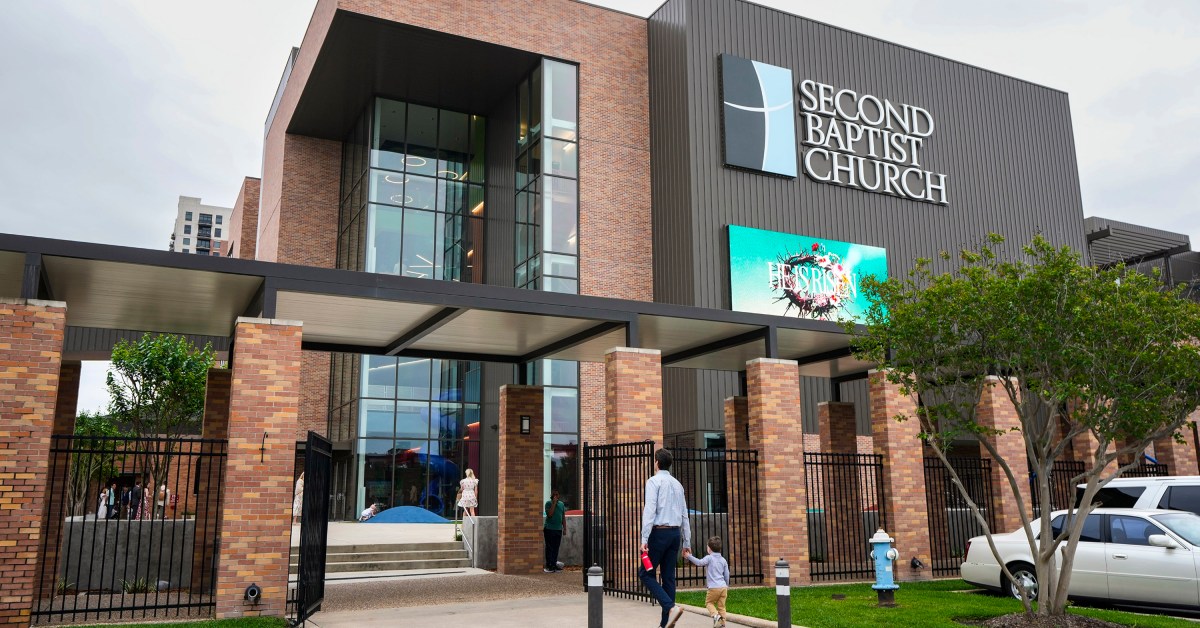
Ed Young Sr.’s former church, Second Baptist in Houston, won a significant victory in a lawsuit brought by current and former congregants last year that claimed leadership deceptively changed bylaws to have Young’s son, Ben, succeed him as lead pastor without a public vote.
A Texas judge issued an opinion on Wednesday, dismissing most of the claims against the Youngs and the Second Baptist leadership team. The court ruled the congregation has the right to govern itself as an autonomous church, citing the legal doctrine known as ecclesiastical abstention—a First Amendment principle that prevents civil courts from resolving church doctrine or certain polity issues.
The judge, Grant Dorfman, said the court could only determine whether Second Baptist’s actions to change its bylaws and remove voting power from congregants were legal—that is, if the church had followed required state procedures for drafting and amending its governing documents. The court could not determine whether the church’s actions were just.
“Disagreements over leadership in so large an organization may be inevitable, even among communities of like-minded believers,” Dorfman wrote in his opinion. “And any court would naturally feel reluctance to pick sides in such a dispute. Fortunately, that is not this court’s role.”
Approaching the case, Second Baptist sought the advice of Jay Sekulow, a high-profile lawyer who represented President Donald Trump in his first impeachment trial and is now the head of the American Center for Law and Justice in Washington, DC. Ben Young and Sekulow both released statements Thursday praising Dorfman’s opinion.
“From the very beginning of this case, we have maintained that decisions about church governance belong to the church, not the civil courts,” Sekulow wrote.
The Jeremiah Counsel, a group of current and former Second Baptist members who brought the lawsuit, did not respond to a request for comment.
In their lawsuit, the group claimed that Second Baptist changed its governing documents in 2023 to eliminate the congregation’s power to vote on virtually all matters, including pastoral succession and budgets.
The Jeremiah Counsel said the change was enacted to ensure Ben Young succeeded his 89-year-old father, Ed. The elder Young had led Second Baptist since 1978, during which time it grew to more than 90,000 attendees at six campuses. Ed Young is also a former president of the Southern Baptist Convention.
The Jeremiah Counsel additionally took issue with Second Baptist’s handling of the vote to change its bylaws, saying the church had misrepresented the nature of meetings where voting took place. Court filings say only 317 church members participated in the 2023 vote.
Decisions over pastoral leadership and budgets are now made by a ministry leadership team at Second Baptist, comprised of the senior pastor and a group picked by him, according to the lawsuit. It alleges that church members are no longer entitled to vote.
Dorfman determined the court had jurisdiction to say if the 2023 changes to bylaws and articles of incorporation were legitimate, identifying them as secular elements of a religious organization. But the judge said that church autonomy prevents it from awarding relief for claims of fraud or failure of fiduciary duties. It also said the members had the right to a full accounting of the church’s assets, property, and finances.
Ultimately the court found that Second Baptist had changed its articles of incorporation without giving members proper notice but that it had amended its bylaws lawfully.
Dorfman dismissed all the other claims, saying the court could not rule on them because of religious liberty laws. The judged allowed the election of Ben Young to stand.
Addressing the fraud claims, Dorfman acknowledged the opinion will likely engender “disappointment and frustration” and could ring unfair.
“That was not the court’s intention, but is a perhaps inevitable result of the church autonomy doctrine and the centrality to our country, our Constitutions, and to our people of the principle of religious freedom that it protects,” Dorfman wrote.
Recent similar lawsuits have tested judges’ willingness to get involved in church polity.
Last month, a lawsuit against Gateway Church, a Dallas–Fort Worth area megachurch with nine campuses, was dismissed after members accused the megachurch of misappropriating tithe money. The court declined to enforce a “money-back guarantee” made to congregants by then-pastor Robert Morris, who pleaded guilty in 2025 to sexually abusing a child in the 1980s. The judge’s opinion also invoked ecclesiastical abstention, saying the matter was not a civil courts issue.
In May, a Virginia appeals court revived a lawsuit against David Platt’s McLean Bible Church that the court had previously dismissed. Members of the DC-area megachurch accused leadership of violating its bylaws governing the election of elders, alleging a Southern Baptist takeover of the nondenominational church. They also asserted a liberal drift in teachings, pinned to Platt’s arrival on staff in 2017.
The doctrine of ecclesiastical abstention dates to an 1871 Supreme Court ruling. In Watson v. Jones, the court wrote that judges cannot weigh in on “a matter which concerns theological controversy, church discipline, ecclesiastical government, or the conformity of the members of the church to the standards of morals required of them.”
