
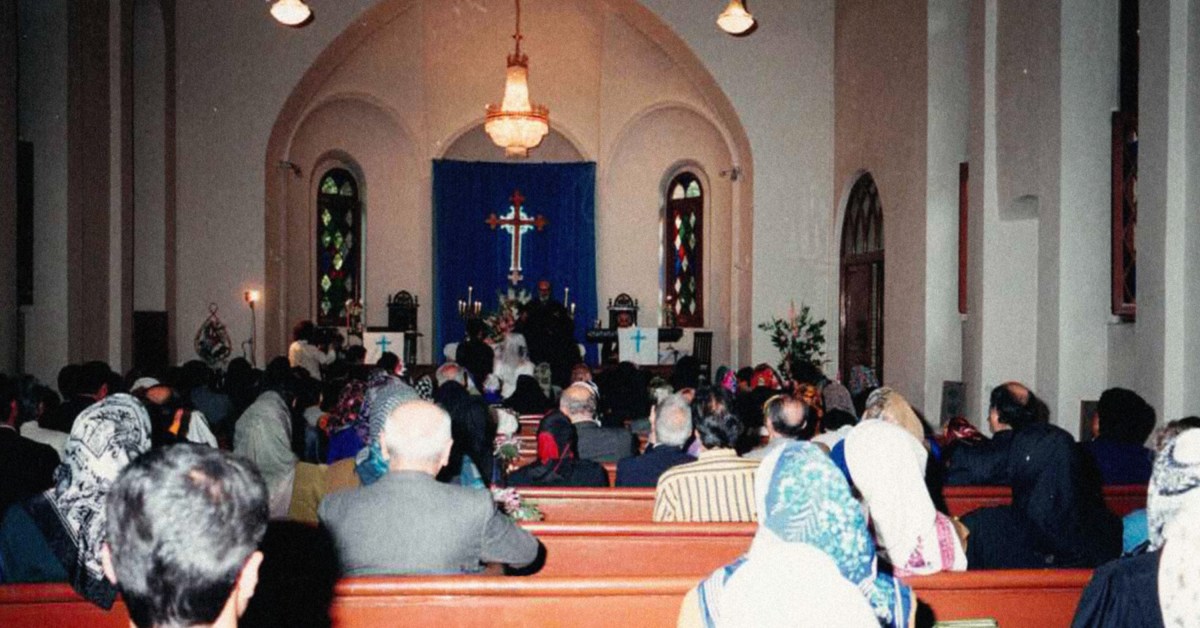
For 150 years, St. Peter Evangelical Church has maintained a visible and vibrant presence in the Iranian capital of Tehran. Mansour Khajehpour—a former elder at St. Peter—said the Presbyterian church was known to everyone in the neighborhood, where he lived from 1991 to 1993.
As a university student, Khajehpour lived in one of the church compound’s residences. As he passed through the neighborhood, shopkeepers would often ask him to deliver orders to other residents. “Walking down the streets, every single shop owner knew all of us,” he said.
The church is across the street from a synagogue and within walking distance of a Zoroastrian fire temple, an Orthodox church, a giant museum, and an Armenian social club. When Khajehpour lived in Tehran between 1986 and 1996, around 150 to 200 congregants regularly worshiped at St. Peter, including Muslim, Jewish, and Zoroastrian converts to Christianity.
“That neighborhood is a multicultural, multireligion neighborhood, and people live in friendship and relationship with one another,” he said. “And the Islamic Republic of Iran is trying to break that.”
In June, the Iranian government issued a deed declaring the church compound—which includes the historic church, dozens of residences, and two schools—the property of the regime, according to Iranian Christians abroad who have ties to the church. Two weeks ago, eight families living on the property fled after threats from security forces, said Sargez Benyamin, executive secretary of the Synod of the Evangelical Church of Iran in Diaspora—the representative body of the Presbyterian churches in Iran. More families and individuals left in the days that followed.
Benyamin, who pastored St. Peter from 2008 until 2015, told Christianity Today that 28 Assyrian and Armenian Christians were living in 20 residential units or single rooms on the church compound. Security forces are pressuring the remaining three families to leave as soon as possible, Benyamin added.
Some are long-standing members of the church. Others have joined since 2014 when Tehran issued new restrictions that forced the congregation’s Muslim converts to migrate to house churches. St. Peter’s leadership sought out more Assyrian and Armenian Christians—who are recognized religious groups in Iran and have historically experienced more freedoms than Muslim-background believers—to join the church.
In recent weeks, government officials have sealed the doors of the church office and the office of the synod’s secretary, which is also located on the church property, and banned all church gatherings, according to Benyamin.
“At the moment we have no property left,” Benyamin said, referring to his denomination. “[St. Peter] was the last.” In 2023, Iran had six functioning Presbyterian churches.
St. Peter’s legal troubles began decades ago. The regime has argued that because American missionaries founded St. Peter, the church compound is foreign-owned and therefore subject to confiscation. Khajehpour said Tehran already seized the church’s boys school in 1979.
Yet Khajehpour and Benyamin said Americans no longer own the property. “The deeds were transferred to [Iranian Christians] many years ago,” Khajehpour said. “It’s already owned by the Iranians. It is our property.”
The Synod of the Evangelical Church in Iran purchased around half of the compound from the American Presbyterian Mission in Iran prior to the Iranian revolution in 1979, Benyamin said, and the deed remains in the church’s possession. In 1994, the Mission issued a declaration through Iran’s diplomatic office in Washington granting the remaining property to the synod.
Still, Iranian authorities are seeking to enforce a 1998 Islamic Revolutionary Court order transferring ownership of the entire compound to the government, Benyamin said.
Tehran has increasingly arrested Christians in recent years. The regime restricts who can attend non-Muslim places of worship. In 2014, the government banned Farsi speakers—who are typically converts from Islam—from attending Christian worship services.
Benyamin was still pastoring St. Peter at the time and asked the Muslim-born members of his church—the majority of his congregation—to stop attending services and meetings out of concern for their safety. He hoped the pause would be temporary and believed then-President Hassan Rouhani, who campaigned as a moderate, might lift the ban.
“Unfortunately, the situation continued to deteriorate and has now reached the point where the government does not even tolerate the presence of Assyrian [and] Armenian Christians in that historic place of worship,” said Benyamin, who fled Iran in 2015 after security and intelligence forces pressured him to leave.
When government officials made it clear they no longer recognized the historic synod as an entity with legal rights in 2015, five Iranian church leaders who had fled Iran—including Benyamin and Khajehpour—reestablished it abroad to oversee the remaining Presbyterian churches.
The Execution of Imam Khomeini’s Order (EIKO)—a network of regime-controlled front companies used to generate under-the-table investments—has claimed ownership of St. Peter, Benyamin said.
Since 2018, EIKO has seized or demolished an Assyrian Presbyterian church in Tabriz, a retreat center in Karaj, an Assemblies of God church in Gorgan, and a Presbyterian church in Mashhad.
Khajehpour accepted Christ at the Mashhad church in 1981. He recalled the church had eight rooms on its second floor and housed people displaced by the Iran-Iraq war. Last month, security forces demolished the church. Benyamin believes no more than five Protestant churches remain in Iran.
Benyamin attributes Tehran’s effort to shutter St. Peter and other churches to several factors, including “the current Iranian government’s hostility toward Protestant churches, especially because of the growing interest among Iranians in the message of the gospel.”
The authorities are also using the recent war as a pretext, Benyamin said, “arguing that they are seizing the property as compensation for damages caused to the Islamic system during the war with America.” The value of the property—about 10 acres in the heart of Tehran—may be another contributing factor. The compound borders administrative offices for Iran’s Ministry of Defense and Ministry of Education.
For many Iranians, the St. Peter church has served as a sanctuary. Khajehpour recalled two individuals who struggled with depression and found solace by sleeping on the church steps overnight. Khajehpour was married in the church and baptized his daughter there. His father-in-law pastored the church until 1990 when the government shut down the Iranian Bible Society, where he was general secretary.
The future of St. Peter appears bleak, Khajehpour noted, yet he believes that the gates of hell will not prevail against Christ’s church (Matt. 16:18). Christians in Iran have encountered trials before—including in 1994, when the regime allegedly executed two prominent church leaders—and the church still grew, he added. Khajehpour and his wife spent 12 days in prison for their faith before fleeing Tehran in 1996.
“This is the dynamic reality of the church. The church will not die,” he said. “The church will grow, and we are a part of that church.”
