
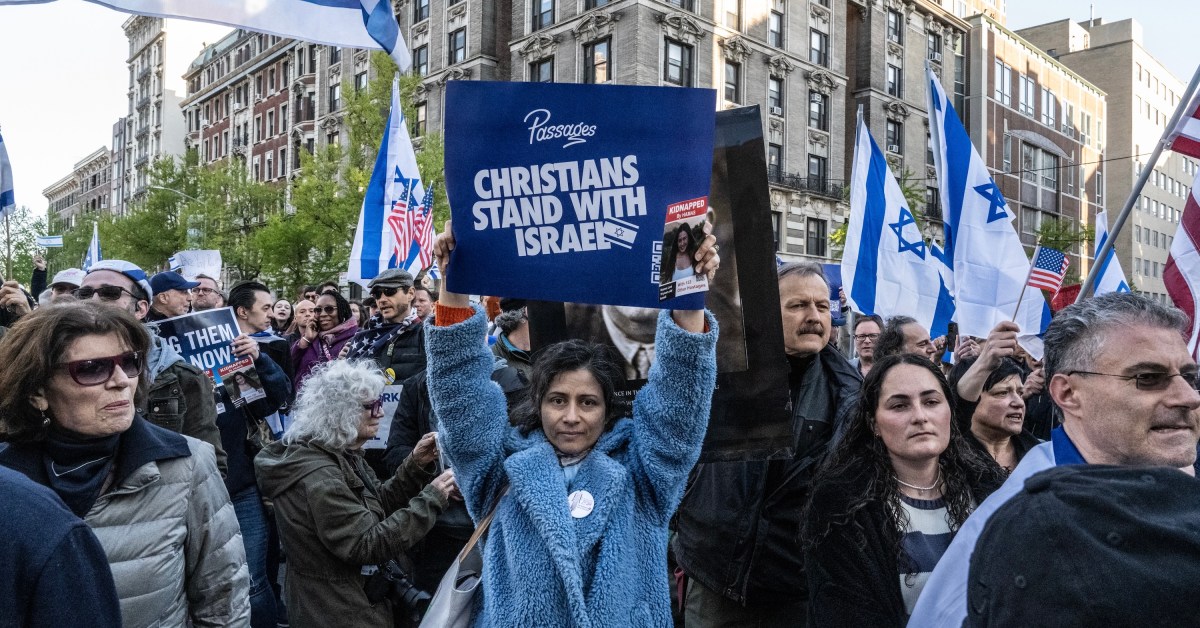
Evangelical Christians are not immune to growing negative sentiment toward Israel among Americans, a new Pew Research Center survey found. While white evangelicals are still more likely to back Israel’s government than other religious groups, their support has plunged since the outbreak of the Israel-Hamas war.
The percentage of white evangelicals with a favorable view of the Israeli people has fallen 10 points since 2024, to 74 percent. Their view of Israel’s government has slipped even more: Around 57 percent have a favorable opinion of the government, down from 71 percent in 2024.
By contrast, half of Black Protestants have a favorable view of the Israeli people, and only 30 percent have a positive outlook on Prime Minister Benjamin Netanyahu’s administration.
Souring attitudes toward Israel do not seem to be the result of warmer feelings toward Palestinian causes: Evangelicals’ views of the Palestinian Authority and the Palestinian people have remained relatively stable since the start of the war.
The Pew findings follow years of conflict sparked by the deadly October 7, 2023, attacks by the militant group Hamas. Around 1,200 Israelis were killed and over 250 taken hostage from southern Israel. Since then, Israel’s military response has killed more than 70,000 Palestinians, according to Gaza’s health ministry and Israeli security.
Reactions to the ongoing violence may explain some of the downward trend, but for evangelicals, a variety of factors may also come into play, from generational differences over eschatology to growing isolationist sentiments. Researchers have also noted rising antisemitism in some quarters.
Ryan Burge, an American religion researcher, said the erosion in support for Israel may be due to a shift in how churches talk about the issue—if they address it at all.
“If you look at the biggest advocates for Christian Zionism, it was the old guard Religious Right folks,” Burge said, referencing Jerry Falwell Sr., Liberty University founder and conservative political activist; Pat Robertson, televangelist and Christian Broadcasting Network founder; and John Hagee, a prominent televangelist and founder of Zionist organization Christians United for Israel.
“The evangelical boomers who were raised on Falwell, Robertson, John Hagee, Zionism—the new breed of evangelicals were not raised on that,” Burge said. “So they have no theological understanding of where Christian Zionism comes from, the biblical justification for it. They’re left to their own devices to figure out how they feel about these issues.”
He thinks this silence may explain a growing discomfort he’s found among college students on both sides of the political aisle to discuss current events in the Middle East.
“A lot of young evangelicals, they don’t fully understand why we support Israel so much,” he said. “It doesn’t make sense to them.”
Burge, who has tracked the decline in religiosity, said many churches are just trying to keep their doors open—and appeal to a broad group of people—and may shy away from weighty or touchy discussions about Israel and the role of the Jewish people in Christianity.
From the 1960s until recent years, Christian Zionism was baked into many traditions within evangelicalism. Dispensationalist theology—which tends to hold that God has a special, separate role for the Jewish people to play in still-unfulfilled end times prophecies—was popular with prominent evangelicals, was fodder for countless books, and was taught in many churches.
Also popular was “blessing-based theology,” according to Daniel Hummel, director of the Lumen Center and author of Covenant Brothers: Evangelicals, Jews, and U.S.-Israeli Relations. That view, drawn from Genesis 12:3, takes God’s promise to Abraham, the ancestor of the Jewish people, to “bless those who bless you” and curse his enemies, as an ongoing promise.
“The way that that cashes out for evangelicals today is you should bless the Jewish people and Israel: The nation of Israel today is Jewish, and so they deserve evangelical support,” Hummel explained.
But he’s seen an erosion of those views among emerging generations as Calvinism has grown in popularity and prominent seminaries have moved more in a direction of covenantalism, which holds that the church is a continuation of the covenant God established with the Jewish people and which downplays the importance of the modern state of Israel in eschatology.
That said, the shift in evangelical views may also be simply due to larger cultural and political trends.
“Thirty years ago, the culture was very pro-Israel, and that’s part of the reason why evangelicals were too,” Hummel said. “Today it’s the same way, just heading in the other direction.”
Republican voters are increasingly disillusioned with foreign entanglements and may have started to question monetary support of Israel.
“It used to be the Republican Party was the party of the hawk—like, let’s get involved, let’s be all over the world,” Burge said. But with nationalism and populism on the rise, politicians who promise to end wars are resonating with voters.
Hummel believes the ongoing war—and concerns about the death toll—may be influencing evangelicals’ views: “There has been an awful war in the last three years that has made a lot of people reassess Israel and whether the Israeli government does share the same values as the US.”
Todd Deatherage, executive director of The Telos Group, a nonprofit focused on Middle East peacemaking, also said the Pew findings accord with broader concerns in America about Israeli military actions.
“A lot of people may not necessarily identify as isolationists, but they really are questioning the perpetual war in the Middle East,” Deatherage said.
Pew found that a majority of Americans over the age of 50 hold a favorable view toward Israel, while support drops among younger groups. Only 32 percent of Americans ages 18 to 29 have a positive view of the Israeli people. Anecdotally, experts have found that younger Christians also tend to be more uncertain—or negative—about their views on the conflict in the Middle East.
Mark Tooley, president of the Institute on Religion and Democracy, has heard with concern how young people view the United States’ relationship with Israel. He’s disheartened by a growing strain of antisemitism among disaffected young men, including young Christians.
Part of the trend may be due to anti-Jewish sentiments expressed by conservative media personalities like Tucker Carlson, Candace Owens, or the noted antisemite Nick Fuentes. While none of these influencers is evangelical, Tooley has found plenty of Christians who follow Carlson or Owens.
Tooley has also heard from pastors who have been at a loss to counteract antisemitic tropes they’re hearing from young men in their congregation.
Most evangelicals don’t hold those views, Tooley said, but he added, “I would say there is a crisis within American Christian Zionism, in that I don’t think they’re reaching new generations.”
