
In this series
In this series


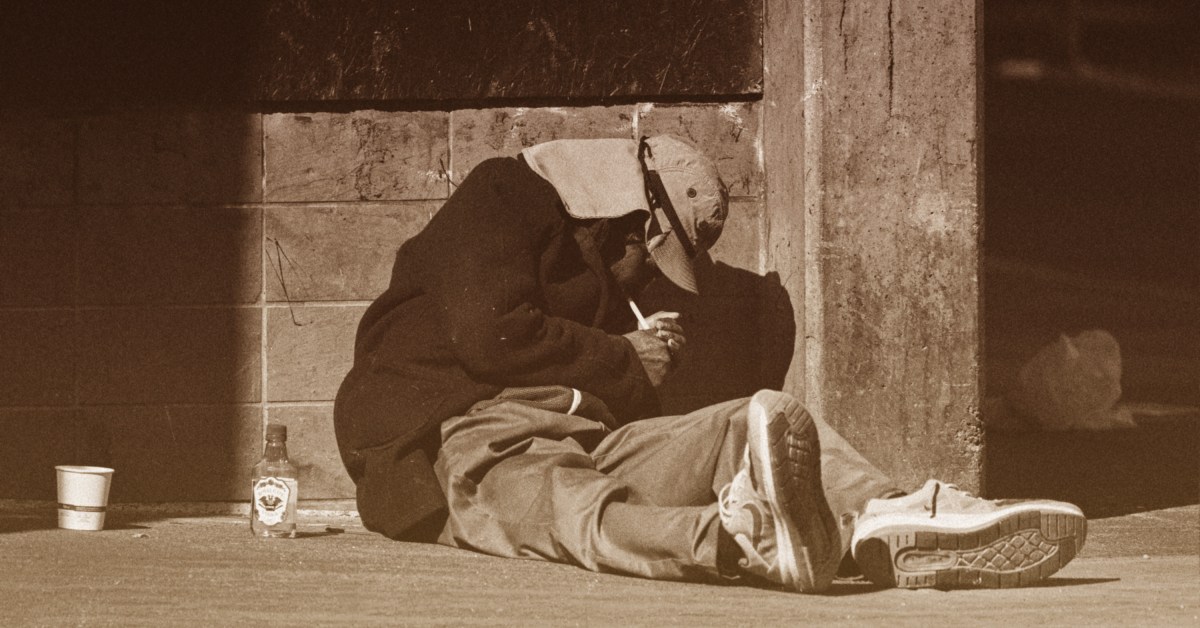
Addiction is nothing new in our country. Sometimes it’s hidden away and people with abnormal habits can still lead mostly normal lives. But numerous studies over the years have linked substance abuse and homelessness.
One oft-cited study showed that more than four out of five chronically homeless people have had alcohol or drug problems. That’s over a lifetime, but another study tested 400 homeless people on the St. Louis streets and shelters for recent cocaine use: Most had detectable amounts.
Jeremiah is a formerly homeless man whom I met at Eden Village, a refuge for the formerly homeless in Springfield, Missouri. He told me about two vivid memories. The first was a one-time disaster: His home burned when he was a child, and Jeremiah made it out with his grandparents and stepdad. But his mom went back in for his sister and never came out.
The second concerned daily degradation via opioids, starting with one Percocet, then five, then anything. “It got to a point to where if I didn’t have a shot drawn up for me in the morning when I woke, I’d be throwing up.”
Jeremiah stole small things from his family for years until “they wanted no part of me.” Then he stole large things from Walmart and went to prison for five years. Then came homelessness. He carried three backpacks and slept at strip malls at night: “Most of them don’t have security.” He’d find an outside outlet, plug in his cellphone and a heating blanket, and it was “like sleeping in a house.”
Days were worse than nights, and Jeremiah sank deeper into drugs and depression: “I tried to kill myself three times. Took enough morphine to kill an elephant. Woke up in the hospital. Second time, I woke up in a mental institution.” In 2020, he entered a “sober living program,” where doctors put him “on 16 different types of meds. A pill for everything”—except his alienation from God.
Later in this series on homelessness, I’ll tell what happened to Jeremiah, but let’s first look at the bouncing baseline of addiction in America—starting, surprisingly, with women. As David Courtwright documents in Dark Paradise, “The outstanding feature of nineteenth-century opium and morphine addiction is that the majority of addicts were women.”
Before Aspirin and Tylenol, Americans used small doses of opiates to relieve pain. Impatient parents gave bawling babies opiated syrups: One ballad described “Paregoric by the bottle / Emptied down the baby’s throttle.” Women in particular might use opiates when they did not want to appear unseemly by drowning their sorrows with liquor.
Courtwright explains how drug use among men grew during the Civil War and thereafter. Union officers and medics gave their soldiers nearly 3 million ounces of opium powders or tinctures and nearly 10 million opium pills. Confederate doctor William Taylor gave constipated soldiers a plug of opium, and Courtwright relates that when Union surgeon Nathan Mayer “thought a soldier needed morphine, he would pour out an ‘exact quantity’ and then let the soldier lick it from his hand.”
War-era demand was so high that six times more opium—146,000 pounds—entered the United States in 1868 than in 1840, and some estimate that by 1870, around 100,000 of the 30 million Americans had a drug problem. A few of these addictions were publicly apparent. At the time, Cincinnati writer Lafcadio Hearn observed, “Walk along the streets of this city any day and you will meet opium slaves by the score … suffering exquisite tortures. … Once in the fetters of opium and morphia, they are, with few exceptions, fettered for life.”
But homes, families, and cheap boarding houses hid most of addiction’s effects. Many men and women in middle-class families, either unwittingly or unwilling to admit a problem, used opiate-containing “nerve tonics” with friendly names. One entrepreneur made a fortune with “Scotch Oats Essence,” which had a 40 percent alcohol base, though sales fell off when a chemist announced the solution contained morphine. The business went belly up, and the proprietor drank himself to death.
Public awareness of “opium slaves,” along with the Pure Food and Drug Act of 1906, gradually made such brews unpopular. Bayer invented Aspirin in 1899, and it was widely adopted during the first third of the 20th century. Opiate use declined, and drug use remained only a minor contributor to homelessness in the decades leading up to the new millennium.
But just as the Civil War contributed to rising opiate use in the 1860s, so did the Vietnam War during the 1960s. Dark Paradise reports that by 1971, half of US soldiers in Vietnam had tried heroin, and some continued to use it when they returned stateside. In the mid-1980s, some among the homeless smoked crack, the potent form of cocaine that then cost only a few dollars for a small vial.
The 1990s brought an uptick in heroin-related deaths. Two addicted lovers in downtown Portland hit front pages nationwide because they hanged themselves from a bridge, their bodies at eye level for Amtrak railroad passengers.
And in the 21st century, says Sam Quinones, chronicler of the rise of fentanyl and methamphetamine in The Least of Us, “People [are] very politically unwilling to talk about [how] these two drugs … are major drivers, both of them, in our problems of mental illness and homelessness.”
But Marsha Michaelis wrote about those drivers in an article the Discovery Institute (which distributes my monthly Olasky Books newsletter) published last month. She described how at a Seattle homeless encampment, a dead man’s “pockets contained what was left of his fentanyl and crack cocaine.” She wrote about Anna in a Porta Potty: “Her small purse was tied to the inside door and a plastic trash bag of clean clothes sat on the closed toilet seat. She’d overdosed on fentanyl.”
I’ve seen homeless users in the Tenderloin district of San Francisco inhaling fentanyl fumes off foil, heated from below with a butane torch lighter—“chasing the dragon,” they say. I never, though, had the misery of seeing what Michaelis vividly described: a dead fentanyl addict “face-down in a pool of his own vomit,” clutching in his right fist the blowtorch of his own destruction.
