
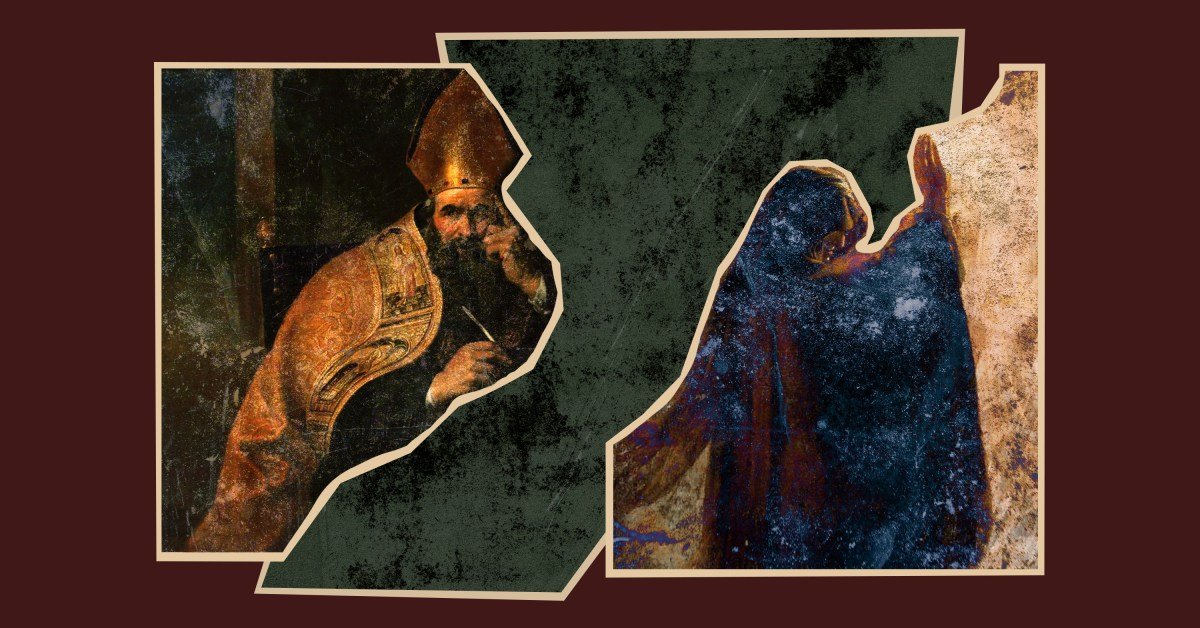
King Saul famously courts a medium in 1 Samuel 28, summoning the ghostly figure of the departed Samuel in a moment of distress and disconnection with God. This summer, German researchers summoned new insight on this mysterious passage after uncovering medieval sermon notes from Augustine of Hippo, one of the defining voices of the early church.
In 2024, Paul Nebauer, a historian in northeast Germany, contacted Latin scholar Christian Tornau with a request. Nebauer had spent years tracking down remnants of a former Cistercian abbey, a Catholic monastery destroyed in the 17th century. He needed help translating a manuscript housed in a diocesan library in Poland.
After almost two years of study—along with insight from doctoral students and researchers in Vienna—Tornau and Nebauer concluded that the writings, which included two previously unattributed sermons, were authored by Augustine.
The sermons date from as far back as the 5th century, Tornau told CT, and can be confidently linked to the famous theologian for several reasons: Their background is North African, linked to the region where Augustine wrote The City of God and other foundational texts. Their words reflect Augustine’s theology and thoughts without simply copying them. And they were packaged together in a manuscript with two other sermons—one already identified as an authentic Augustinian work.
The full manuscript was written in Bad Doberan, a German town, in the 12th century, according to Tornau, and may have been copied from a lost manuscript in Amelungsborn Abbey, a historic Lutheran monastery in Lower Saxony. The writings were then passed to the Pelplin library in Poland by Cistercian monks, OSV News reported. The sermon notes originally caught Nebauer’s eye because of two phrases: pythonissa, which is medieval Latin for “witch,” and Resuscitatio Samuelis, denoting the “raising of Samuel.”
Augustine was preaching on 1 Samuel 28, the sermon notes revealed. In the biblical passage, Saul, who has “expelled all mediums and spiritists” from Israel (v. 3), secretly inquires of a necromancer. God has stopped answering Saul through dreams and prophets, so the troubled leader seeks an emergency—and unnatural—meeting with Samuel, who is then “disturbed” from death (v. 15) and prophesies Saul’s destruction at the hands of the Philistines.
“The narrative was a problem for ancient Christian exegesis,” Tornau said. “How can the necromancer exert magical [or] diabolical power over Samuel, a saint of God? Is God unable or unwilling to prevent this?”
The passage is debated to this day, but before Augustine’s time (AD 354 to 430), the exegetical tradition essentially boiled down to two interpretations, according to Tornau: Either Samuel appeared because God ordered or permitted sinful sorcery to take place, or Samuel didn’t appear at all—rather, an evil spirit took the form of Israel’s prophet and deceived Saul.
The newly identified Augustine texts mention both options, citing the pros and cons of each, and conclude that both interpretations are acceptable, Tornau said. This openness contrasts with Augustine’s predecessors in church history, who argued aggressively for one take over another.
Augustine’s take also doesn’t factor in a third interpretation. According to Julianne Burnett, an Old Testament professor at Asbury University, others propose that the medium deceived Saul in his desperation. The medium is the only one in the passage to initially see Samuel after realizing King Saul’s hidden identity, describing the raised figure as an “old man wearing a robe” (v. 14). It’s possible Saul was “weakened to the point of believing an act of trickery,” Burnett told CT.
Augustine, meanwhile, preached about the first possibility—that God allowed the real, deceased Samuel to be summoned as a legitimate warning to Saul—on a Sunday, according to Tornau. He ended this sermon on a “cliffhanger,” Tornau said, until a follow-up sermon on Wednesday, when he addressed the possibility of an evil spirit tricking Saul. Augustine apparently wanted his congregation to wrestle with both possibilities.
Today, many theologians emphasize the story’s moral over its specifics: Regardless of how Samuel appeared, Saul was rebellious to seek him through a séance, courting supernatural evil. “This passage is clear,” Burnett said, “that the Lord cannot be manipulated and he will not tolerate the violation of his laws, even by a king.”
Yet while defending the possibility that God willed or allowed Samuel to be conjured, Augustine suggests Saul may have even repented and found redemption after hearing Samuel’s foreboding prophecy.
Augustine doesn’t provide any biblical evidence for this, Tornau said, but he draws an analogy to the thief on the cross (Luke 23), teaching that “an hour of repentance was enough” for that man’s salvation. Augustine doesn’t commit to the idea of Saul’s salvation, Tornau added, but he takes it seriously enough to repeat the illustration at the end of one of the newly identified sermons. “This is unparalleled in Augustine and ancient Christianity in general,” Tornau said.
The idea may have been independent, Tornau explained, or it may have been inspired by more sympathetic images of Saul among Rabbinic Jewish scholars of the time. The Bible spells a dire end for Saul, who falls on his own sword in battle (1 Sam. 31) after Israel is handed over to King David, but Augustine’s approach in the newly identified manuscript “combines intellectual honesty and episcopal humility,” Tornau said.
And also a bit of humor, according to fellow researcher Dorothea Weber. The discovered sermons included Augustine explaining to his congregation “why he did not have a chance to prepare for the Bible passage he was supposed to preach on,” Weber told OSV News. He “tried to buy some time” and, despite improvising, still “achieved his typical stylistic brilliance.”
Above all, the theologian wanted his audience to “think for themselves,” according to a statement from Germany’s University of Würzburg, where Tornau works. This reflects Augustine’s own flexibility as a thinker. As CT wrote in 2003, the early church father was openly flawed, even mistranslating certain biblical texts: He “changed his mind … on many occasions, and recorded the fact so that nobody would think he was infallible.” Yet he consistently prioritized fellowship with God, prescribing belief that elevates understanding.
The newly identified sermons will be the subject of a critical edition from Tornau and the Corpus Scriptorum Ecclesiasticorum Latinorum, an academic series managed by the University of Salzburg in Austria, later this year. The manuscript’s uncovering follows a 2008 discovery of two Augustine sermons in the German town of Erfurt, as well as a 1990 discovery of 26 incomplete or unidentified sermons held in the country’s Mainz City Library.
