
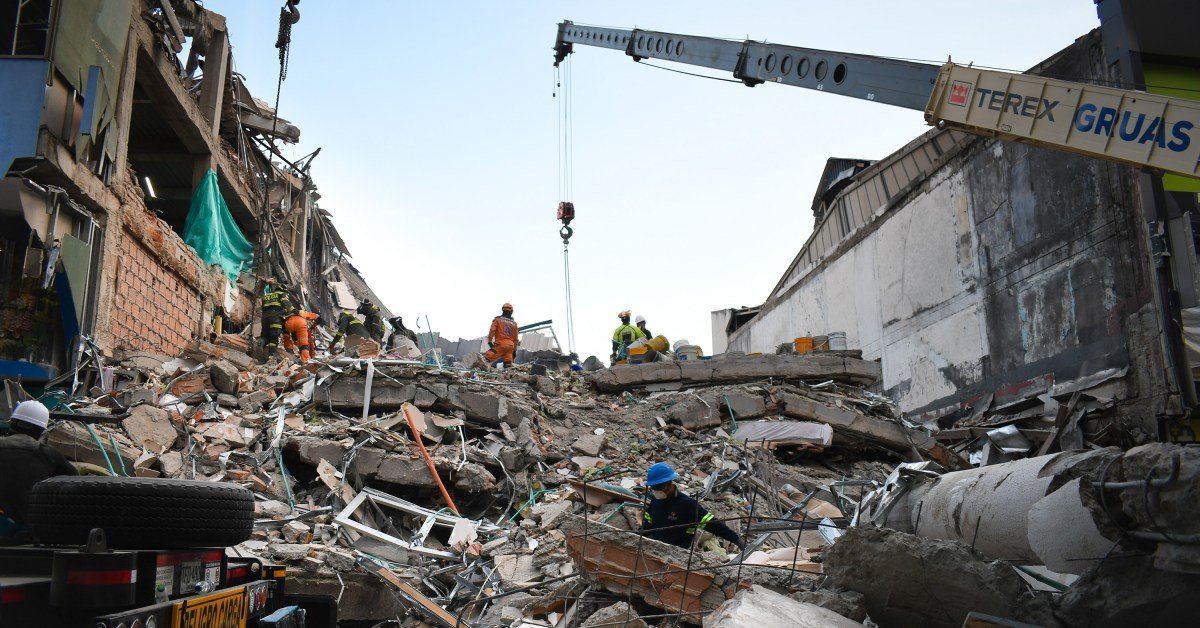
On August 13, three days after a 7.4 magnitude earthquake rocked western Colombia, rescue crews in Pereira, a city in Colombia’s mountainous coffee region, were still searching for life beneath the ruins.
Hundreds of volunteers in hard hats, Red Cross workers, firefighters, army members, and paramedics surrounded a collapsed seven-story hotel in the city’s downtown. Periodically, workers on top of the debris raised fists in the air, signaling for silence, and others followed suit, fists going up in a line snaking for blocks. Sophisticated equipment listened for sounds that could indicate someone was alive beneath the rubble.
Later that evening, volunteers congregated behind yellow caution tape, waiting for their shift to form a human chain atop the collapsed hotel and help rescuers remove the debris piece by piece. Among them sat a group wearing blue vests with the words Haciendo a Jesús Famoso (“making Jesus famous”) emblazoned across the back.
The night before, they’d been there from dusk until 4 a.m.
“Those organizing it told us it would be more effective at night, because a lot of people were already coming in the day,” said Nissinjawer Valencia, a member of the group.
The group came from a church called Palabra Pura, located just a few blocks from the fallen hotel. After confirming everyone in the congregation survived, the church organized a group to support the search-and-rescue-efforts.
“They had heard signs of life” yesterday, Valencia told CT. “So, praying and relying on our faith, we hold onto the hope that we would find people still alive.”
Last Monday’s earthquake was the strongest in Colombia in a century, felt as far away as Ecuador and Peru. The government has reported 289 deaths, nearly 200 missing people, and more than 26,000 destroyed residences.
In response, the entire country mobilized. Charities and government task forces sprang into action, but so did churches and individuals—transporting and handing out supplies, and cooking enormous amounts of soup, beans, rice, and meat for their affected neighbors.
Fernando Ferreira, a small business owner and member of Comunidad Cristiana de Fe in Pereira, opened his home to one of his employees whose apartment was damaged, as well as a group of church volunteers who traveled six hours from Medellín. In the days following the earthquake, Ferreira and his wife cooked hundreds of lunches and passed them out at a park where displaced residents of an apartment building are staying in tents. Ferreira’s pantries, along with buckets on his kitchen floor, are filled with rice, beans, and other nonperishable food donated by friends across the country.
Next to Ferreira’s home towers a cracked 20-floor apartment building that swayed like a pendulum during the quake.
“Right next to me there are evacuated buildings, and here I am perfectly fine,” Ferreira said, explaining why he felt motivated to do anything he could to help his community. “It’s like when you are saved and you immediately want to go out and share the Good News.”
Several hours away in Cali, Colombia’s third-largest city, churches are serving others while navigating their own grief. Three of the churches CT spoke to had members or close connections of members die under collapsed apartment buildings. Iglesia Tierra Nueva lost a dedicated service team member, a woman who was found in the spot in her home where she always did her morning devotions, according to María del Mar, the church’s communications director.
“We trust that she went to the presence of the Lord right in the moment when she was already praying, when she was meditating on the Word,” del Mar said. “That is what comforts our hearts at this moment, but obviously it’s still difficult.”
Since the earthquake, the church has been receiving donations and sending teams to deliver supplies to affected parts of Cali and other regions.
 Photo by Hannah Herrera
On Friday back in Pereira, locals searched for the best way to serve as the city was flooded with aid and rescue teams. Volunteers congregated at Magenta Life Coaching, a business teaching soft skills and personal development.
Álvaro León, Magenta’s CEO, prayed after briefing a group of volunteers on the day’s tasks. “You brought us through unscathed and left us standing with a purpose, the purpose of helping those who were not so fortunate,” he said. “Lord, we surrender ourselves to you, that you, our beloved Father, may direct us and guide us.”
While many volunteers were focused on search-and-rescue efforts, León said hardly anyone had gone to affected towns on the city’s outskirts. Volunteers left Magenta in motorcycles, vans, and trucks to wind their way through the mountain roads overlooking the picturesque Barbas River Canyon.
In Arabia, a small town almost 5,000 feet above sea level, volunteers gathered at a community center on the main square with a view of the town’s historic Catholic church, which had lost large chunks of brick.
“When we got here, there was no electricity, there was nothing. There were three cans of tuna in the collection center,” León said. By Friday afternoon, the small center was filled with hundreds of rolls of toilet paper, pounds of rice, mattresses, toothbrushes, and crackers.
“Ask the Lord, and it will be given to you,” León said. “And just as [Jesus] multiplied the fish and the loaves, when you ask with faith, love, and service, thinking of others, the Lord will also multiply for you.”
León, dressed in an orange-and-camouflage button-down, is a member of the Legendarios, a Christian organization that trains men to be “the heroes and hunters” of their homes and emphasizes humanitarian service.
León said the morning of the earthquake, he ran down three flights of stairs with his dog and saw a woman crying with two children. She explained that her elderly father was upstairs and she didn’t know how to bring him down. So León took her keys and bounded up the stairs. On the fifth floor, he said he found other older people.
“I started organizing them so I could carry them down the stairs, to calm them down a bit because they were very agitated. And from that moment on, I understood that the Lord was calling me to serve, to contribute, and to help,” León said. He’s working with health department officials to help coordinate aid and set up a shelter for displaced families at a nearby farm.
A block away from Arabia’s town center, a wooden home had completely collapsed—except for one room in the back. Three generations of women lived there. Lina Rincon told CT her grandmother was in the back room when the house, which had survived another large earthquake decades ago, fell around her. Rincon’s cousins pulled her grandmother, who was unhurt, out through the window.
The family is currently living in a room in the local hospital. “We were left with nothing,” Rincon said.
In their loss, the family is holding onto their faith. Rincon’s mother, Mariela, said she doesn’t blame God for natural disasters.
“We are a family of lots of prayer and lots of faith,” Mariela Rincon said. “And now more than ever.”

