
In 1997, employees at a warehouse in Scottsboro, Alabama, uncovered the remains of a four-foot-tall animatronic dwarf in the back of a tractor trailer.
The white-haired, radio-controlled puppet, whose name is Hoggle, had last been seen in Jim Henson’s 1986 film Labyrinth. Packed away and lost for nearly a decade, it may not have been discovered at all if it weren’t for Unclaimed Baggage.
That’s the name of the 50,000-square-foot facility in the middle of a quiet, working-class town, where trucks back into a loading dock and a team of “openers” unlocks trailers packed with bags, boxes, and suitcases—all lost luggage.
For blocks along West Willow Street, orange and turquoise signs point to the facility, which includes a retail store that draws treasure-hunting tourists six days a week. Up to 7,000 new rollouts every day!
Unclaimed Baggage buys literal tons of items from just about everywhere that people misplace bags: domestic airlines, buses, trains, trucks, hotels, theme parks, rental cars. Then it sells, donates, or repurposes whatever mysterious contents it finds.
Bryan and Sharon Owens, the owners of the operation, consider this their biblical mission—to redeem the lost, unclaimed, and rejected for the glory of God.
Bryan’s parents founded the company when his father, Doyle, heard about a bus line in Washington, DC, that was overflowing with unclaimed bags. Doyle, whose own parents had been peddlers dating back to the Great Depression, borrowed $300 and a 1967 Chevy pickup to drive hundreds of miles and buy a bundle of luggage. He and his wife, Sue, resold its contents on card tables in a rented house.
In 1978, Doyle expanded his business, signing a contract with Eastern Air Lines.
Today, airlines really want to reunite luggage with passengers—and they’re really good at it, using advanced tracking systems to return 99.5 percent of lost bags to their owners, according to Unclaimed Baggage.
But with United States flights carrying 2.7 million people each day, plenty of bags still remain unclaimed after three months, which is when they’re deemed abandoned. So Bryan and Sharon Owens—who bought the business from Doyle in 1995—aren’t hurting for product. As the country’s only retailer of lost luggage, their inventory is so large that they also opened an online store in 2020. Then, in 2023, they added a museum of rare finds to the Scottsboro facility.
 Photo courtesy of Unclaimed Marketing
Shoppers at Unclaimed stroll aisles and peruse shelves while sipping Starbucks from the store’s cafe. But the business wasn’t always so lucrative. Bryan remembers his mom thinking “we were gonna starve to death” when his dad first stopped selling insurance. He also recalls times in college when they had no bags to process, so his dad had everyone deep clean the warehouse instead.
Faith kept them afloat. The Owenses attended a Southern Baptist church together. Every Sunday, Bryan said, after dressing for service and shining their shoes, his father would write a check for the offering, even when money got tight and they’d pull from cash savings in a metal Band-Aid box to pay for gas and groceries. “The Lord was really in it,” Bryan told CT. “My parents were holding things lightly.”
He and Sharon learned to do the same. They took over shortly before the implosion of the dot-com stock market bubble, then weathered plunges in airline travel during the Great Recession and COVID-19. Still, unlucky travelers across the nation stocked the company’s shelves with books, coats, cameras, and golf clubs. Lost commercial shipments eventually also joined the mix.
The Owenses liken the initial unboxing of new truckloads to Christmas morning. It’s also “a hot mess,” Sharon said. “Most boxes are boring.”
Some trailers yield piles of broken equipment, like strollers, wheelchairs, or prescription eyeglasses. Staff take mounds of clothing and put them through the company’s own laundry and dry-cleaning facility.
The entire process amounts to something like an “archaeological dig,” Bryan said. Each decade’s bags carry their own fashion and electronics trends, although this year also produced plenty of retro finds—a 1973 cassette tape of Elvis Presley’s Aloha from Hawaii via Satellite, a boxed 1960s Ken doll, a 1957 letter addressed to Marilyn Monroe, a Union Army sword from the Civil War.
Men’s T-shirts were the most frequently found item in 2026. But Unclaimed Baggage also retrieved lots of men’s wedding rings from carry-on bags. And Rolex watches. And, naturally, heaps of abandoned phone chargers.
But there have been wackier pulls. Over the years, employees have unearthed a live rattlesnake, a shrunken head, a set of 10-karat gold-and-diamond dental grills, a bear pelt packed in salt, a 10-foot Tibetan horn, an Egyptian burial mask from 1500 BC. Once, Bryan said, they unwrapped an old rag inside a worn-out suitcase to find a solid 40-karat emerald.
These are the headline grabbers that power the museum. But the Owenses have taken recent steps to reposition Unclaimed Baggage as an overtly Christian venture, not just a thrifter’s paradise. Bryan says he gained a theology of work through Charles Colson’s Centurions leadership program, which helped him to see Unclaimed’s operation as a calling.
Reclaimed for Good, the company’s charitable arm, is an outgrowth of that calling. All those orphaned eyeglasses—about 2.5 million in total, Sharon estimates—are sent to Lions Clubs International, which distributes them in underserved countries. Broken wheelchairs are sent to Joni and Friends, which works with incarcerated volunteers to restore them. Even lonely socks find a home: They’re sent to The Odd Sock, a nonprofit that pairs up garments and gives them to homeless shelters and rehab centers.
These efforts double as environmental care, executive Mindi Cooke told a Fox News podcast. Unclaimed tries to minimize landfilling materials—about one-third of its baggage is sold, one-third is donated, and one-third is recycled.
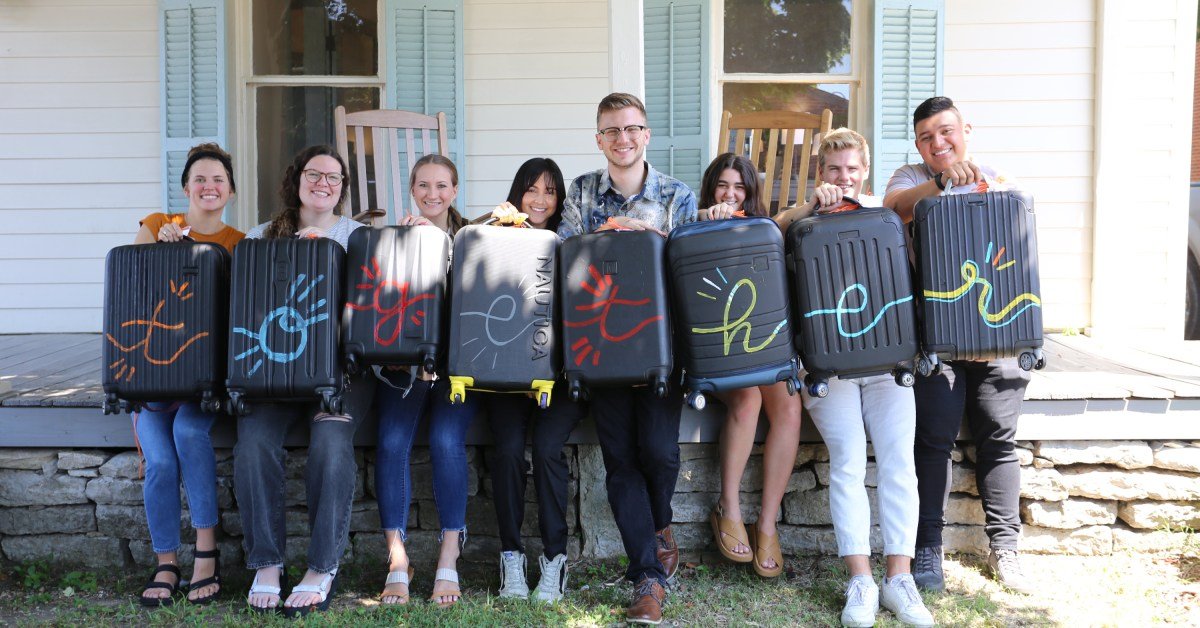
Another endeavor involves hard-sided suitcases. Years ago, an Unclaimed staffer was touched by a news segment about foster kids who moved their belongings in trash bags. So employees organized volunteers to paint flowers and other pictures on salvaged suitcases, then give them away. This year, Unclaimed partnered with 25 artists from New York City’s Society of Illustrators to expand the idea, painting professional art on suitcases, which will be displayed at airports across the country to raise awareness of foster care.
Another illustrator worked with Sharon Owens to produce a children’s book, Tuesday’s Bear, about a teddy who gets left behind at a bus station, only to be cleaned, stitched, and relocated to a new home after he is found. “It’s really an allegory of what Jesus has done for us,” she said.
Visitors to the store are part of their story. One of them, a young journalist named Stephie Grob Plante, profiled Unclaimed for Vox in 2016, months after her best friend was killed by a drunk driver. During her time in Scottsboro, Plante was treated to dinner and invited to movies by loyal shoppers and got a personal audience with founder Doyle Owens. She “lived this concept of repair,” Sharon said, and wrote later that she “found God at Unclaimed Baggage” through its people.
The Owenses are now based in Atlanta, where Bryan serves as an elder at Christ Covenant church and has expanded the family business by founding NetTracer, a bag-tracking software used by Delta, Southwest, and JetBlue. As the Unclaimed Baggage center draws about 1 million visitors each year, he insists any facility expansions will happen only in Scottsboro.
“That’s who brought us to the dance,” Bryan said. “Why the Lord chose us, in this little small town, it’s not because we’re smarter or brighter. Israel wasn’t chosen because they were mightier.”

