
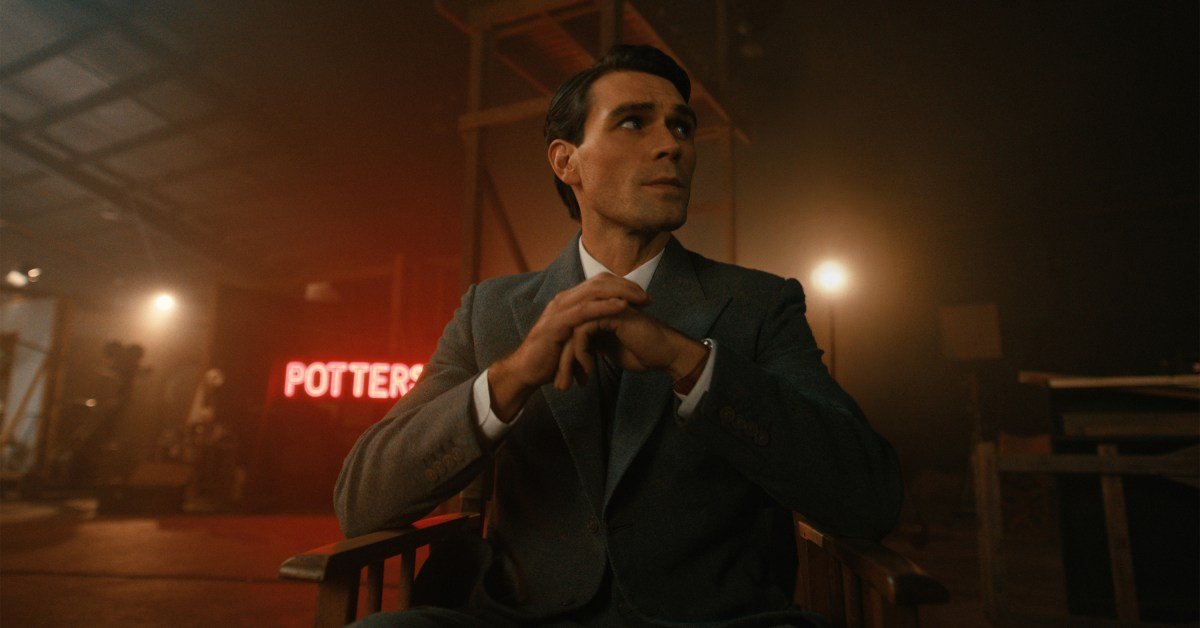
James Stewart is returning to the big screen, and director Aaron Burns has a Christian magazine to thank for it.
When Burns was researching for Jimmy, his upcoming biopic of the late Hollywood icon, he had plenty of help, including from Stewart’s daughter, Kelly Stewart-Harcourt. While editing, he even had Stewart’s own Academy Award in his office. But his biggest inspiration was the actor’s essays for Guideposts.
In them, Stewart reflected on his enlistment in the US Army, for which he flew 20 missions as a World War II bomber pilot. He returned from the war a changed man, he wrote, and his prayer at the end of It’s a Wonderful Life was a real cry for help. Stewart felt the hopelessness of people who had nowhere else to turn, he recalled, and sobbed for “our Father in heaven.”
Burns is a relative unknown in the mainstream film industry. But Fathom Entertainment, which specializes in faith-based features, agreed to put Jimmy in theaters this November.
Stewart’s father, a hardware store owner in rural Pennsylvania, was “a bit of a Bible thumper,” Burns told CT. Jimmy explores the ups and downs of their relationship, as well as how Stewart, a lifelong Presbyterian, navigated the move from show business to war and back again.
KJ Apa, who plays Stewart, previously drew on his own church upbringing to portray Christian singer Jeremy Camp in the biopic I Still Believe. Prior to securing Jimmy’s top role, the actor asked his father to pray for the right opportunity to present itself, Burns said.
Both men picked a good time to reenter this particular market. Faith stories are suddenly everywhere, and Christian filmmakers are aiming wide to grow loyal audiences.
Pop culture has “transformed into a mosaic of micro-cultures,” according to futurist Thomas Frey, where some of the most successful stories are sold to devoted niche groups rather than mass audiences. Hollywood seems to be catching on, mining Reddit and YouTube for viral ideas. Why play it safe for the masses when you can court superfans from far corners of the internet—or from church pews?
Christians proved their strength in this game with an unprecedented crowdfunding movement to get The Chosen off the ground. Dallas Jenkins’ seven-season show, which follows Jesus through the eyes of his disciples, is a far-reaching streamer, just like Jon Erwin’s House of David.
Angel Studios, which helped launch The Chosen, is one of Hollywood’s fastest-growing outfits. Its 2025 family musical David had a historic opening for faith-based animation. Jonathan Roumie, who plays Jesus in The Chosen and also starred in Angel’s romantic comedy Solo Mio, has appeared on The Tonight Show, featured in a Super Bowl ad, and modeled for a luxury fashion shoot.
 Courtesy of Prime Video © Amazon Content Services LLC
Burns’s Jimmy is more of an underdog play, marketed heavily to military veterans, but the fact it exists at all speaks to the expansion of the market. Once reserved for explicitly religious material, the faith-based space now doubles as a launching pad for broader redemption stories.
Yet the rise in Christian content could also present a temptation—to compromise biblical values or sanitize hard truths to stay profitable and relevant. Christianity isn’t necessarily supposed to be a “consumer-friendly” faith, as The Gospel Coalition’s Brett McCracken told CT. Many parts of the Bible aren’t “PG-rated and life-affirming” in a contemporary sense, he said, and bigger spotlights, along with bigger paydays and more influence, are “historically fraught terrain.”
Christians should be applauded for providing families with an alternative to darker, edgier, deconstruction-heavy stories, McCracken said, but the other extreme is presenting a vague, inoffensive faith defined only by “feel-good experiences.” He imagines a Christian production’s reception would suffer—either among believers or among mainstream audiences—if it drew firm lines on an issue like sexuality or focused on Jesus’ critiques of wealth.
Jimmy, however, isn’t explicitly labeled a Christian movie. It’s a true story—and a PG-13 one—that happens to incorporate faith. Which begs the question: What is a Christian film? The definition (or perception) has changed over time, and the lines might be blurring again.
In the 1950s and ’60s, Hollywood was flush with big, colorful biblical epics, like Cecil B. DeMille’s Ten Commandments and William Wyler’s Ben-Hur. That era’s faith-focused filmmakers were artistic and highly educated, according to film critic Joseph Holmes.
But as Christianity’s influence on American culture declined later in the 20th century, high-profile directors told increasingly secular (and polarizing) stories, like Martin Scorsese’s The Last Temptation of Christ (1988), Holmes said. Gentler Christian movies were left to directors whose résumés had more church skits, music videos, and TV commercials than formal training.
With the exception of Mel Gibson’s The Passion of the Christ (2004), many of the independently made faith-based hits of the 2000s also catered heavily to the steadiest group of churchgoers at the time: women over 35. That meant lots of Hallmark Channel comfort and positivity, Holmes told CT. Now Americans are having fewer kids, the “pipeline of moms is withering away,” Holmes said, and young men are suddenly leading renewed interest in religion.
It’s perhaps no coincidence that the first collaboration between Angel Studios and Erwin’s Wonder Project, another faith-first venture, was the George Washington war biopic Young Washington. That film was more American than Christian, and it epitomizes the hazy line between sacred and secular as the industry strives to grow from preachy to accessible.
Erwin might be leading this charge. Just four years after launching Kingdom Story Company, a gospel-focused studio, the filmmaker stepped down to focus fully on Wonder Project, a “values-based” production house for those “unafraid of Christianity and the American dream.”
Traditional studios had been treating faith like a genre instead of an actual audience, Wonder Project CEO Kelly Merryman Hoogstraten told CT. So Wonder Project’s strategy is “intentionally broad,” but with a common thread: It prioritizes tales of courage, hope, and inspiration that “restore faith in … God, family, country, or dreams.”
Angel Studios’ output suggests a similar approach. Drummer Boy, upcoming from Christian pop duo For King & Country, is an action musical about brothers on opposite sides of the Revolutionary War. Zero A.D., planned for December, is a desert epic marketed like the Bible’s answer to the Dune franchise. Then there’s Hershey, a Thanksgiving biopic of the famous chocolatier. Some of these titles point to Christ; others merely offer clean inspiration for all ages.
“Everyone is throwing mud at the wall and seeing what sticks,” Holmes said. “How vague can we be and Christians still accept it? How explicit can we be and atheists still accept it?”
Actor Cameron Arnett, whose titles include The Forge, sees this as mostly a positive development. He points to the recent success of PG-rated movies, which in 2024 led the box office for the first time in decades, as evidence that uplifting films are “really the heart of the country.” Most people want to love and collaborate with each other, he said, but the Enemy is out to kill and destroy (John 10:10), and Hollywood has too often echoed such divisiveness.
Next Easter could be a litmus test for all moviegoers—a blockbuster showdown between The Chosen’s crucifixion film, Mel Gibson’s Passion follow-up The Resurrection of the Christ, and Greta Gerwig’s Chronicles of Narnia adaptation.
That’s not accounting for the possibility that The Way of the Wind, a Jesus epic long anticipated from Terrence Malick, might finally be released. Malick’s films are more poetic and experimental, so critic Brett McCracken expects his Jesus story will be “the furthest thing from a commercial hit.”
That doesn’t mean it won’t be a strong witness. More mainstream thrillers like Doubt (2008), Calvary (2014), and First Reformed (2018) aren’t feel-good or family friendly by most standards, but they each depict an earnest, albeit tortured, wrestling with faith. McCracken contends some of the best Christian stories can emerge from secular filmmakers toying with their own beliefs.
Those who’ve walked the tightrope inside the industry have met other battles. The Chosen has grown so much—with its season 6 finale and season 7 kickoff set to debut as feature films—that creator Dallas Jenkins is facing a lawsuit from early investors alleging they were squeezed out of the brand’s massive earnings. Angel has expanded its annual release calendar every year since its 2021 inception, but it lost distribution rights for The Chosen over a breach of contract and settled a separate lawsuit from another studio alleging a “hostile takeover” of their work.
The potential pitfalls aren’t stopping others from taking calculated risks with diverse canvases—from documentary-style comedy to supernatural horror. “It’s about time,” Matt Neff, CEO of Sight & Sound Ministries, told CT. “We know the Creator of the universe, so as believers, we should have an inside track to create art and tell stories.”
Sight & Sound is best known for live, large-scale stage productions of Bible stories at 2,000-seat theaters in Lancaster, Pennsylvania, and Branson, Missouri. In 2018, about a year after screening filmed versions of their shows, Sight & Sound leaders had an epiphany: They could make other movies, too. They were already used to building both elaborate sets and special effects.
Besides, they saw Ephesians 4:11—the commissioning of pastors, teachers, and prophets to build up the body of Christ—as a template for expanding their work. If their stage shows evangelized and their conservatory shepherded young actors, then Sight & Sound films could prophesy to the rest of the world. Their debut feature, I Heard the Bells (2022), earned almost twice as much as its reported $3 million budget, despite a limited holiday release.
“It’s an extremely difficult art form to pay for itself,” Neff said. “The built-in base we have helps us. Theater is like our seasoned adult. Film is like our toddler, just this little rascal.”
Mitch Hudson, director of The Promised Land, is angling for something sillier. Pitched as The Office in ancient Egypt, with a documentary crew interviewing Moses and the Israelites in the desert, his YouTube series is getting a second season after finding a way to mix jokes about tribal feuds and golden calf worship with relational drama pulled straight from Exodus.
The Promised Land’s pilot episode has more than 4.6 million views. Hudson’s plan is to make 40 total episodes over five seasons, culminating with the end of Moses’ life and the transition to Joshua’s leadership. A prequel film covering the plagues and Exodus is also in the cards.
 COPYRIGHT © 2026 BY ANGEL, ALL RIGHTS RESERVED
This isn’t quite a full-circle return to Charlton Heston flexing with stone tablets in The Ten Commandments. Hudson, inspired by Parks and Recreation and VeggieTales, is after not the scope of Exodus’s supernatural events but “the effect of them on people.” Frogs swarming out of the Nile to overtake the lands? Sorry, Hudson says, but there’s something funny about that.
The director has battled personal fears about staying true to the Bible, but plopping characters into a comedic context doesn’t keep him up at night. “The joke is that this is real,” Hudson said, “and it happened to people like you and me.” Which is why he loves it when fans envision faces from The Promised Land when they read the Bible. “It’s not holy, face-glowing Moses, even though he does experience that. They’re thinking of a person instead of a vague impression.”
Others are going darker. Horror is the fastest-growing genre in Hollywood, often profitable thanks to lower budgets—and maybe a cultural hankering for paranormal action. That’s not to say Christians are eager to replicate The Exorcist (1973). But “we serve a supernatural God, and we should represent him in a supernatural way,” actor Cameron Arnett told CT.
It’s one reason Arnett joined Soul Snatchers, a cult thriller in which he plays the father of a cursed missionary family in Puerto Rico. Directed by Julio Román, a pastor in Caguas, Puerto Rico, the indie production is tracking for a Halloween-season release. Haiti-born Arnett, who said he’s seen loved ones influenced by voodoo culture, isn’t sure the church will appreciate this story right away: “Too many Christians are afraid of dark spaces, but we’re endowed to cast light.”
 Courtesy of Soul Snatchers.
These are tonal opposites of the nostalgic Jimmy or one of Aaron Burns’s next biographical features. This summer, the director flew to Malaysia to film a drama about Hudson Taylor, a 19th-century British missionary who adopted Chinese dress and customs at the height of the Opium Wars. Then he’ll work on an animated adaptation of The Mythmakers, a graphic novel about the friendship between C. S. Lewis and J. R. R. Tolkien.
Every offshoot of the Christian film space is at least partially a product of the moment. The Promised Land producer Richie Johns thinks his show’s fans are “on the periphery” of traditional Christianity—they listen to Forrest Frank, watch shows exclusively on YouTube, and are after a “more comfortable experience” with church, he told CT.
The fact that they tune in at all could speak to the culture’s underrated comfort with the Bible. Studios have increasingly milked beloved books and other source materials to build and rebuild cinematic universes. “That’s why The Chosen was so well timed,” The Promised Land’s Hudson said. It was relatable, even playful, but it also drew from the highest-selling book of all time.
Younger audiences are also more inquisitive about what’s real and what’s not: Is this video generated by artificial intelligence, or was it created by humans? Can I believe this politician’s words? In some ways, it’s never been easier to share a story, sell a show, or make a movie and add to the noise. The best Christian entries, then, strike a balance, according to Burns: They entertain an audience, but they also entertain a thought, an idea, a transformative truth.
The church has used all kinds of artistic expressions to propagate the faith, Burns added. Stained glass windows. Exquisite paintings. Street puppet shows. Now the work continues on the screen. “We’re not filmmakers,” Arnett argues. “We’re his storytellers.”


