
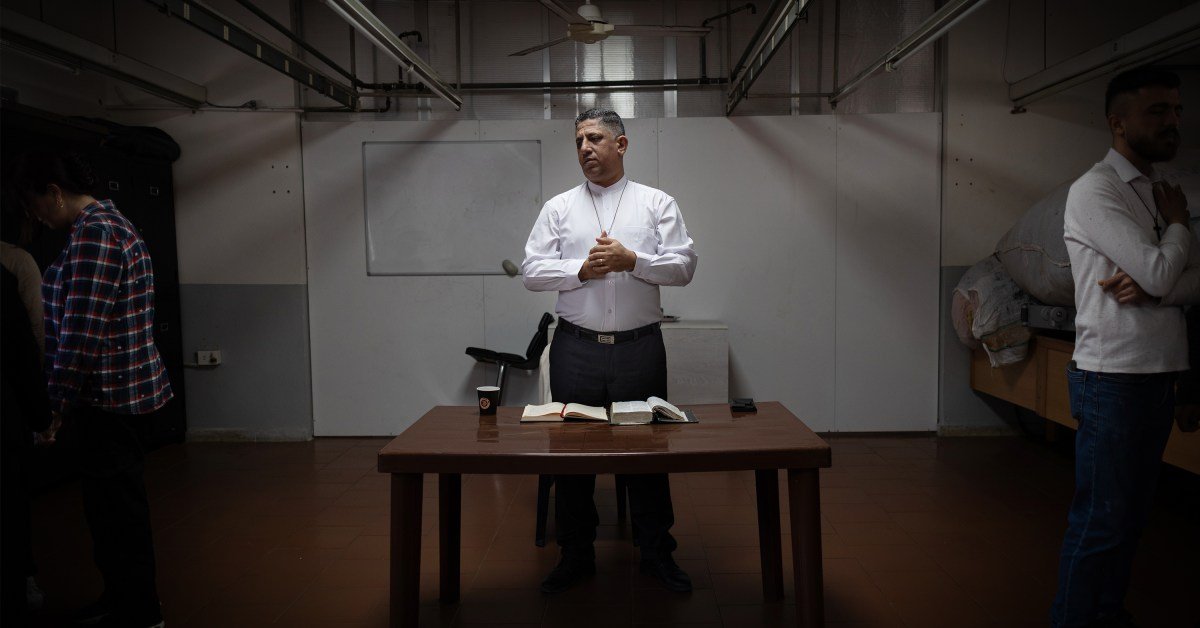
Earlier this summer, Nehad Hasan decided to travel from his home in Lebanon to Syria for a family vacation. He wanted his children to meet extended family and to see their ancestral homeland of Afrin, a Kurdish-majority region in northwest Syria. As the pastor of a Kurdish church in Lebanon, he also wanted to reunite with Kurdish believers who had returned to Syria in recent years.
“The first 15 days were like a honeymoon,” Hasan said. During those two weeks, his family traveled around the country, meeting with friends and relatives and talking about their faith, enjoying Kurdish cuisine, and watching the World Cup.
Then in late July, Hasan and his family embarked on a road trip through Afrin. As Hasan was driving, plainclothes security officers pulled him over. At first, they made vague comments about issues with Hasan’s car. But after they took him in for questioning, Hasan learned authorities were accusing him of multiple crimes, including apostasy and incitement of religious hatred.
Hasan was surprised. He didn’t understand why authorities were arresting him then, as he had made two prior trips to Syria since the new Sunni leadership had taken over the country.
Within days, news of Hasan’s arrest reached churches and Christian groups throughout the Middle East, raising questions about freedom of religion in post-Assad Syria. For many, it was evidence of the government turning its back on its commitment to build a pluralistic country that respects and protects the rights of minorities.
“I didn’t imagine that they would take me for these reasons,” Hasan said.
After a coalition of Islamist rebel forces overthrew President Bashar al-Assad’s regime in December 2024, interim president Ahmed al-Sharaa and his government started to rebuild a country devastated by nearly 14 years of civil war.
In a bid to win international support and legitimacy, al-Sharaa’s government cracked down on Hezbollah’s weapon-smuggling networks, joined the US-led international coalition against the Islamic State group (ISIS), and vowed that Syrian territory would not be used as a launching pad for attacks against Israel.
The new government also promised to form a pluralistic and inclusive country that respects and protects the rights of Syria’s religious and ethnic groups, which include Christians, Sunni and Shia Muslims, Druze, Alawites, Kurds, and other communities.
Nearly two years into al-Sharaa’s rule, widespread sectarian violence has repeatedly undermined that pledge. Massacres, revenge killings, and extremist attacks have targeted Alawites, Druze, Kurds, Shiites, and Christians. Government forces have committed some of the bloodiest incidents, including last spring’s massacres in Syria’s coastal region—attacks which left more than 1,400 people dead, most of them Alawite civilians.
The government has launched investigations into such incidents and vowed to hold perpetrators accountable, but there has been limited accountability thus far.
In addition, many minorities describe a creeping Islamization across Syria, one that emboldens Sunni extremists. For instance, the 2025 interim constitution stipulates that Islamic jurisprudence serves as the main source for legislation. Since then, one province has banned makeup for female public-sector employees, and authorities have published a now-walked-back decree in Damascus to ban the sale of alcohol.
Others point to the composition of the Syrian government and recent national elections. While the cabinet makeup is representatively proportional to the Sunni majority, no minorities are represented in meaningful security and intelligence roles. Meanwhile, controversial parliamentary elections last year faced scrutiny due to the lack of minority representation in Syria’s postwar legislature.
Sunni populism is growing, says Malik al-Abdeh, managing director of the consultancy group Conflict Mediation Solutions. This populism “revolves around this central idea that Syria is for the Sunnis.”
“This idea doesn’t necessarily collide with the idea that there should be representation of other groups in government,” al-Abdeh continued. But Sunni populism believes “Sunnis should control the coercive arms of the state. And since power flows from the barrel of the gun—at least that’s the case in the Middle East—then Sunni control of the army and the security forces should be accepted by everybody.”
For many minorities in Syria, this sentiment leaves them deeply unsettled and afraid.
Even against this backdrop, Hasan is not sure why he was arrested in July. After his initial detainment, police took him to Jinderis, a town near the Syria-Turkey border, where they informed him he was wanted. Hasan said police then brought him to the district capital of Afrin, a city roughly 12 miles east. The first prison to which they took Hasan rejected him because he was a convert, so police took him to another in Afrin.
There, he faced questioning for a 2021 television interview in which he spoke about converting from Islam to Christianity in 2008, as well as for social media posts that authorities saw as insulting to Islam and the prophet Muhammad.
Hasan said police then brought him to a third prison in Afrin and had him stand before a judge, who informed him he was charged with violating Syria’s laws on cybercrime, specifically pertaining to insulting religion and inciting religious hatred or violence.
Since al-Sharaa came to power, authorities have used these laws broadly to attack freedom of speech, leading to arbitrary arrests, according to rights groups. The cybercrime law, which came into effect in 2022 under Assad, has faced particularly fierce scrutiny.
“The problem in Syria is that the laws are very elastic and open to interpretation, especially the laws that pertain to online hate crimes,” said al-Abdeh. He added that the law gives the state the right to spy on people and requires internet providers to store users’ traffic data and provide it to authorities upon request.
Furthermore, the law allows Syrian authorities to crack down on activities they see as targeting the constitution; insulting public officials, state institutions, and religion; or harming national prestige, morale, and financial standing. “It’s also very open to interpretation, and many people have been arrested based on this crime for things having nothing to do with religion,” al-Abdeh added.
In June, Syria’s Justice Ministry announced it would form legal and technical committees to review the cybercrime law and others. Following the review, the ministry ordered limitations around implementation of the law, including a prohibition on pretrial detentions unless warranted by exceptional circumstances.
In July, however, Amnesty International declared the measures not enough. In a statement, it called on Syrian authorities to amend the law, noting its use to restrict freedom of expression.
The charges against Hasan baffled him. He believed the posts were taken out of context and he noted that one of the posts levied against him wasn’t even his.
“There are many positive posts I’ve written or published” focused on things like humanitarian relief efforts in Syria, Hasan said. “But they didn’t focus on those. This is how I realized they only wanted to detain me.”
As Hasan’s case unfolded, his wife, Silva, who stayed in Syria after he was detained, informed others of what had happened. As the news spread, she received messages from a non-Syrian number telling her Hasan needed to sign a paper pledging not to return to Syria. The couple does not know who sent the messages.
Meanwhile, churches and Christian organizations around the Middle East and in the rest of the world prayed for Hasan’s release.
 Photo by Hunter Williamson
“This is the first time the church and the world unites because of a Kurdish man from a Muslim background,” he said half-jokingly. While Hasan’s case wasn’t the first of its kind, the church unity that it stirred touched him deeply.
Among those praying were Jaman Ahmed and members of his home church in Kobani, a Kurdish-majority city in northern Syria. To him and others in the church, Hasan’s arrest seemed like the latest blow to religious and political freedom under the transitional government.
“After the Assad regime, there’s no freedom—not just religious freedom but even freedom of speech,” he said. “Freedom, even in politics, is gone.”
Distrust of the government remains high in Kobani, especially after fighting earlier this year between government forces and Kurdish militias that led to the collapse of a Kurdish-led autonomous enclave in north and northeast Syria.
During the peak of the fighting at the start of 2026, the church in Kobani found itself caught in the crossfire, facing a dire humanitarian crisis as food, water, and medicine ran low and the internet and electricity were cut.
The Syrian government and Kurdish officials ultimately reached a cease-fire agreement that outlined a pathway toward integrating the autonomous region into the Syria state. Al-Sharaa also signed a presidential decree affording Kurds long-sought citizenship, language, and cultural rights that were denied to them under Assad.
Yet sectarian tensions still persist between Kurds and surrounding Sunni Arab communities. Earlier this month, protests erupted across northeast Syria after members of a Sunni Arab tribe reportedly murdered a Kurdish man. The tension sparked prison riots in Kobani, which led to a fire that reportedly killed several inmates and injured more than a dozen others.
 Photo by Hunter Williamson
Over the summer, Ahmed and his son, Maxim, attended a local meeting headed by the Kobani district director, Ibrahim Muslim, who assumed the position earlier this year as part of the region’s integration into the Syrian state.
During the meeting, the father and son expressed their concerns regarding safety and security: “My son said that we’re afraid that someone from other sides might come and blow up a church.”
Muslim and the officials with him urged them not to be afraid and said they were “ensuring safety for all sects, including Christians,” Ahmed said.
Ahmed and his son remain skeptical of the government, but they are particularly worried about non-state actors. They believe the government is unable to protect them from Sunni extremists who feel emboldened in the post-Assad era.
Such fears are not unfounded. Last summer, a relatively obscure Sunni extremist group called Saraya Ansar al-Sunnah claimed responsibility for a suicide bombing at a Greek Orthodox church in Damascus that killed more than 20 people and wounded dozens of others. Several months later, the group carried out a similar attack on a Shia Muslim mosque in Homs that left eight people dead.
Al-Abdeh said extremist groups aim to use such attacks to undermine and discredit the government. To a degree, it seems to have worked. The attacks have led many minorities to question whether the government is able or even willing to protect them.
“Everything that has happened shows that this government isn’t serious,” Ahmed said. “All the Islamist groups have stepped up and are freely oppressing the entire population.”
Hasan agrees. In early August, after two weeks of detention, officials dropped the charges and released him. After he reunited with Silva, she received a call from the unknown number that had previously messaged her.
“Why isn’t your husband signing the pledge?” the caller asked.
“He got out without signing the pledge,” she replied.
After the family returned to Lebanon a few days later, Hasan spoke about his arrest on a local Christian television station. He then received a message as well, this time from a different number.
“Didn’t you pledge that you would not talk about Christ?” the person wrote.
“What pledge do you mean?” he asked, adding that he’d like to see a copy of it. Then the number blocked him.
Such threats have not deterred Hasan. He plans to return to Syria. As far as the government goes, he believes he’s in the clear. Shortly after his release, an intelligence officer encouraged him to return, telling him to “open five churches, not just one.”
“You can feel that the official stance of the government is different from that of certain individuals on the ground who are trying to impose their will,” Hasan said.


