
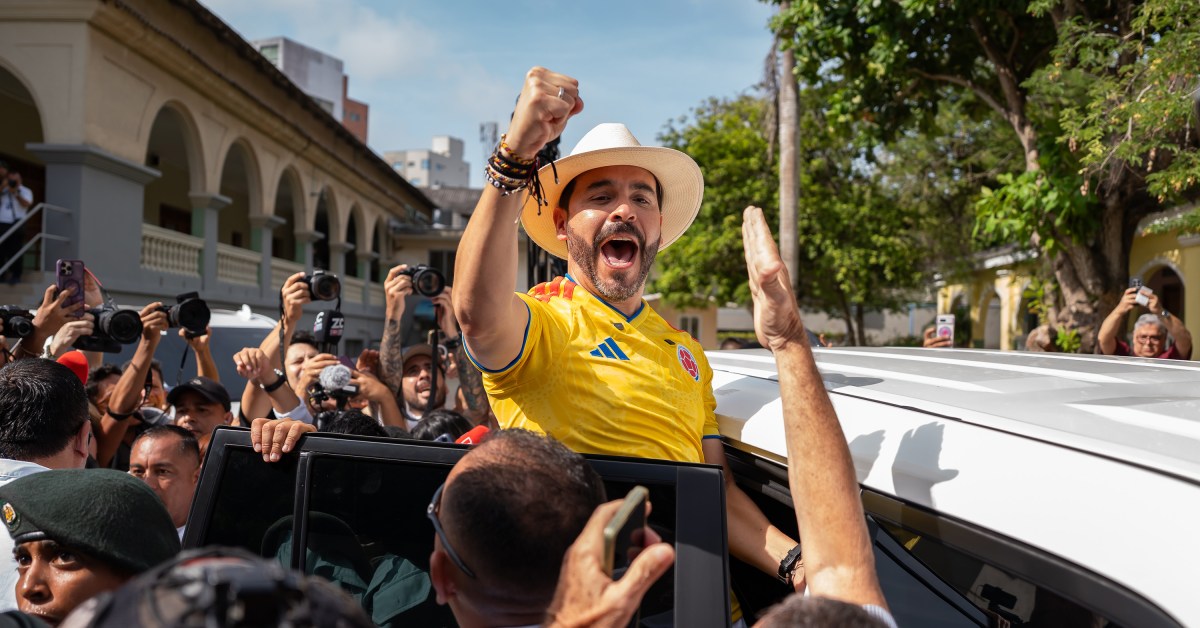
When María Margarita Giraldo heard right-wing political outsider Abelardo de la Espriella was poised to win Colombia’s presidential election Sunday, she felt relieved.
To Giraldo, a 76-year-old actress from Bogotá, Colombia, who gave her life to Jesus 35 years ago, De la Espriella’s victory represents a turning away from socialism, which she blamed as the cause of poverty in Latin American countries like Venezuela.
At first, she was unsure about De la Espriella, as she felt the millionaire businessman appeared arrogant. The candidate, who has no political experience and no political party backing, has been compared to El Salvador’s Nayib Bukele, with his ironfisted approach to crime and his similar goatee, and has secured the endorsement of US president Donald Trump.
Yet after he chose Minister of Finance José Manuel Restrepo as his vice president, Giraldo “became convinced that [De la Espriella] was someone who would surround himself with capable people.” A Colombian economist, Restrepo is known for his managerial approach in the public and private sectors and had previously been minister of trade, industry, and tourism.
“I voted with conviction and conscience for the proposals that I believe would revive the economy, address the immense debt left by Gustavo Petro’s failed government, and improve security,” Giraldo said. “We must take a firm hand, without a doubt, against the narco-guerrillas who have seized control of half the country.”
De la Espriella’s win marks Colombia’s shift to the right after four years of President Gustavo Petro, the country’s first leftist leader. Under Petro, cocaine production grew as he promoted a policy of payment for voluntary eradication and crop substitution, instead of more radical methods. The expansion of the illicit cocaine industry strengthened criminal groups in the jungle regions and increased kidnappings, massacres, extortions, and murders. Just three days before the runoff of voting, fighting between armed groups led to a drone bombing of an evangelical church—a bombing that injured six people and killed a 10-year-old boy.
In the first round of the election on May 31, De la Espriella won 44 percent of the vote, followed by left-wing candidate Iván Cepeda, who won 41 percent. Because neither reached the 50 percent threshold, the two squared off on Sunday’s runoff, where De la Espriella is headed to a razor-thin victory with 49.7 percent (almost 13 million votes) of the vote compared to Cepeda’s 48.7 percent, with more than 99 percent of votes counted.
Evangelicals in Colombia, who make up 16 percent of the population, are divided in their support of De la Espriella. Although there is no data on the percentage of evangelicals who voted for him, his campaign has rallied the support of some Colombian megachurches and evangelical political groups. César Caballero, CEO of the polling firm Cifras y Conceptos, estimates that a majority of evangelical voters supported De la Espriella. Many were drawn to his promise of security, his embrace of conservative values, and his conversion to Catholicism.
Yet others—especially younger evangelicals—voted for Cepeda due to his proposals to negotiate peace with armed groups, his defense of the environment, and his support for historically excluded populations like Indigenous groups and Afro-Colombians.
“Clearly, it would be misleading to think that all non-Catholic Christians vote the same way,” Caballero said. “There are people on the left, center, and right within churches. Many are uncomfortable when their pastors talk about politics. These are people who vote according to their own conscience.”
De la Espriella, a 47-year-old former Miami-based criminal defense attorney and businessman, made a name for himself representing several of the country’s most notorious criminals, including Colombian businessman Alex Saab (a close associate of former Venezuelan president Nicolás Maduro) and a pastor accused of sexually abusing 27 women. The pastor was ultimately acquitted by the courts.
Formerly an atheist, De la Espriella said he converted to Catholicism five years ago after his devout aunt died of COVID-19 during the pandemic. Her death plunged him into a severe depression that left him unable to speak for 12 days. Yet during her funeral Mass, he said he experienced a peace unlike anything he had ever felt before.
“As an atheist, I did not believe in anything that reason could not explain,” he recalled in a radio interview. “But as I listened to the priest’s words, I began to feel a calmness and a special connection that I never wanted to lose.”
Some evangelicals feel aligned with De la Espriella’s conservative views on traditional marriage, pro-life issues, and Israel, especially as Colombia has some of the most progressive laws in Latin America. The government allows abortions up to 24 weeks, legalized same-sex marriage a decade ago, and has allowed same-sex couples to adopt for even longer.
De la Espriella promised to respect these Constitutional Court rulings, but he said one of his first actions upon taking office will be to abolish the Ministry of Equality, created by the former administration to protect the rights of LGBTQ individuals, women, ethnic minorities, and people with disabilities. They also expect him to restore diplomatic relations with Israel and move the Colombian Embassy in that country to Jerusalem.
Yet not all evangelicals are on board.
One of them is Yajaira Bermúdez, a 36-year-old psychologist who works at a Christian school in Cota, a town about 11 miles outside Bogotá. She said Cepeda’s view of social justice resonated with her worldview. “The proposals that caught my attention the most were those that relate to peace building, human dignity, reducing inequalities, and attending to historically vulnerable populations,” said Bermúdez. “I believe we are privileged to live in such a biodiverse country with such extraordinary natural wealth. We have a moral or ethical responsibility to protect it.”
Fracking was a central issue in the presidential campaign. Cepeda promised to continue the previous administration’s energy transition policy, which prohibits the exploration of new hydrocarbon deposits. Meanwhile, De la Espriella stated that his new administration would do “responsible fracking as much as it takes.”
Sebastián Pascagaza, a 34-year-old musician and leader of a Christian rock band, said Cepeda’s advocacy for the environment and the poor also won his vote. “My focus isn’t on individuals, but on government plans,” Pascagaza said, noting that while Petro failed to deliver on many of his promises, “I still believe in the project… which is to pursue renewable energy, empower rural communities, boost agricultural exports… and treat our land better.” He added that the plan includes crop exchanges, purchasing land to give to small farmers, reaching out to remote areas, as well as striving for justice, mercy, and peace. “I consider that to be a Christian goal.”
The election results have also revealed generational, geographical, and socioeconomic divides in Colombian society. While 60 percent of people between 18 and 25 years of age voted for Cepeda, 79 percent of those 61 and older voted for De la Espriella. At the same time, the right-wing candidate won in the major cities of the country’s central region, while the ruling party’s candidate won in the outlying and jungle regions. In cities like Bogotá, the poor neighborhoods in the south voted for Cepeda, while the rich in the north voted for De la Espriella. These demographic differences were also evident within the churches, Caballero said.
Caballero noted that while evangelicals have the same voting rate as the larger population—about 60 percent—many members of politically engaged megachurches, such as Iglesia de Dios Ministerial de Jesucristo Internacional, Misión Carismática Internacional, and Centro Mundial de Avivamiento, come out to vote for the candidates their pastors endorse.
De la Espriella spoke at the pulpit in megachurches such as Centro Mundial de Avivamiento in Bogotá and Iglesia Ríos de Vida in Cartagena, where pastor Miguel Arrázola declared the candidate was “the Cyrus Colombia needs,” a reference to Isaiah 45.
Colombia has two evangelical political parties: Colombia Justa Libres and the Movimiento Independiente de Renovación Absoluta (MIRA), the latter affiliated with the megachurch Iglesia de Dios Ministerial de Jesucristo Internacional. Both parties endorsed De la Espriella’s campaign ahead of the June 21 runoff.
“One could say that non-Catholic Christians who actually vote represent about 1 million people in the country today,” Caballero said. This is significant, as De la Espriella won by about 250,000 votes in the runoff. Meanwhile, a recent Pew Research Center study found that 63 percent of Colombians cared about whether their president was a person of faith. Petro is a non-practicing Catholic, and Cepeda has been private about his personal life and has not declared himself a practitioner of any religion.
During the presidential campaign, a majority of national Christian leaders chose to remain neutral and did not openly endorse any candidate. The Evangelical Confederation of Colombia (CEDECOL) called for a bipartisan nationwide prayer initiative during the seven days leading up to the runoff election.
However, CEDECOL’s president, pastor Lydia Arias, has repeatedly criticized the outgoing government’s progressive policies during debates streamed on YouTube.
“We need to wake up,” she said. “Christianity and socialism are incompatible. Some are trying to use the figure of Jesus for political purposes. That is ideological hijacking.”
For the first time in the history of Colombian presidential elections, artificial intelligence played a central role. Supporters of both candidates used generative AI tools to create content manipulating the image of Jesus Christ and to portray him as approving of their preferred candidate.
Meanwhile, well-known Christian music artists such as Alex Campos and Daniela Galeano also voiced their support of De la Espriella through social media videos explaining why they believe voting for the right-wing candidate was the option most consistent with the Bible.
“At one point I used to think… ‘I’m not interested in politics,’” said Campos, one of Colombia’s most popular Christian singers. But given the current situation in Colombia, “I encourage everyone who is able, to go out and vote—and not just cast a blank ballot… I believe your vote will make a difference.”
Other Christian influencers like Tomás Castaño Marulanda (better known by his Instagram handle, @TeoCotidiana) criticized pastors for allowing politicians to visit their churches during the election campaign. Meanwhile Paula Barbosa (@PaulaDeFrente) openly supported Cepeda, portraying him as a defender of historically marginalized minorities.
De la Espriella’s rise came in response to the assassination of right-wing candidate Miguel Uribe Turbay, who was shot as he delivered a speech on the streets of Bogotá last August. Police believe the Segunda Marquetalia—a group linked to the Revolutionary Armed Forces of Colombia guerillas—was behind the killing. The group had strengthened its revenue through drug trafficking and illegal mining during the Petro administration, which offered protection to its leaders in exchange for participation in peace negotiations.
Following Turbay’s death, De la Espriella moved quickly to fill the vacuum among right-wing candidates. He launched his campaign at a massive event in a Bogotá arena. In a gesture aimed at evangelical voters, he played a recording of himself singing a Christian adaptation of “Hallelujah” by Leonard Cohen.
Cepeda also sought support from religious groups during the final stretch of his campaign. Two weeks before the first round, he organized an interfaith forum at the Colegio Americano de Bogotá, the city’s oldest Protestant educational institution, where he promised to defend religious freedom if elected president. Representatives from Muslim, Jewish, evangelical, and Indigenous communities participated.
And just two days before the runoff, he held an event in the city of Barranquilla, where representatives from 750 churches in the north of the country announced their support for his candidacy, prayed for him, and gave him a Bible. “Colombia urgently needs to reconcile with itself,” Cepeda said during his speech. “We are brothers and sisters; we share a common origin. I dream of a country where protecting the social fabric is a priority.”
Nevertheless, the outgoing government had lost credibility among many evangelicals due to the appointment of Alfredo Saade as Petro’s chief of staff and later as Colombia’s ambassador to Brazil. Saade, who presented himself as a pastor, initially gained considerable support among Christian communities in Colombia’s Caribbean region during the 2022 election cycle. However, CEDECOL withdrew its support after determining that he had no pastoral training and did not lead any Christian congregation.
Evangelicals also bristled at the appointment of Richard Gamboa Ben-Eleazar, a self-proclaimed anti-Zionist rabbi whose credentials were widely questioned, as the director of the Office of Religious Affairs.
From her apartment in Bogotá, actress Giraldo said that amid the electoral uncertainty, she found peace in 2 Thessalonians 3:2–3: “And pray that we may be delivered from wicked and evil people, for not everyone has faith. But the Lord is faithful, and he will strengthen you and protect you from the evil one.”
She is grateful these elections have finally come to an end, as arguments with fellow actors and church members who hold different political views have caused her a great deal of stress in recent weeks.
“I also say, ‘Lord, you are our God who loves Colombia so much, who has given us incredible riches: two seas, fertile land for producing food,’” she said. “In other words, the central geographical location of Colombia is special. I can’t believe that God would abandon this very special place that he ultimately created.”
