
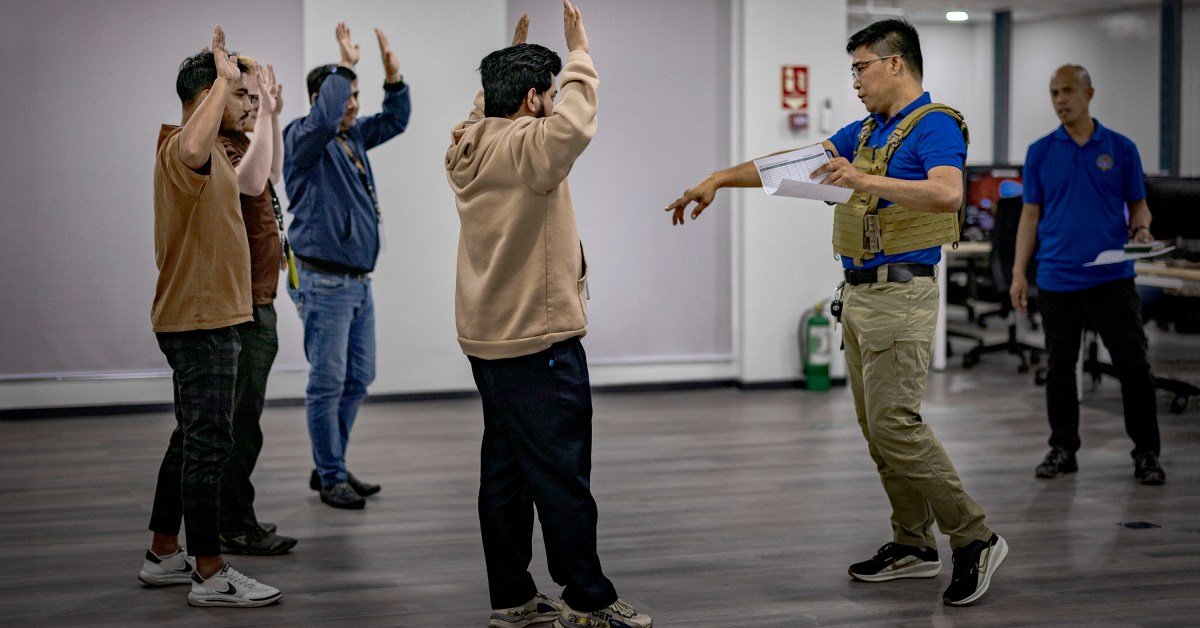
Since Marcus testified against a major scam syndicate in a Manila courtroom in September 2023, the Burmese national has needed to hide his identity and constantly look over his shoulder, fearful that he would be re-enslaved, tortured, or killed.
In May, the Philippine court announced its verdict: The three Chinese leaders who had enslaved him and more than a thousand others received life in prison.
“Initially, I did not know how to describe the feeling [upon hearing the verdict],” Marcus said. CT agreed to give Marcus a pseudonym due to security concerns. “Justice was served, and now that chapter is closed.”
Marcus, who had been imprisoned in a giant facility in the Philippines where overseers forced him to extort money through cyberfraud, played a key role by being one of a few survivors willing to testify in the landmark case.
It’s not the first time the criminals running the centers have faced punishment. In 2023, China captured mafia leaders running scam compounds in Myanmar’s Shan State and executed them this year. Yet this was the first case to be tried without extradition or questionable means of capture.
Since the centers started in 2021, an estimated 300,000 or more people from about 80 countries have been tricked into working in scam centers Southeast Asia. Crime syndicates that previously ran casinos and online gambling in special economic zones in the region started scam compounds in response to COVID-19 lockdowns and travel bans impacting their bottom line. And it became profitable: The Global Anti-Scam Alliance estimates the scams generated more than $1 trillion in 2024 alone.
With governments starting to crack down on these centers, thousands of victims, left in debt and traumatized by torture and coercion, have returned to their home countries only to deal with shame and guilt over the innocent people they had conned.
Marcus is not only fighting for his captors to face justice but also seeking to provide care and healing for other survivors of scam centers. In 2025, he teamed up with another scam center victim to start United Resilience Network with the help of International Justice Mission (IJM). The group seeks to prevent exploitation and support survivors’ recovery.
“As a survivor of forced scamming, I believe restoration support is … essential,” Marcus said. “Rescue alone does not heal the trauma or rebuild the lives that trafficking has shattered.”
For Marcus, it all began in 2022, when he lost his job in Myanmar as the country dealt with the impact of COVID-19 and the 2021 military coup. With a good education and the ability to speak multiple languages fluently, Marcus had been his family’s main provider, helping his elderly mother receive medical care and his younger sister attend school. The pressure felt overwhelming.
So when he saw a job ad on social media for a marketing position at a trading company in Dubai in the United Arab Emirates, he was intrigued. After researching the company online and meeting with a local family who claimed their daughter worked for the organization, Marcus applied. He passed several interviews and soon found himself on a flight to Dubai.
It didn’t take him long for him to realize the job was not what he’d signed up for. His employers confiscated his passport, constantly monitored him and the other workers, and would not allow him to leave the building without an escort. Seven days a week, his employers forced him to work from 6 a.m. to midnight catfishing people online with the goal of scamming tens of thousands of dollars from them.
To evade the label of human trafficking, the Chinese criminal syndicate paid Marcus the promised salary—with a catch. They claimed that because they provided his transportation, housing, food, and toiletries, they could deduct those costs from his paycheck. If he clocked in a minute late, failed to meet their quote, or even took a toilet break, they docked his salary.
After contracting COVID-19, he saw his debts mount due to the days he took off sick, and his overseers sold him to a sister company in the Philippines, sending handlers to fly with him and other workers to the Southeast Asian country.
By 2023, Marcus was convinced he would never get out. Every day, he sat at his desk in the compound where he lived and worked—under constant surveillance—with 1,000 other people in a special economic zone in Pampanga province in Central Luzon, Philippines. Legally, the building was owned by a Philippine Offshore Gaming Operator (POGO) called Sun Valley.
In April of that year, an Indonesian worker attempted to escape and alert his embassy, Marcus recalled. However, the criminal overseers caught him and brought him back to the compound, forcing him into an isolation cell for days without light, food, water, or a proper toilet. Marcus said the criminals didn’t need to beat anyone to get them to behave or work after that—they all feared receiving a similar punishment.
About a month later, authorities from the Indonesian embassy showed up to rescue the Indonesian nationals and arrested one of the Chinese supervisors. But, Marcus recalled, the supervisor returned an hour later, boasting, “Everything can be solved with money.”
What Marcus did not know was that the Philippine National Police and the Philippine Justice Department’s anti-trafficking council had been monitoring the POGOs. They sensed that the compounds were not simply gambling hubs, as many foreigners flowed into these locations and never left.
Gideon Cauton, IJM’s Southeast Asia senior adviser, noted that earlier that year Philippine president Ferdinand “Bong Bong” Marcos Jr. had started a commission against organized crime to crack down on scam operations and POGOs as he became more aware of the situation.
The Indonesian worker’s escape confirmed their suspicions. But the coordinated raid needed to happen before any corrupt locals or officials could tip off the criminals, which would lead them to shut down the scam farm and destroy evidence.
In May, as Marcus sat at his computer, Philippine law enforcement kicked down the doors of his workplace. The room filled with armed military and police, shouting for everyone to get down. Marcus and others dropped to the floor.
The operation eventually cleared the entire compound, with rescuers retrieving the sick first. Marcus and the others awaited questioning for hours. Authorities had to determine who were victims and who led the operation.
After lengthy overnight questioning, authorities identified Marcus as a victim who was willing to cooperate. The head of the national police met with him and gave him photos to identify the scam center’s leaders. A prosecutor met with him and asked if he was willing to testify. He agreed.
“They moved fast after that,” Marcus said. “I was taken to Manila and placed in a shelter.” He spent five months in witness protection there with support from IJM and the anti-trafficking council.
The authorities made sure all his needs were met, helping him get in touch with his family and providing him counseling. For the first few days, he spent his free time sleeping, yet he still feared ending up back in the scam center. He grew restless as he heard very little about his case.
To help Marcus take his mind off of these fears, IJM staff, social workers, and Philippine police officers took him out periodically for karaoke, dinner, or short trips. Even the prosecutors cared for him. Cauton later said that this process was as new to the team as it was to the survivors, as most victims at Sun Valley chose to be repatriated rather than wait indefinitely to testify. Marcus said a strong sense of responsibility kept him on this difficult path: “I felt I had to do it for the other victims,” he said. The weight of his scam work also left him with heavy guilt.
Cauton, an attorney and a former agent with the Philippines National Bureau of Investigation, helped the team build a case from survivor testimonies, digital evidence, and the money trail. The government pursued human trafficking charges rather than the lesser charge of scamming.
Finally, in September Marcus found himself in a Philippine Supreme Court room. He was the first witness to be cross-examined.
“[The scam operators] had a fantastic lawyer,” he said. “They tried to tip the favor against me. At one point they asked me if I had any proof against the accused. After all, there was no physical evidence I took on my phone or person from the scam farm. My response was simple: ‘Me. I am the living proof.’”
After testifying, Marcus was allowed to leave the Philippines. At the time, his family had left Myanmar and had gotten jobs in Thailand, so he joined them there, where he continued to hide his identity. The Philippine government and IJM helped him leave, and IJM continued to check in with him.
“Testifying was my way of turning pain into purpose, and this outcome proves that justice is possible when survivors speak,” Marcus told IJM.
Marcus also decided to help others like him. He joined IJM as a survivor consultant, although he hides his true name and refuses to appear in photos or videos. He met another scam center survivor, Gavesh, a Sri Lankan who was tricked into forced scamming at Myanmar’s KK Park scam center. After getting sold between different compounds, Gavesh agreed to pay a ransom to his captors to escape. When he arrived at the Sri Lankan embassy in Thailand, the officials considered him a criminal. (CT agreed not to use Gavesh’s real name due to security concerns.)
It was only through the help of IJM that Gavesh received official recognition as a victim of forced criminality. IJM helped provided shelter for him as he went through lengthy questioning and paperwork to prove his innocence. Gavesh became the first-ever scam-center survivor from Sri Lanka to be acknowledged as a victim rather than a criminal.
“IJM really cared for me,” he said, adding that the team felt like friends by the end of the victim identification process.
Together, Gavesh and Marcus created the United Resilience Network to empower survivors of forced scamming by amplifying their voices, advocating for justice, raising awareness, and strengthening their support systems after they leave the centers. Through the network, survivors have shared their experiences and insights with government agencies, nonprofits, and the tech companies that scammers use to find their targets. Although the group is still in its early stages, they also work to connect survivors with aftercare support in their home countries.
“[Before], I did not even know places like this existed,” Gavesh said of the scam centers. “If I did, I never would have gone. I want to expose it and let people know.”
IJM also helps churches in countries with a large number of scam survivors, especially in Africa and Asia, learn how to support survivors. The group teaches church leaders what survivors have experienced and how to help them break through the stigma and guilt. IJM also uses church networks to spread the word about forced criminality. For instance, in Indonesia, IJM partners with the Catholic anti-trafficking group Talitha Kum Indonesia, which sends volunteers into vulnerable communities—including areas where traffickers may recruit people—to raise awareness about fake job listings.
Each summer, IJM holds an annual prayer gathering, and this year, the main focus was on forced criminality and online child sexual exploitation. As hundreds of believers prayed for those trapped in scam centers, Cauton noted that the event was an important step in mobilizing the church to get involved in the rescue and restoration of survivors of one of the fastest-growing forms of human trafficking in the world.
“Part of the main calling of the church is to protect the oppressed,” Cauton said. “You have a role in the process. Before, raise awareness and influence to educate. During people’s enslavement, pray and support the groups working on the ground to free them. Afterwards, survivors come out with complex trauma and shame. They need support.”
