
In this series
In this series


“Alcohol use disorder,” to use the formal term, has always existed in America. It’s often hidden among the housed and visible among those on the streets—or half visible, as it was with Barry, a 50-year-old at the Watered Gardens homeless mission I visited on a reporting trip to Missouri.
On a beautiful day when he was young, Barry told me, his mom abandoned him and his three siblings on a playground. From there, a ping-pong foster care childhood began.
As an adult, Barry consumed eight “tall boys” (25-ounce beers) and a pint of whiskey a day. He favored Earthquake High Gravity Lager for its aroma of corn syrup and wet hay, he said, along with its ability to “get you buzzin’ like a chainsaw … like putting your finger between the sprocket and chain on a motorcycle and then having your buddy crank the throttle. You may lose half a finger, but it’s an experience.”
Barry would work for a while and then party until the money ran out. He roamed all over: California, Virginia, North Dakota, Missouri, always “buyin’ a Greyhound ticket to somewhere I’ve never been.” This became the pattern of a lifetime: “Worked for three months, then got thirsty again,” he said. “Went to detox in Joplin, came back and went on a monthlong binge.”
In a bygone era, Barry would have flopped in a single-room-occupancy hotel on a bed separated from his neighbors by a plywood barrier with chicken wire above. But that bottom end of the housing market no longer exists in most of America after mid-century urban renewal projects.
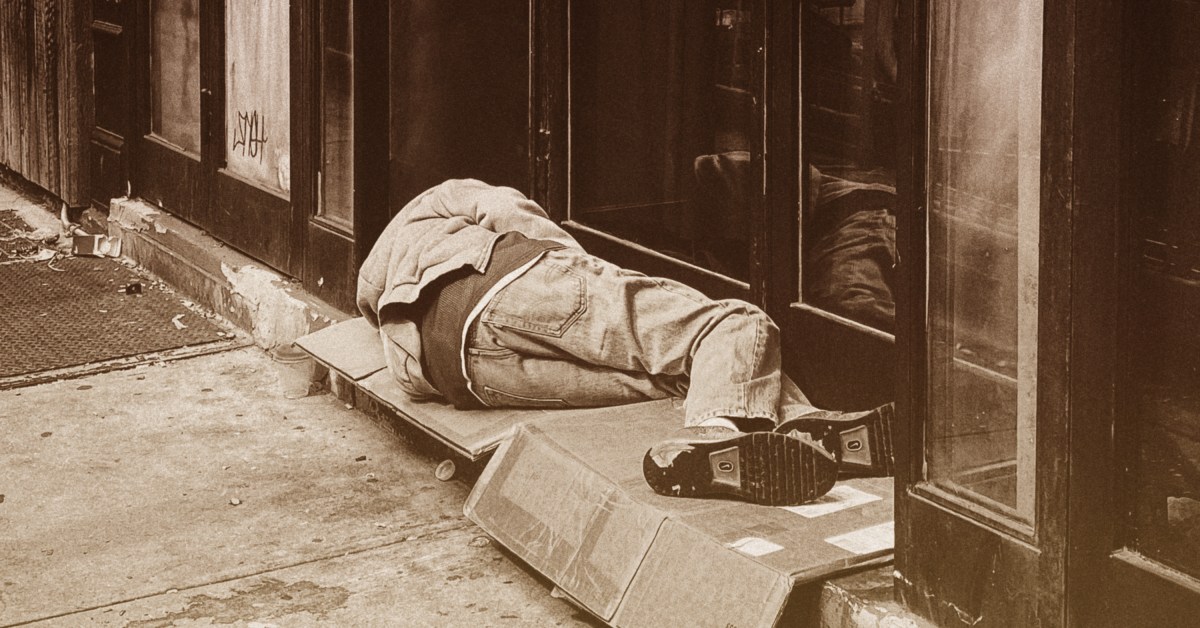
Instead, Barry slept outside or, when seeking luxury accommodations, spent six weeks in a Porta Potty outside a public library: “It was a big one. I could do a twisting stretch-out with the toilet seat and my stuff. It didn’t smell bad. They cleaned it twice a week.”
Experiences like Barry’s—except for the Porta Potty—are not unusual. Many and perhaps most of the chronically homeless (as distinguished from the temporarily in trouble) are alcoholics and/or drug addicts. The problem is two-way: Many with addictions become homeless, but living on the streets is such a hard reality that it leads many without prior addictions to self-medicate or seek temporary oblivion.
The alcoholic homeless were not as visible as they are today until 1971. That’s when implementation of the Uniform Alcoholism and Intoxication Treatment Act began to move alcoholism from the realm of criminal justice—the police and their “drunk tanks,” sometimes cruel but not unusual—to the streets. New state laws decriminalized public drunkenness, so jails could no longer be a default location for sobering up. Cities changed, and not as the act’s architects intended.
Heather Mac Donald has described how in Los Angeles from 1975 to 1985, arrests for public intoxication dropped from 50,000 to 4,000. This was a benefit for perpetrators in some ways—but not others.
As former Skid Row alcoholic Clancy Imislund, who later headed LA’s Midnight Mission, told Mac Donald, before that legal shift, “police picked up street drunks for their own protection.” Then, “the police started leaving them lying there, where gangs took their money and beat the hell out of them.”
In Portland, Oregon, before decriminalization, police arrested those inebriated and put men in a large cell that could hold to 30 or 40 (it could fill up during the city’s Rose Festival) and women, with their typically lower numbers, in a smaller cell.
This mass warehousing was not a good solution, the Portland newspaper Street Roots noted, because “sobering alcoholics can have seizures, vomit, tremors and rapid heart rate—all very dangerous to a person already enfeebled by excessive drinking.”
But the decriminalization era brought new and different problems: Fortified wines like Night Train, Thunderbird, or MD 20/20 were popular and strong, and “unconscious or extremely intoxicated men” who once would’ve been in the drunk tank could instead “littered the streets; in doorways, in lavatories, in public buildings and public parks. … Many ended up in the county morgue.”
This new way of dealing with drunkenness did not demolish the revolving door between homelessness and jail but built a “padd[ed] revolving door” next to it, as researchers Ronald Fagan and Armand Mauss described it. “There is nothing to stop the chronic inebriate from self-referral to the detox center (with its comfortable accommodations and friendly staff) two or three times in a given week,” they wrote. “This round of life can continue indefinitely, at public expense if the client is indigent.”
The dilemma here is similar to what we face when seeking to help homeless people burdened with multiple adverse childhood experiences. Most of us want to be kind without encouraging self-destructive or dangerous behavior. Is it possible to balance those impulses? Or does our wariness of contributing to harm keep us from helping?
Not if we understand the distinction C. S. Lewis made between kindness and love. “There is kindness in Love: but Love and kindness are not coterminous,” he wrote in The Problem of Pain. If “separated from the other elements of Love,” kindness indicates “fundamental indifference to its object, and even something like contempt of it.”
This insufficient kindness “consents very readily to the removal of its object,” because it cares only about relief of suffering, not growth in virtue. “It is for people whom we care nothing about that we demand happiness on any terms: With our friends, our lovers, our children, we are exacting and would rather see them suffer much than be happy in contemptible and estranging modes.”
This kindness is indifference spiffed up into a benevolence tuxedo, but it is love we owe to homeless people as much as anyone else. And, as Lewis wrote, “Love is something more stern and splendid than mere kindness.”
