
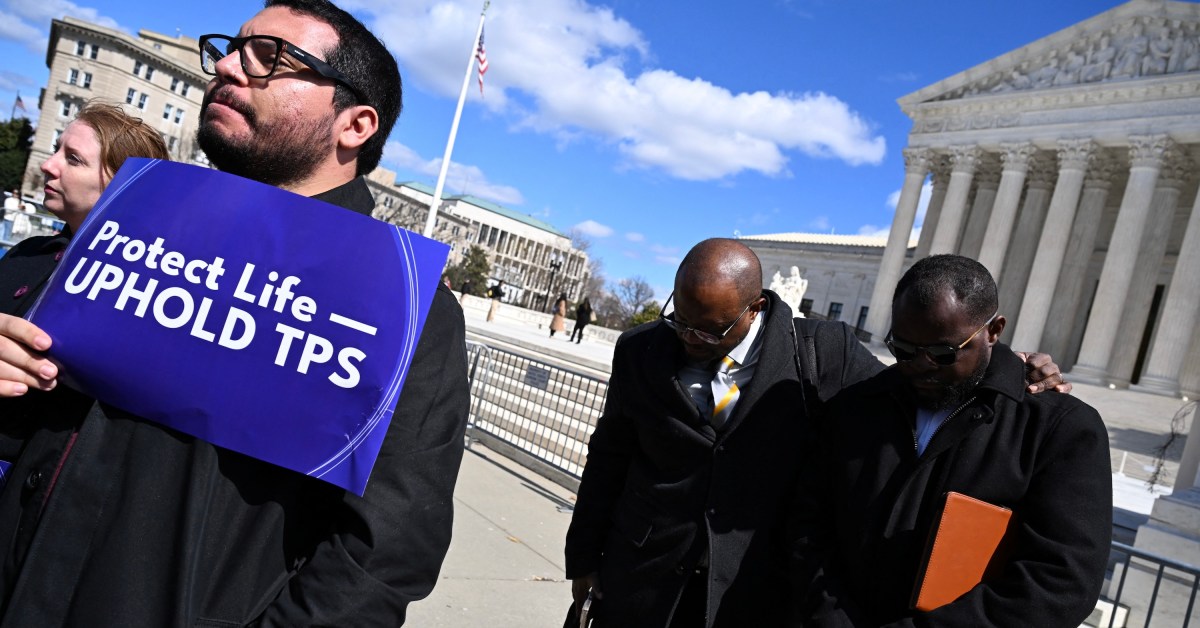
Right now, the State Department’s travel advisories for Haiti and Syria are both at code red: Do not travel. Haiti, the government says, is in a “national state of emergency.” Syria should not be visited “for any reason.”
Despite that, last year the Trump administration tried to terminate Temporary Protected Status (TPS) for immigrants from Haiti and Syria, seeking to strip hundreds of thousands of immigrants of permission to live and work in the United States. Lawsuits blocked the efforts.
But on Thursday, the Supreme Court held that the administration’s decision was not subject to judicial review, giving Homeland Security the green light to deport those who previously were able to work and live legally in the United States.
The news left Haitian and Syrian communities, as well as Christians who have advocated for TPS holders, in shock and dismay. The decision likely also bodes ill for TPS recipients from other countries.
Around 330,000 Haitians reside in the country under TPS. The program allows foreign nationals to remain in the United States if their home countries are deemed unsafe for return due to crises like war or natural disaster. Haitians were first granted the designation in the wake of their country’s horrific earthquake in 2010. The federal government extended TPS for Haitians after subsequent emergencies, including the 2021 assassination of Haiti’s president and endemic gang violence that fueled a further exodus from the Caribbean nation.
Syrians became eligible for TPS in 2012, during a civil war and the brutal regime of Bashar al-Assad. The country has struggled since, and around 3,900 Syrians now face legal uncertainty.
TPS is a designation that must be reevaluated periodically. President Donald Trump, during both his administrations, has sought to end TPS for various groups, igniting multiple legal challenges.
The Supreme Court’s decision will likely affect more than just Haitian and Syrian TPS holders. Last year, there were just under 1.3 million TPS recipients from 17 countries in the United States, according to the nonpartisan Congressional Research Service. So far, Trump has ended TPS for recipients from Venezuela and Honduras. Other countries with protections that will expire soon include Salvadorans and Ukrainians.
Keny Felix, president of the Southern Baptist National Haitian Fellowship, told CT these individuals “face the prospect of being returned home to conditions marked by violence, instability, persecution, and humanitarian crisis, placing countless families at risk.”
Felix’s organization plans to connect churches and ministries with immigration attorneys to host legal forums and walk them through next steps. They also expect churches and nonprofits will see a surge in demand to meet immediate basic needs.
There are around 12,000 Haitians living in Springfield, Ohio, which came under a national spotlight during the 2024 presidential election when Trump and Vice President JD Vance amplified lies about the Haitian population.
In Springfield, Central Christian church pastor Carl Ruby had hoped the Supreme Court might hand down a more favorable decision. “I was shocked that it was a 6–3 decision—and the worst possible outcome,” he told CT.
Ruby’s church is small, but over the last couple years, Haitians have been part of a revival of churches in the community. Last Sunday, Central Christian had 138 people in the pews. Fifty of them were Haitian, with around 30 joining in the last year. Ruby estimates he’s done 20 child dedications in the last year as well. Now, local churches seem likely to shrink.
“This will devastate our church,” he lamented.
It’s unclear how quickly Haitians and Syrians could become vulnerable to deportation. A lower court must now reconsider the case in light of the Supreme Court’s ruling, which could mean protections and work authorization may remain for another few weeks. Or the government might seek to deport people immediately.
Churches like Central Christian anticipate challenging days ahead as their Haitian neighbors face the threat of removal, expiring driver’s licenses, and revoked work permits.
“We’re going to have people needing help with rent; we have people needing help with food,” he said. “We have churches who are committed to providing sanctuary, if that’s needed.” Christians are making plans to accompany Haitians to immigration hearings, which have suddenly become even more fraught, and people were already afraid to go.
On Thursday, the church sent a notice that people could come and pray.
Half an hour after the Supreme Court’s decision, on a Zoom call with reporters, Ruby sat beside Vilès Dorsainvil, a former pastor in Haiti and president of the Haitian Community Help and Support Center. Dorsainvil’s face was grave, his shoulders slumped.
“To me, today was the saddest day since I’ve been here,” said Dorsainvil, who is currently in graduate school and now doesn’t know whether he’ll be allowed to stay and continue his work and studies. “From what I knew about the US, I thought it’s a country where justice and human dignity would always be upheld. … I’ve been really disappointed.”
“There’s a strong commitment in Springfield for the faith community to stand with Haitians who are at risk of deportation,” Ruby said on the press call. “The Scriptures say a lot about this topic, and many of us feel a duty to stand with the Haitians.”
But there are limits to what the community can do.
That evening, Dorsainvil, Ruby, and hundreds of community members gathered outside city hall Tuesday evening in a rally focused on lamentation and solidarity. A couple performed “Amazing Grace” and “America the Beautiful.” Faith leaders took the stage: Two Haitian pastors spoke about the impact to their community and prayed in their native Creole tongue, according to local outlet Springfield News-Sun.
Casey Rollins, executive director of St. Vincent de Paul in Springfield, a Catholic charitable organization, said the community is mourning the decision: “As people of faith, we cannot unsee what is happening in Haiti.”
Rollins worries ramped-up deportations could separate parents and children. “Enforcement and deportation policies must always consider the best interests of each child,” she wrote in a text message. “Please please please, most importantly, we MUST keep minor children out of detainment.”
First Baptist Church of Springfield, led by pastor Adam Banks, is one of more than 20 churches that have rallied in support of Haitians. They’ve held monthly prayer vigils, driven Haitians to immigration hearings, accompanied them to appointments, and contacted politicians.
That work isn’t over, Banks said. He wants Haitians in the community to know “they are not in this by themselves.”
Banks’s church has had Haitian families join and has also seen them leave. Some have voluntarily deported themselves. After hearing about the Supreme Court decision, Banks thought of the African American spiritual “I Shall Not Be Moved.” He hopes the church is “steadfast, committed, really immovable” in its support of its neighbors.
“That includes citizens, that includes TPS folks, folks that have been doing right by the law, and the law has changed time and again on them.”
The Supreme Court’s 6–3 decision held that the courts could not review or enforce the administration’s ability to administer TPS. Writing for the majority, Justice Samuel Alito said the “text is clear” that the federal law creating the program prevented courts from weighing in on the Homeland Security secretary’s TPS decisions.
He also wrote that the Haitian petitioners’ claim that the revocation of their TPS designation was driven by racial animus was “unlikely to succeed.” Despite Trump’s public comments that Haitians are “poisoning the blood” of this country, Alito noted the administration had a “strong, race-neutral” explanation for why it ended Haiti’s termination—namely, that it “simply opposes the TPS program” and has sought to end protections for other groups as well.
Alito noted lawyers’ argument that a judicial bar on reviewing TPS decisions could allow for “shocking abuses” of the program, but said it is up to Congress, not the courts, to “stop that abuse.”
In a last-minute filing earlier this month, lawyers for Haitians had also raised concerns about newly released government emails that suggested Homeland Security terminated TPS without consulting with the State Department, as required by law. The majority wrote, essentially, that courts cannot get into the weeds about what led up to a TPS decision.
In a dissent joined by two other liberal justices, Justice Elena Kagan wrote, “After today, a Secretary can announce to the world that she didn’t consult with anyone—more, that she didn’t evaluate country conditions at all—before making, extending, or terminating a TPS designation. And the courts will be powerless to intervene.”
In a statement, Christian refugee organization World Relief asked the Trump administration to reconsider its redesignation of TPS, and also urged the Senate to pass a bill that would reinstate TPS for Haitians. The House has already approved the bill. It’s unclear whether the Senate will move forward with the legislation, or whether Congress would have a veto-proof majority should it pass both chambers.
Matthew Soerens, vice president of advocacy and policy for World Relief, said in the statement deporting Haitians would also lead to family separations, with parents having to make an “awful choice” of whether to leave US-born children behind or relocate with them.
Legal experts said that former TPS holders may be able to try other paths, such as requesting asylum, but that those paths have significantly narrowed under the Trump administration’s hard-line approach to immigration.
“The reality is, in addition to cutting off programs like Temporary Protected Status, the Trump administration has really made it almost impossible to receive asylum,” said Katie Kersh, managing attorney of Advocates for Basic Legal Equality in Dayton, Ohio. “The clients that we see, the people we talk to in the community, they have followed the law, but the law has abandoned them. They came here on a parole program, they applied for TPS, they applied for asylum, and now the administration is taking those long-held safeguards away from them and leaving them with nothing.”
Kersh’s nonprofit provides free legal services to low-income individuals. It has hosted free clinics to help Haitians determine whether to apply for asylum, which some of them have done. She expects more will do so in the coming days. But it may not avail much relief.
“It needs to be understood that there is not simply some other path for them to follow,” Kersh said, “and we are at a tremendous risk of seeing mass enforcement in Springfield.”
