
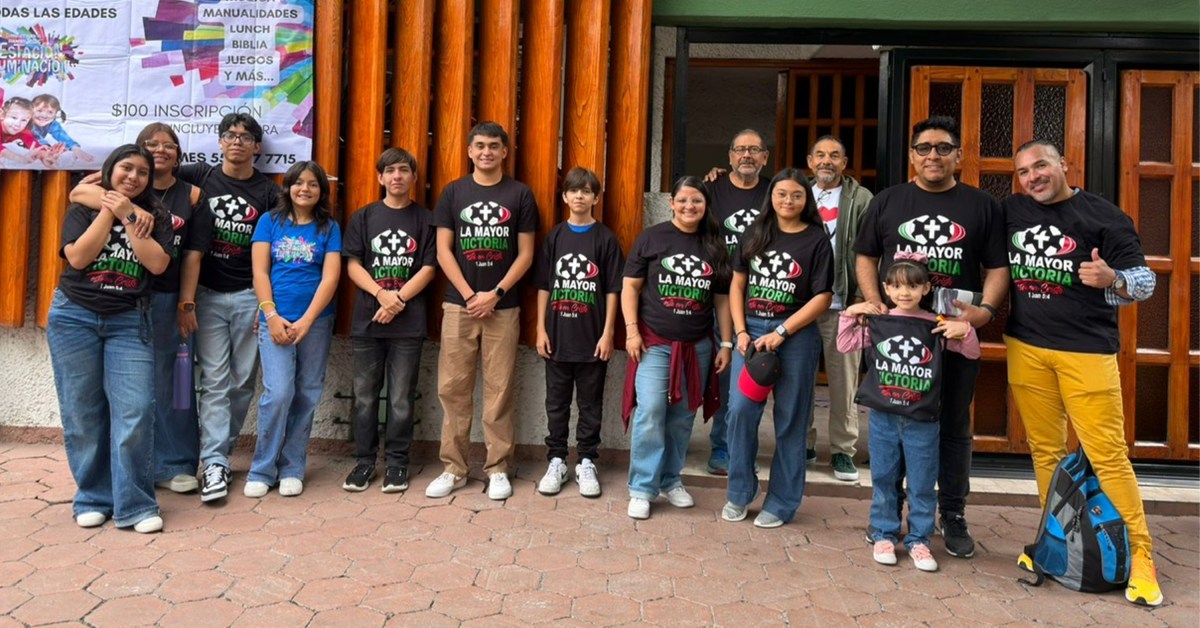
As Mexican midfielder Brian Gutiérrez kicked off the opening match of the 2026 FIFA World Cup on June 11, the 100 people at the Iglesia Bautista Estrella de Belén in Mexico City erupted with applause and cheers. For the first time in its 66 years, the church gathered to watch a sporting event: In a country that nearly worships soccer, it was a watch party combined with a gospel outreach.
The match highlight wasn’t the final score—although local fans clearly appreciated Mexico’s 2–0 victory over South Africa in Aztec Stadium, six miles south of the church. The climax came at halftime.
“Something very interesting happens in the locker room at halftime,” pastor Israel Amaro preached during the 15-minute break. “The coaches make adjustments, analyze the mistakes, and motivate the players. They know that if they don’t make those adjustments, they won’t achieve victory.”
“And the Bible teaches us that it is also a halftime for us—that is, it’s a time when we can make adjustments in our lives to achieve the greatest victory, one that goes far beyond winning a game.” That, the pastor said, demands changes in people’s vision, confidence, and direction: toward Jesus. “The World Cup has a champion every four years, but salvation in Christ is a victory that lasts forever.”
The world’s biggest sporting event will likely draw an estimated 6 billion viewers, and FIFA and the World Trade Organization expect at least 6.5 million fans to travel to one or more of the 104 World Cup matches in the 16 host cities. Some see in these fanatics an opportunity to profit, but local churches are uniting to find a mission field—especially in Latin America, where devotion to soccer is almost religious.
Mexico, as one of the three North American host countries, will hold 13 matches in Mexico City, Guadalajara, and Monterrey. The nation is the first to host the tournament three times, and many Christians there don’t want to waste the opportunity to evangelize.
Local churches are adopting a wide variety of resources and strategies. The Bible Society of Mexico, for example, has produced leaflets with the World Cup game schedule on one side and a gospel tract with key verses on the other.
Texas Baptists established with Mexican churches the Yellow Card Initiative: Volunteers distribute yellow cards—resembling those referees use to warn athletes against unfair plays—with a QR code. When a recipient scans the code with a smartphone, a website with a video pops up. “This yellow card is God’s warning,” the video, available in 14 languages, tells the viewer. “That’s what sin is: breaking the rules of the God who made you.”
And Texas-based ministry EvanTell handed out 260,000 evangelistic leaflets in Mexico, around 60,000 in Central American countries, and 15,000 in Brazil, in partnership with local churches and denominational groups. Around 60,000 people participated in its online training to learn how to approach soccer fans.
“It’s something incredible, what God is doing,” said Edwin Pérez, EvanTell director for Latin America. “What better opportunity than this World Cup, given by God, to tell the world that, in addition to the excitement and euphoria that football can bring, there is also eternal hope?”
With the motto un gol, una meta (“one goal, one objective”), the evangelistic campaign aims to use the World Cup to unite churches and encourage people to present the gospel with clarity and simplicity.
Christians have converged on streets and in parks to evangelize in the weeks preceding the games, and they have brought the gospel to crowds of soccer enthusiasts during the matches outside stadiums and at FIFA-organized fan fests in host cities.
In Mexico City, Iglesia Bautista Estrella de Belén has been preparing for this moment for months. Its members went out several times to distribute tracts around the city with the theme La Mayor Victoria (The Greatest Victory).
On June 6, church members went to Parque de los Venados, a recreational area two blocks from the church. They played soccer with neighborhood teenagers and held a “keepy uppy” ball-juggling contest, with small prizes for the winners.
“At first, they were reluctant, didn’t want to get too close,” Amaro said. “But soccer helps us connect with people who wouldn’t accept any other approach.”
For the opening game, the church urged members to invite friends and relatives who did not know Christ. Those who came found a multipurpose hall decorated with the flags of different countries; balloons shaped like soccer balls; and two big tables with sodas, french fries, hot dogs, and peanuts. Up front were three big screens tuned in to the match and a Trionda, the official match ball of the Cup, atop a stand. “People will not leave this place without hearing the Word,” Amaro said.
Although watch parties are a big part of churches’ World Cup evangelistic strategies, Amaro resists relying on them alone, even for all the Mexico matches. “The other games are in the afternoon or evening at times when people are working or studying,” he noted.
Even so, he and other church members will continue to follow the World Cup and produce related social media content, such as soccer-themed TikTok evangelistic videos.
In one of Amaro’s videos, he stands with a soccer ball in his hands, with some of the ball’s panels painted yellow, black, red, and green. The colors align with those used in The Wordless Book, a picture book dating back to evangelist Charles Spurgeon in the 1860s and using a color code to present the gospel to children.
Amaro said those videos, the evangelistic outings, and the sports activities have boosted youth engagement with the church. In addition to attracting new people, the World Cup is strengthening ties within the local church.
“This fills me with hope for a new generation of believers, more contextualized and committed,” he said.
