
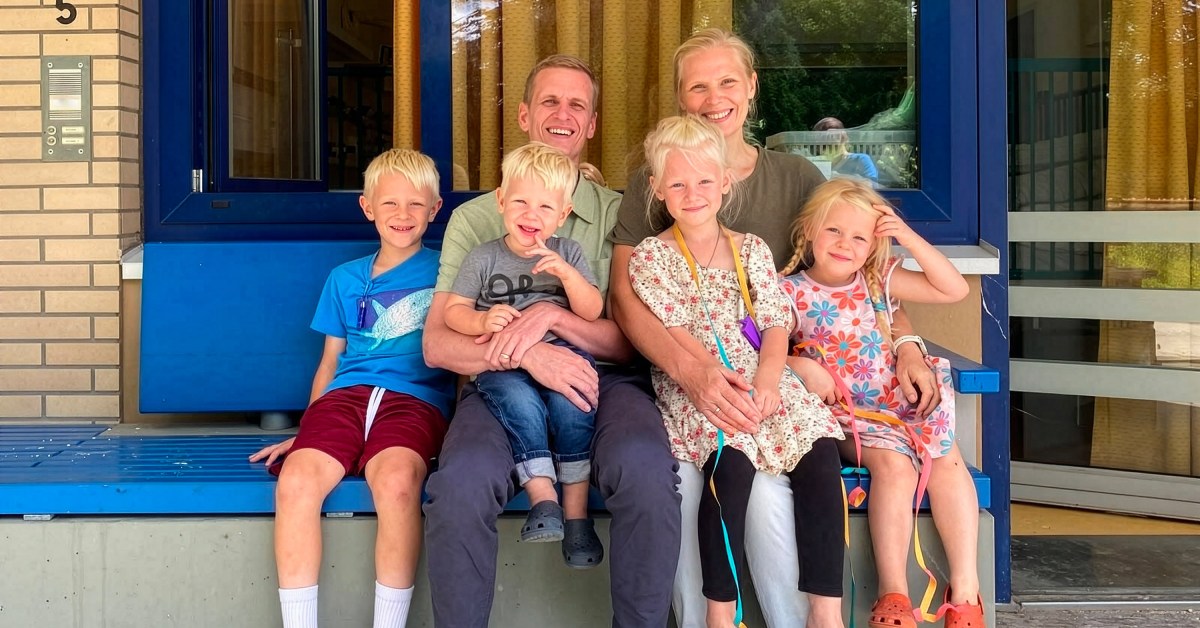
Much of the world knows Peter Stafford as the missionary doctor who contracted Ebola during the most recent outbreak in the Democratic Republic of the Congo. But in his home village of Nyankunde, he sometimes goes by a different name.
“They call me ‘Father of Luke,’” Stafford told CT. “Papa de Luke.”
Luke is Stafford’s 7-year-old son, a popular kid who plays in a local soccer league and has three younger siblings and many friends in Nyankunde, a town in eastern Congo near Uganda where the Staffords have lived since 2021, after being deployed there by their mission agency, Serge. A school photo shows Luke as the sole white boy in a large group of Congolese children.
 Peter Stafford
Luke’s parents, Peter, 39, and Rebekah, 38, work as doctors at Nyankunde Hospital—an evangelical hospital affiliated with the Christian Health Service Corps that has a staff of around 100 people. Peter works as a surgeon, specializing in burn treatment; Rebekah is an ob-gyn. They serve Nyankunde’s population of around 13,500 residents, often short on supplies like gloves and masks. Medications for HIV and TB can go unstocked for months. Clean water and electricity, scarce in the village, aren’t always a given even at the hospital.
Despite this, according to the Staffords, Nyankunde Hospital is one of the better-supplied medical facilities in a region where many roads are unpaved and personal automobiles are rare.
Nyankunde also has a troubled history. In 2002, a local massacre fueled by tribal conflict and competition for resources killed more than 1,000 people and destroyed the region’s hospital.
The Staffords see it as a privilege to be in the area as the village has rebuilt, serving people who have experienced much violence and uncertainty. They have no plans to leave, saying God has called them there.
“Congo is our home,” said Rebekah Stafford, who spoke with her husband to CT by Zoom. “We don’t feel like we’re sacrificing by living there, and we both feel at peace there, despite what many people would say were reasons not to live in the Congo.”
But now, the Staffords are more than 7,000 miles from their home, temporarily relocated to the United States as the Ebola virus devastates the DRC and surrounding areas. Since early May, the Centers for Disease Control and Prevention (CDC) has recorded at least 1,048 cases and 267 deaths in the DRC, and 20 cases with 2 confirmed deaths in Uganda, making this the second largest Ebola outbreak on record. The Staffords say the numbers are likely an undercount.
The family cannot travel back for, at a minimum, three months—the CDC is still monitoring Peter Stafford’s recovery, and Serge’s insurance won’t pay for a return flight just yet. And even when they are able to return to eastern Congo, their medical specialties are not useful for combatting a disease like Ebola.
Looking back, Peter said he is simply grateful to have left the country with his life.
“I have that opportunity to tell my family how much I love them, and how thankful I am that I get to be with them for another day,” he said.
Before the outbreak, the Staffords’ days usually revolved around work, a mix of local schools and homeschooling for their children, soccer practice, and making time to be together.
In the weeks leading up to the May 15 announcement of the Ebola outbreak, there were a series of unexplained deaths in the town of Mongbwalu, 35 miles north of Nyankunde.
The Staffords always had plans for the possibility of Ebola. They were vaccinated for the known strains. They had decided that, were there an outbreak, one of them would stay home with the children while the other worked in the hospital.
They never got to put their plan into action.
According to Peter, a patient died at the hospital on May 14 with Ebola-like symptoms but tested negative for the virus in the hospital. Peter said the patient was likely tested for the Zaire strain, which was responsible for a Western Africa outbreak that killed more than 11,000 people from 2013 to 2016. But this year’s outbreak is caused by the rarer Bundibugyo virus.
On May 15, the day Africa Centres for Disease Control and Prevention and the DRC’s Ministry of Health confirmed a new Ebola outbreak, Nyankunde Hospital had a staff meeting to address its response. The next day, Peter Stafford started experiencing symptoms.
“I didn’t feel quite right,” he said. He called a hospital colleague and said, “I might be paranoid with the recent announcement yesterday, but I just feel like I’m a bit off.”
He isolated himself in his bedroom. His symptoms worsened, and on Sunday night the hospital confirmed he had contracted Ebola.
Despite a rooted faith and hope of heaven, Peter was afraid. He had always thought of Christ’s victory over death as a card to trump earthly peril, but when faced with a life-threatening situation, he was disheartened.
“I was scared, and I didn’t handle it necessarily as well as I would have hoped,” he said. “I had hoped that there was still some chance that it was something else, that it was the flu or maybe malaria.”
The Bundibugyo variant of Ebola is less fatal and less virulent than others, but previous outbreaks still had a mortality rate of 25 to 50 percent. Peter recalled a statistic that, since he is in his 30s and otherwise healthy, he had a 65 to 70 percent chance of survival. But the risk of spreading the virus to his family was high.
Rebekah and another colleague, Patrick LaRochelle, were also both exposed to the virus by the patient but were not symptomatic and never tested positive for Ebola.
Peter felt intense fatigue; at times he could not stand up to look out the window. He also had an intense fever but no thermometer to measure it. He felt delusional and could not eat or sleep. He desperately wanted to see his family but did not have the energy to record videos to send them or find some other way of connecting.
“We had just learned with our kids these small little verses. One was, ‘When I am afraid, I put my trust in you’ [Ps. 56:3], and that was just continuously replaying in my mind,” Peter said.
Peter stayed in the bedroom from Saturday to Monday. He said it was hard, only being able to see his family through a window while being unable to recover at all. He told Rebekah that at times he did not know if he could take it anymore, saying he wasn’t in his right mind.
Meanwhile, Rebekah was isolating with the children in the rest of their home, with only hospital staff making their way through the house to deliver things to Peter and check on the rest of the Staffords. Rebekah knew they would be evacuating from Nyankunde soon and began packing up the house.
“I’m thankful for that, because it just gave me something to do,” Rebekah said. “I just went into the kitchen and started doing dishes, and I started sobbing for, I don’t know, a couple hours. God gave me that moment to let it out and express what I needed to express and then be ready to go.”
Their children had mixed reactions to news of the evacuation. The younger siblings, who did not understand the gravity of the situation, were excited to go to the United States and see their cousins. Luke, the oldest, took it the hardest.
“He’s got really good friends,” Peter said. “He really likes his soccer club. And then, when I got sick on top of it, it was hard for him. Multiple times he broke down crying.”
The embassies got to work, driving Peter on Monday night to the nearby city of Bunia, where he could be evacuated from the country. The family was transported to Charité University Hospital in Berlin, where Peter could receive specialized treatment. Peter arrived first, followed two days later by Rebekah and the children, who were monitored by medical professionals.
 Peter Stafford
LaRochelle was taken to a different hospital, in Prague, but showed no symptoms. Before the two parted in Bunia, LaRochelle reminded Peter that even Christ asked for his cup to be taken from him and that there is no shame in fear, weakness, and worry in a dark place.
“That was an encouragement,” Peter said. “I don’t necessarily have to feel ashamed in the weakness that I experienced.”
On the plane, medics gave Peter a monoclonal antibody treatment that made him feel nearly instantly better, according to the Staffords, though his fever and other symptoms lingered. Monoclonal antibodies are synthetic antibodies that prevent viruses from replicating and have proven effective against Ebola in the past.
When Rebekah and the children reunited with Peter in Germany, the kids were able to see their father for the first time since he became sick, albeit through medical tent windows. But the interaction was short-lived; Peter could only stand about 15 seconds before needing to return to his bed.
“It was very sweet but also just a reminder too of how sick he was,” Rebekah said. “But still with a sense of humor. I finally got in bed and he texted me, ‘Well, that didn’t go as planned.’”
Peter said he and his family received remarkable care in Germany. Staff and doctors were exceedingly kind, and he improved so much he almost felt he needed to justify the care he received. He likened their treatment to Genesis 18, where Abraham is unaware he is hosting angels.
On June 6, Charité released Peter and his family symptom-free.
“They were the good Samaritan to us,” Peter said. “We’re not citizens of there, they don’t know us, but they took us in.”
A week later, the Staffords flew to the United States, where they are staying with family. They hope to return to the DRC as soon as they can.
The couple said they have been overwhelmed and humbled by the support of their village and the global community. Doctors risked their lives to check on their family. They have more toys for the children now than they did before the epidemic.
Recently, the family heard from some missionary friends that a 12-year-old boy Peter had operated on in Nyankunde had been praying for him.
“He said, ‘Well, Dr. Peter healed me, so I’m going to pray that God heals Dr. Peter,’” Rebekah said. “His life is hard, and we pray that that little glimpse—or his understanding of who God is and his willingness to pray to God—will continue in his life.”
The Staffords said they are still grieving for the families and communities they have left behind in Nyankunde. Many have no option to evacuate if they get sick and have limited treatment options. Samaritan’s Purse set up the village’s Ebola treatment center at Nyankunde Hospital only recently, the week of June 15.
“I’m incredibly thankful for what I have received and for my health, but there are many, many people very similar to that who aren’t able to get to get that care,” Peter said. “They’re suffering, and there are families that are grieving.”
The Staffords receive constant updates from contacts in DRC. One reported hearing of 30 people dying in one day. Public visibility campaigns tell sick people to go to hospitals, but many fear entering medical sites with other sick patients or dying alone in quarantine.
“I don’t know if I necessarily feel guilt, but I feel sadness that our friends, everyone else, if they get sick, this is what they have,” Peter said. “I think to lament and to be sad for what is occurring there can be a Christian attitude toward it.”
The Staffords also keep in contact with LaRochelle, who was recently reunited with his wife and three children.
The Stafford children are cranky with the time change. They have a lot of perks in the United States, namely playing with their 20 cousins and having ready access to ice cream. While Peter and Rebekah feel an urge to go back, they are also trying not to miss the blessing this reprieve is.
“We don’t want to take these days in the US for granted. We want to soak them up with family. But the pace of life has gotten a lot slower, and I’ve already started discussing how we need to have some projects or something,” Rebekah said.
In the meanwhile, the family is asking Christians to keep the Congolese people in their prayers and to look for opportunities to support medical workers and missionaries, as the Ebola outbreak rapidly accelerates.


