
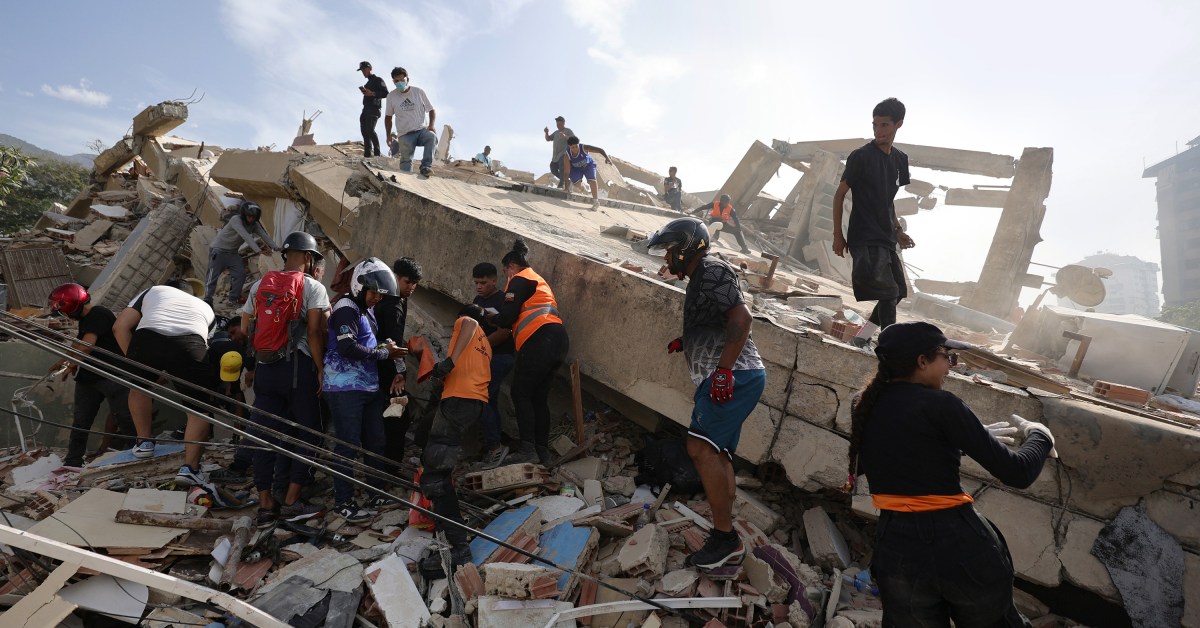
Valentin Aguana, pastor of First Baptist Church of Petare in the metropolitan region of Caracas, was at home Wednesday preparing to leave for a 6:30 p.m. church service when he started hearing strange sounds from above his home.
“It was like someone was walking on the ceiling,” he recalled. It took a second before he realized that an earthquake was shaking the entire building.
As the tremors subsided, Aguana quickly reached out to his church members on a group chat. “Everyone indicated that they were okay, though a bit nervous,” Aguana said. They decided to cancel the service that night, since many members wanted to stay home to prevent looting.
The next day, Aguana inspected the church building and was relieved that it had not sustained structural damage.
Other churches were not so lucky, as two earthquakes, magnitudes 7.2 and 7.5, struck the epicenter of Yaracuy State, west of Caracas, at 6:04 p.m. At least 1,450 people were killed and more than 50,000 remain missing.
The number of casualties may have been amplified by the timing of the earthquake. It happened on a public holiday, Battle of Carabobo Day (which marks a decisive victory that led to the country’s independence from the Spanish empire), and during a World Cup match, so many soccer fans were at home instead of outside.
“I’m on the street right now; we have nowhere to go,” said Carlos Navarro, pastor of Yo Soy Church, a Pentecostal congregation in Maiquetía in the coastal state of La Guaira (formerly Vargas). The city, home to the country’s main airport, was one of the hardest hit by the earthquake.
Yo Soy is a thriving congregation situated on the city’s main avenue, four blocks away from the beach. Three months earlier, the church posted an Instagram reel of a young woman sitting in front of the church alone. In the next scene, she’s surrounded by other people, laughing. “The church is not the building; it is you,” the overlaid text read.
On June 24, Yo Soy’s church building collapsed.
“We believe the Lord is sustaining us, but we ask for prayers,” Navarro said. “Do not abandon us; cover us with prayer.”
The disaster hit a country already in crisis. Since 2013, Venezuela under Nicolás Maduro has faced hyperinflation, political repression, gang violence, and a shortage of food and medicine. Eight million people left the country. The US ousted Maduro in January and took control of the country’s oil industry, yet economic conditions have not improved for many Venezuelans.
Churches and Christian organizations face a daunting challenge as they provide earthquake aid while dealing with the government’s broken relief system. Many Venezuelans felt the government’s response was inadequate, especially during the important early hours of rescue.
The Red Cross estimates that currently 300,000 people need immediate assistance. “We have problems even to buy food here,” said Rafael Ramírez, pastor of Iglesia Bautista La Espada, also in Maiquetía. “We didn’t have much access to medicine already. Now it’s getting worse.”
On Friday, the Baptist National Convention of Venezuela posted on its WhatsApp channel a video appeal from Ana María Coello, director of social services of the Baptist Association of the Caracas region. “If you are interested in sending a donation to our region, we are urgently requesting supplies for intravenous treatment for our hospitals,” she said. Baptist volunteers also asked for medications such as pain relievers, IV fluids, gauze, tape, and syringes.
In the city of La Guaira, two of the three public hospitals had to scale back services as the earthquake damaged their infrastructure. Venezuela already lacked doctors: Between 2014 and 2019, almost half of all doctors left the country, according to the head of the Venezuelan Doctors Federations.
In the Caracas metro area, Parque del Este in the Sucre municipality has emerged as a relief hub. People displaced by the earthquake have set up makeshift tents in the park with little support from the government.
“They are afraid to return to the apartments,” Aguana said. “We are preparing 80 to 100 meals to serve the people closest to us. Other churches will be there as well.”
Accessing La Guaira, the hardest-hit state, is more difficult. Technical teams took three days to clear the roads between Caracas and La Guaira. On Friday night, the Venezuelan government restricted access to La Guaira to official vehicles and volunteers with a special authorization—all civilians seeking to provide aid in La Guaira are required to register at an emergency center set up overnight in a sports arena in Caracas.
“In the most affected areas, there is no good phone coverage, nor is there electricity,” said Klixon Castillo, pastor of Iglesia Bautista Biblica de Valencia. “They need food and clothing. There are food shortages and supermarkets are being looted.”
While the city of Valencia, which is 100 miles west of Caracas, was less affected by the earthquake, members of Castillo’s church lost family members who lived in La Guaira. The church quickly set up a collection center for donations and began serving food to the displaced.
International ministries have also stepped in. World Vision launched a humanitarian response, focused on child protection; psychosocial support; safe shelter; and water, sanitation, and hygiene. On Saturday, Samaritan’s Purse sent a Boeing 767 cargo plane carrying an emergency field hospital—which includes a critical care unit, pharmacy, and laboratory—capable of treating more than 100 people each day.
Samaritan’s Purse will also place volunteer doctors and nurses on standby in churches in the La Guaira area, according to César Mermejo, president of the Evangelical Council of Venezuela. Patients with more serious injuries will be taken to the field hospital for treatment.
The Evangelical Council also intends to buy satellite internet links to improve communications between churches and relief centers to speed up delivery donations. He noted that the organization will transport food and supply 16 soup kitchens.
Ramírez, the Baptist pastor in Maiquetía, was at a summit with 30 other pastors in Caracas when the earthquake hit. When he finally returned home hours later, he found that many buildings in his city had collapsed. His church had been under construction on a recently purchased plot of land, and was spared major damage. On Friday, two days after the quake, they turned the site into a collection center for donations.
On Sunday, the church held a worship service in its usual space—a covered patio with parishioners sitting on white plastic chairs. Wearing a blue polo shirt and sweatpants, Ramírez preached on Psalm 46:1–3 about God being believers’ refuge and strength.
“The earth shook and destroyed what we thought was secure,” Ramírez said. “The Bible does not say the earth will not tremble; it says that when it does, he will be our help. The earth he created is also awaiting its redemption.”
