
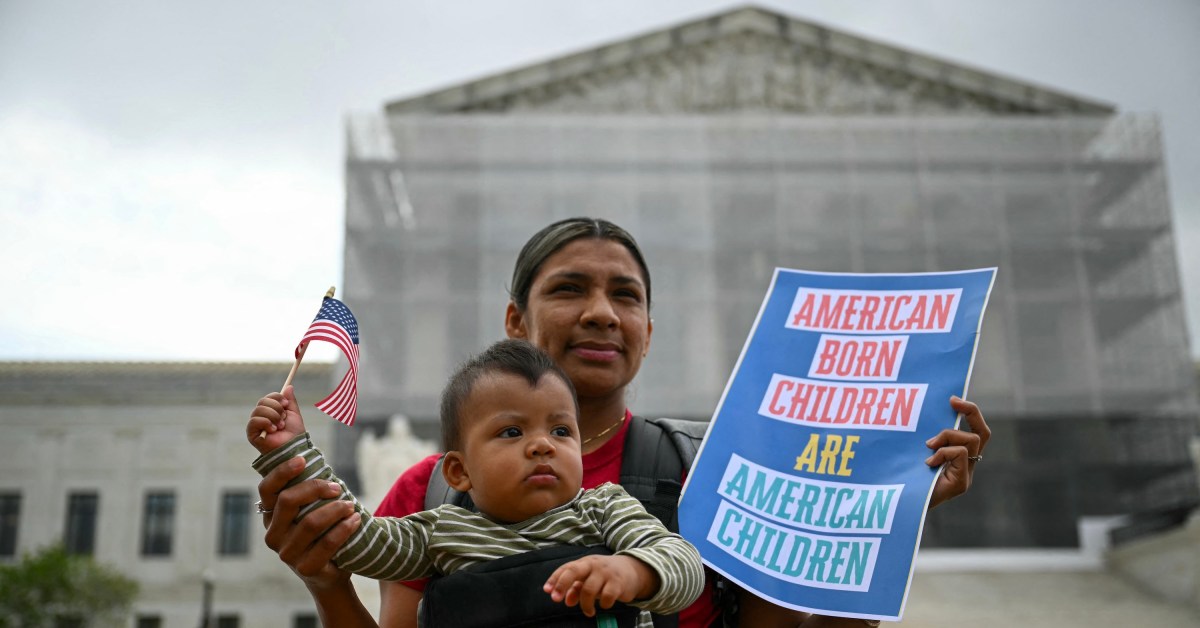
For months, the team at National Latino Evangelical Coalition (NaLEC) has been fielding questions from worried families about what would happen if President Donald Trump were allowed to end birthright citizenship, the legal principle that nearly everyone born in the United States automatically receives citizenship.
The president sought to do so on his first day retaking office, issuing an executive order that would have denied citizenship to children whose parents are in the country illegally or temporarily. Courts almost immediately blocked the order from taking effect.
Gabriel Salguero, a pastor and president of NaLEC, said his team has prayed, “God, make us like the midwives” from Exodus 1, who defied an unjust edict to kill babies born to Israelite families.
“Our prayer has been that the children would be allotted what is rightfully, constitutionally theirs: citizenship,” Salguero said.
On Tuesday, the Supreme Court agreed with that view. On the last day of its spring term, the high court struck down Trump’s order, deeming it unconstitutional.
Advocates for immigrant communities and faith leaders celebrated the decision. Now, Salguero said, “there will be prayers of thanksgiving.”
Had the ruling gone another way, it would have left in limbo the legal status of millions of children born to immigrants and undone a precedent that traces its roots to America’s founding.
Salguero pastors a church that includes many immigrant families, including undocumented and mixed-status families. He said communities like his all over the country can breathe a “collective sigh of relief.”
Conchita Cruz, with the Asylum Seeker Advocacy Project (ASAP), said, “This is a day that is also important to those who value the US Constitution.”
Many of ASAP’s members are people of faith who have been vocal about the impact the president’s order might have had on families, children, and churches.
“Christian communities have been particularly moved by those kinds of concerns, the concerns that expecting parents have about their children’s future,” she added. “Those are concerns that we all share when we have children, about wanting the best for your child, and wanting to make sure that they’re safe, and wanting to bring a child into the world, knowing that they won’t face persecution.”
Writing for the majority in Trump v. Barbara, Chief Justice John Roberts held that Trump’s executive order violated the 14th Amendment of the Constitution, which states baldly that “all persons born or naturalized in the United States, and subject to the jurisdiction thereof, are citizens of the United States.”
The majority held that whether the parents of children born in the United States are present in the country lawfully or unlawfully, the children still satisfy “both elements of the Citizenship Clause.”
“Under the Constitution, they are citizens at birth,” Roberts wrote.
He called the arguments of Trump’s legal team—that birthright citizenship should be limited to those “domiciled” in the United States or, in other words, those who had made the United States their permanent place of residence—“dramatically revisionist.”
“Citizenship, then and now, was the right to have rights—to freely participate in our political community. The Framers of the Fourteenth Amendment extended that promise to ‘every free-born person in this land,’” Roberts wrote. “We keep that promise today.”
The court struck down the executive order as a 6–3 majority, with Justice Brett Kavanaugh concurring with Roberts, Justice Amy Coney Barrett, and the three liberal justices. However, Kavanaugh dissented on another part of the decision. He and three other conservatives on the court, Justice Samuel Alito, Justice Clarence Thomas, and Justice Neil Gorsuch, diverged from the majority on the constitutional question, making the ruling in that respect a 5–4 decision.
While agreeing that the executive order should have been struck down, Kavanaugh disagreed that it violated the 14th Amendment. Instead, he wrote it contradicted a federal law, the Immigration and Nationality Act, that Congress issued in 1952, which is very similar in language to the 14th Amendment. He added that Congress could constitutionally amend that law or enact a new one “establishing exceptions to birthright citizenship for children born to foreign citizens unlawfully or temporarily in the country.”
Other dissents were more vociferous in their disagreement. Alito called the opinion “a serious mistake” and the practice of birthright citizenship “a medieval rule.” While acknowledging that people who had lived in the US for years as a result of their parents immigrating legally had a “strong moral claim to be able to remain in the land where they grew up,” he said that was a challenge for Congress to remedy.
Thomas agreed with the administration’s arguments that domicile and allegiance were important for establishing who could be a citizen, and raised concerns about “birth tourism,” the concept that pregnant women travel from other countries merely to confer US citizenship upon their children. (During oral arguments in May, the administration told the court “no one knows” how common the practice actually is.)
Trump was quick to weigh in, writing, “Too bad for our Country,” and calling on Congress to take action. He argued that a constitutional amendment was unnecessary.
His Republican allies on the Hill also lamented the decision. House Speaker Mike Johnson said in a press conference that he was “very disappointed” and added, “I think it subjects the country to serious challenges going forward and we’ll have to deal with it as a Congress.”
“That this is now cemented in the Constitution means that if you want to take it away, the Constitution needs to be amended,” said Raul Pinto, deputy legal director of transparency at the American Immigration Council. “I hope that this forecloses this question.”
Tuesday’s ruling comes on the heels of several where the Supreme Court gave the Trump administration permission to continue its crackdown on immigration. Last week, it granted Homeland Security authority to deport Haitians and Syrians who had been in the country under a legal status the administration decided to end. That same day, it also upheld US border officials’ practice of turning away asylum seekers before they reach the US-Mexico border.
“While so many of our members and other immigrant families will celebrate this decision, it is coming at the same time that communities are dealing with unprecedented fear, both of detention and fear of falling out of the authorized workforce,” Cruz said.
Salguero said that after those decisions, birthright citizenship felt even more important as a win.
“We needed some good news,” Salguero said. “It was important news that we reaffirm the dignity of these people in our churches, that they’re not thinking, Oh my goodness, am I going to have to pack up? Are my kids going to be in citizenship limbo?”
The Supreme Court weighed in on a number of other hot-button issues this term, including executive power, Trump’s tariffs, conversion therapy, voting laws, and gun laws. On Tuesday, it also upheld state laws banning transgender students from competing on female-only sports teams.
