
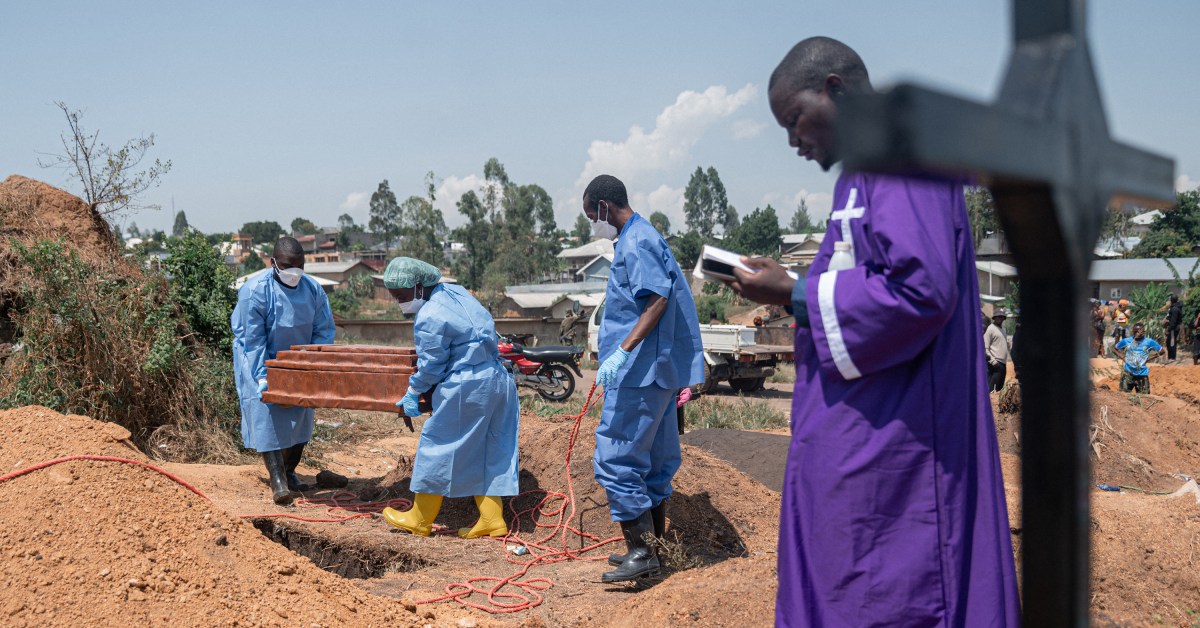
Denis Dalanga, founder of Ministère Chrétien des Familles Church, a network of churches largely in Democratic Republic of Congo (DRC), has watched the Ebola outbreak ravage his community.
His niece living Mongbwalu—a mining town in eastern Democratic Republic of the Congo (DRC) that is the epicenter of the latest outbreak—died from the virus in May. One of Dalanga’s church members in the same town has remained under treatment for Ebola for two weeks. Another member, a female health worker in Bunia, tested positive on May 22 but recovered within three weeks. The church in Mongbwalu, Dalanga said, remains closed.
“As I speak to you, Ebola is spreading very quickly,” he said, his baritone voice weighed down with grief. “Because there is no treatment, people are dying like grasshoppers.”
Dalanga struggles to make sense of the sheer number of people in the area who died from Ebola infections so quickly. Besides the church in Mongbwalu, Ministère Chrétien des Familles also has six church plants in Bunia and one in Kinshasa—all of which are affected by Ebola.
Health care workers and pastors such as Dalanga are fighting to keep their communities safe as the novel Bundibugyo strain of Ebola—which has no approved vaccine or treatment—outpaces attempts to stop the spread. International aid cuts in Africa, the ongoing conflict in Congo, and cultural distrust of health authorities have hamstrung the region’s early warning systems and slowed containment of the virus.
Dalanga must do what he can to translate public health instructions into a language his congregants can trust. The church’s role, he said, is not only to comfort the grieving but also to help people believe the warnings before more families are lost.
“We are praying for the victims,” he said, “but it is urgent that people understand the reality of the danger in order to stop this carnage.”
As of June 29, Congo’s government reported 1,274 confirmed Ebola cases and 360 deaths, according to Reuters. The actual number of cases is believed to be higher, as many suspect the outbreak began weeks before the World Health Organization declared an emergency on May 16. The outbreak is centered in the eastern province of Ituri, while confirmed cases have also been found in Nord-Kivu and Sud-Kivu. Uganda reported 20 confirmed cases, including two deaths.
The Bundibugyo strain of Ebola has an estimated fatality rate of about 30 to 50 percent, though the WHO has only reported a 14 percent fatality rate in the current outbreak. In contrast, the 2014–2016 outbreak of the Zaire strain, which killed 11,325 people, had a fatality rate of about 40 percent.
Ebola spreads through the blood or bodily fluids of someone who is sick or has died from the illness. Direct contact with these fluids—particularly on open wounds or the eyes, nose, and mouth—or with bedding or clothing contaminated by them can spread infection.
According to the WHO, Ebola response in Africa relies on a chain of linked actions: detection, community engagement, contact tracing, laboratory services, infection control, logistics, safe and dignified burials, training, and case management. When one link weakens, the whole response slows.
USAID cuts defunded programs intended to help many those actions, including detecting Ebola cases, alerting communities, dispatching response kits, and strengthening local health systems, according to medical news outlet STAT.
Dr. Paka Essodolom of the Togolese Institute of Agronomic Research said uncertain international funding has left researchers in Africa more cautious about launching projects that require expensive equipment, long-term investment, or scientific partnerships abroad. This can slow the purchase of equipment and imported medicines and limit training opportunities.
“It is also pushing African researchers to seek greater autonomy and more local solutions,” Essodolom said.
But those local solutions take a long time to build. Africa Centres for Disease Control and Prevention head Jean Kaseya promised a vaccine and treatment for the Bundibugyo strain would be available “by the end of this year.” In the meantime, 11 adjacent countries remain at risk for Ebola to spread across porous borders into their populations.
Years of conflict, much of it originating from fallout in the 1994 genocide in neighboring Rwanda, have also hampered Congo’s health care system and response to contagious diseases. In late May, the WHO called for a cease-fire so authorities can focus on containing the Ebola outbreak. Because mass displacement forces many people into overcrowded refugee camps, Ebola can spread rapidly among those living in these conditions.
According to Reuters, armed groups have also limited access to high-risk areas, making it difficult to track the virus’s spread and treat affected community members.
Local residents have resisted health authorities’ guidelines too, often reacting in fear.
In late May, a crowd set fire to an Ebola treatment center in Rwampara after authorities refused to release a victim’s body for family burial, according to the Associated Press. Days later in Mongbwalu, angry residents attacked and burned a treatment center operated by Doctors Without Borders/Médecins Sans Frontières. During this second incident, 18 patients suspected of having Ebola fled into the community.
Distrust has also caused locals to blame Ebola deaths on other causes. “The population does not want to believe that the disease exists,” Dalanga said.
At the beginning of the outbreak, some residents believed “an evil coffin” was moving through the town at night and casting spells, the pastor said. Many attribute these deaths to mystical forces or the sacrifices gold miners perform to ask for spirits’ guidance as they dig.
Bishop Nicke Drandu Ahutu of the church Église du Réveil du Congo in Ituri has heard some people characterize Ebola as a political invention, a spiritual curse, or a scheme concocted by profiteering health care workers.
“The rumor that complicates things is the belief that the response team is there to make money on their backs,” Ahutu said. “And that those who die are dying because they went to the hospital.”
That belief can turn deadly. Ahutu said some sick people stay home until the disease is advanced. When they are finally taken for treatment and die, families conclude the hospital killed them instead of recognizing that they arrived too late.
Dalenga said disbelief also causes many to ignore public health warnings. Some people have continued buying and eating bats sold in local markets, despite longstanding public health warnings that diseases can spread from infected wildlife to humans.
From the pulpit, Dalanga has turned to stories such that of Naaman, the Syrian commander who came seeking healing from the prophet Elisha in 2 Kings 5, to help believers understand the seriousness of obeying instructions, even when the instructions feel humbling, painful, or unfamiliar.
“We explain that if we take this disease lightly, we risk contaminating ourselves, our families, and even the whole church,” he said.
Ahutu said seven pastors in Bunia have died from the disease, and one church, La Louange, closed after losing three pastors. Fear has also thinned congregations. Ahutu said his church usually draws 150 people or more on Sundays, but only 68 came the previous Sunday.
In Dalanga’s churches, congregations have split into smaller gatherings to reduce crowd size and offerings are handled differently to prevent the virus’s spread. Members do not immediately touch the money brought by worshipers. They leave it in the offering box, disinfect the bills and coins, expose them to the sun, and then count them later.
The hardest instruction, Dalanga said, is also the most necessary: Do not approach the sick or the dead, even when they are family.
“It is too hard,” he said, “but we accept it like that.”
In many communities, honoring the dead means bringing the body home, gathering relatives around it, washing or touching the body, praying nearby, and accompanying the person to burial. But bodies of those who die from Ebola can remain highly infectious, and direct contact with the body or its fluids can expose relatives and mourners to the virus.
In Ituri Province, the government no longer allows hospitals to return the bodies of Ebola victims to their families, Dalanga said. When a patient dies, the hospital works with the Red Cross and burial teams to provide body bags for the burial. The body is placed in the bag immediately, he said, without waiting until the next day.
The family is informed and may buy a coffin “to offer a dignified burial,” but the body remains sealed. Relatives can come, but they must remain at a distance. They cannot wash the body, touch it, or even see it one last time.
“If you want to accompany your brother or your parent to his last resting place, you do it from far away,” Dalanga said. “This disease is truly devastating.”
Dalanga said he wants his church to understand both dangers: the Ebola virus itself and the fear around it. Fear can make people hide symptoms, flee treatment, reject safe burial teams, or attack the very people trying to help them, he said. He wants their sanctuary to become a place where fear is broken.
“In these moments,” he said, “anxiety is an enemy as dangerous as the disease.”
