
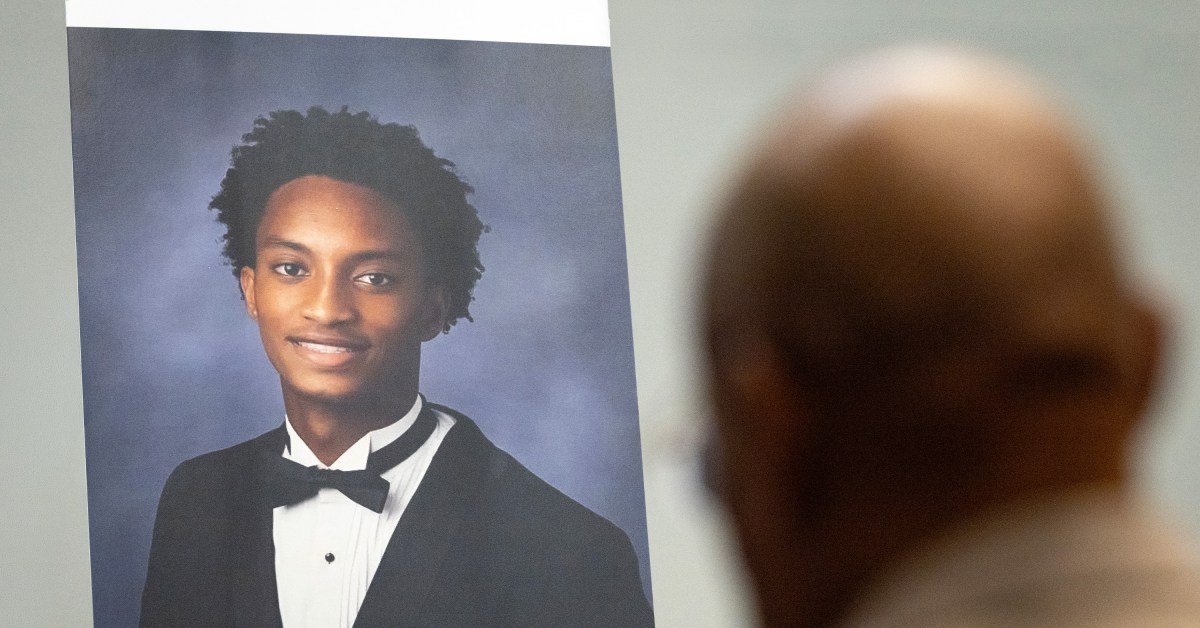
Crowds walked through metal detectors and into the navy pews of Greater St. John African Methodist Episcopal (AME) Church on Wednesday evening to celebrate what would have been Nolan Wells’s 19th birthday in a service that included worship, prayer, and calls for truth about how the Black teen died.
The event drew local residents, Wells’s family, civil rights leaders, prominent Black clergy, and even filmmaker Spike Lee to Biloxi, Mississippi, a coastal city roughly five miles from Wells’s hometown of Ocean Springs.
Some locals arrived with a cardboard sign that read “NOLAN,” or wore blue shirts for the occasion. Others brought flags showing photos of Wells.
Inside the building, the choir of about two dozen belted out worship songs like “You Are Worthy of My Praise” and Elevation Worship’s “Trust in God” between speakers, some of whom invoked race as a possible factor in how Wells—who was found dead following a boat trip with a group of white friends—passed away. Others encouraged attendees to not speculate about what remains under investigation but also to not be silent about questions that remain unanswered.
“We will pray like the ancestors prayed. We will trust God,” Erika Crawford, an AME bishop who oversees churches in Mississippi and presided over the event, said in her introductory remarks.
She said the crowd had gathered to not only seek truth but also rebuke every “active intimidation” and “scare tactic”—alluding to an anonymous professional complaint filed against Wells’s mother, Christine Wells-Wonsley, after she spoke out about her son’s death.
“We have come to not manufacture a story but to believe God always reveals the truth,” Crawford added as attendees erupted into cheers. “We have come because our hope is built on nothing less than Jesus’ blood and righteousness.”
Wells was found dead on July 6, two days after taking a boat trip with friends to celebrate the Fourth of July. The group had traveled to a remote 10-mile barrier island, called Horn Island, off Mississippi’s Gulf Coast. The family’s lawyers said about 200 people were on the island that day. Wells’s friends came back, but he didn’t. His mother reported him missing the next day and search crews found his body face-down in the water.
The questions about what happened have sparked intense speculations, both online and offline, that are heightened by Mississippi’s dark racial history and community distrust toward law enforcement and the criminal justice system.
Local authorities initially said they believe Wells drowned and don’t suspect foul play. Still, they have said they are continuing to investigate what happened that day and aren’t able to give public updates while doing so.
Some witnesses have told investigators that Wells had been drinking with friends on the island. One of Wells’s friends said that the teen stayed behind on the island to talk to a girl. Wells’s parents, however, are skeptical of both claims and have indicated they don’t believe their son, an athlete who could swim, accidentally drowned.
Benjamin Crump, a prominent civil rights attorney who represents the Wells family, also questioned why the teen’s friends took his phone and keys with them when they left the island. Last month, the family commissioned an independent autopsy, which was paid for by former NFL player Colin Kaepernick. The manner of death was found to be “undetermined.”
The case in Mississippi is the latest incident to inflame racial tensions in America. Wells’s death came just a few weeks after a Black teen named Karmelo Anthony was sentenced to 35 years in prison for fatally stabbing a white peer, Austin Metcalf, in Texas. That case also gained national attention and was discussed on social media in racial terms, even though lawyers in the case said the killing was not racially motivated.
At the two-plus-hour service commemorating Wells’s birthday Wednesday, attendees listened to a reading of Psalm 27 and cooled themselves with paper fans as speakers talked about Wells’s kindness, his love for sports, and their support for his family.
Emile Hoskins, who lives in nearby Gulfport, said he came to the event because the case has been on his mind lately. He works at a local radio show that has been discussing Wells’s death. Hoskins, who is 70, mentioned the young people he’s spoken to are trying to make sense of what happened. The community, he said, has come together around the tragedy. He hopes that continues, “because we need it desperately.”
Mimi Hanshaw, another local attendee, said she came to the service to support the family and the community. “I’m a person of peace and unity,” Hanshaw said. “All I want is for justice and the truth be told.”
Civil rights leaders and some prominent clergy—such as Jamal Bryant, the keynote speaker—struck a more forceful tone about the case, even as some of them simultaneously suggested they weren’t going to pre-judge what happened. Bryant preached his sermon on the dialogue between Cain and God in Genesis 4, after Cain killed Abel.
“Today, we end a cycle of vicious, violent racism,” the influential Georgia-based pastor said during the beginning of his remarks. He called on Mississippi’s governor, Tate Reeves, to “get on every judge” in the state about the case and said the state doesn’t have 31 years to solve the case, referencing the time it took to convict the man who killed civil rights leader Medgar Evers in Jackson in 1963.
“We need answers before this year is over,” Bryant told the crowd. “Before December 31, somebody is going to have to answer about what happened to Nolan Xavier Wells.”
Some who have been following the case from afar have noted it’s fair for people to ask questions about what happened to Wells and put a spotlight on the case to make sure local officials do their jobs well.
“I don’t feel like African Americans are unreasonable to say the death of a Black child under suspicious circumstances reminds us of these other scenarios,” said Esau McCaulley, an associate professor of New Testament and theology at Wheaton College. At the same time, McCaulley argued, there’s a tendency to treat these cases as points on America’s “racial scorecard.”
“If you get enough racial incidents on one side, it’s going to prove racism exists in America. And then on the other side, if we could dismiss all of these cases, then there is no racism in America,” McCaulley said. But “I don’t actually need that final piece of evidence. … I understand there’s a race problem in America, and I don’t need a particular case to do that work.”
Crump, the family attorney, said at the event his team will continue to fight for truth in the spirit of famed Black journalist Ida B. Wells and Mississippi native Fannie Lou Hammer. He also lamented personal attacks directed toward the family for wanting answers about what happened to their son.
“This pain that we have is insurmountable,” Wells’s mother told the crowd near the end of the Wednesday service. She said she got up that morning and had to resist the urge to FaceTime her son to sing an off-tune happy birthday song.
“I miss the warmth of your hugs, [and] I miss hearing you say, ‘I love you mom,’” she said. “But I know you and grandma are in heaven right now enjoying a cup of coffee and toast.” After the family consoled each other, an attendee brought birthday balloons and a cake with candles on the stage. The crowd sang happy birthday to Wells, and his family blew out the candles.
