
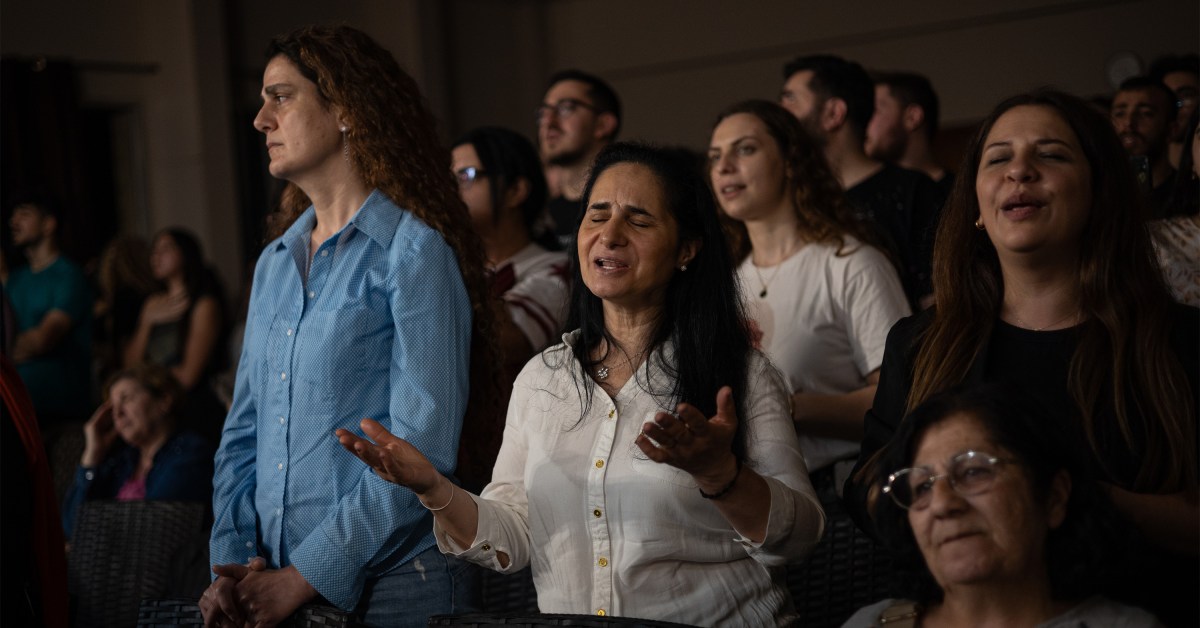
On a May evening, Claudette El Hajj organized five buses to bring 150 people displaced by the war in Lebanon to a worship night in a hilltop town overlooking Beirut. Many were Christians who had been forced to flee their homes in southern Lebanon due to heavy fighting between Hezbollah and Israel. But at least a handful of Muslims—invited by Claudette and other guests—also attended. As the event got underway, Claudette stood in the back of the crowded auditorium with dozens of others without a place to sit.
At the front of the room, Claudette’s 31-year-old son, Gabriel, and his evangelical band, B-Sharp, led the congregation in worship. They began with well-known Arabic worship songs, like “Asmaak Tadaouni” (“I Hear You Calling Me”). Then the focus shifted. Gabriel played the familiar opening notes to “Salam, Salam”(“Peace, Peace”), a popular ’90s Christian song by Egypt’s Better Life band.
But the band had changed the lyrics. After singing “Peace, peace upon God’s people across all of Lebanon,” Gabriel’s wife, Yara, and two other vocalists sang out the names of Lebanese cities and villages where Christians and Muslims have suffered through conflict for the past two and a half years. The audience began to shout, cry, and wail as they heard their hometowns mentioned.
“We thought that people would like the song,” said Gabriel, “but we didn’t expect such emotion.”
That night moved him and Yara as well. Yara hails from the biblical city of Sidon, while Gabriel’s family comes from the Christian border village of Rmeich. Both are among the 15 southern areas named in the song and caught in the seemingly endless fighting between Hezbollah and Israel. While the song’s lyrics captured the despair, the performance also offered a rare moment of unity amid a war that deeply divides Lebanon. At a time when many Lebanese Christians are glad to see Hezbollah-aligned Shiite areas under fire, the congregation prayed for peace over those areas.
Hezbollah’s March 2 retaliation against Israel for killing Iran’s Ayatollah Ali Khamenei scuttled a tenuous November 2024 cease-fire and inflamed long-simmering sectarian tensions in Lebanon. Three months into the war, support is growing for controversial government efforts to disarm Hezbollah, a Shiite Muslim militia and political party that for decades has been one of two primary representatives of the sect.
According to a recent poll, Christians are overwhelmingly critical of Hezbollah. With emotions still raw from the last full-scale conflict in 2024—which erupted after Hezbollah opened what it called a support front for its Palestinian ally Hamas in Gaza—Christians accused the group of dragging the country into yet another conflict.
The anger grows as the death toll mounts. Since March, Israeli attacks have killed more than 3,700 people and wounded 11,700 others, according to Lebanon’s health ministry, which does not distinguish between civilians and combatants. Hundreds of thousands of people remain displaced, uncertain of when or if they will be able to return home.
Though inflamed by ongoing events, criticism of Hezbollah predates the war. Critics have long accused the group of using its vast arsenal of weapons to hijack the state and assassinate opposition politicians, charges that Hezbollah denies and that have rarely been tried in court. And in recent weeks, Hezbollah officials indirectly threatened the government, warning that citizens could overthrow it if Lebanese officials continue direct negotiations with Israel.
Members of B-Sharp have felt this polarization firsthand.
“I used to blame Shiites for much of the suffering and found myself struggling with bitterness and resentment,” Gabriel said. But in prayer and Scripture reading, he felt convicted. How could he, a child of God, harbor hatred toward anyone? “I repented and asked God to teach me to love them.”
Gabriel believes the Christian community in Lebanon needs to show that same love and grace toward one another. As an interdenominational band, B-Sharp aims to see young believers overcome church divisions to unite in worship. But that night, the call to unity extended beyond the faith, to Muslims in the room as well. The Lebanese edition of“Salam, Salam” deliberately mentions places where Hezbollah has widespread support—including Haret Hreik, a now-devasted part of Beirut’s southern suburbs.
As Gabriel looked at the congregation that night, a crowd diverse in age, denomination, religion, and geographic origin, he said he saw an image of the unity B-Sharp hoped to foster and a reflection of the calling that Christians have to love their neighbors and enemies.
B -Sharp wasn’t the first evangelical band to revise the lyrics to “Salam, Salam.” During the 2006 war between Israel and Hezbollah, a band called Strongholds replaced the descriptive verses about God’s peace surpassing all understanding with direct mention of suffering areas in Lebanon. The song mentions the poor Sunni Muslim area of Akkar in the far north, the Christian town of Zgharta in the Lebanese mountains, and the biblical city of Tyre in the south, now a Shiite-majority city.
Lebanese call that round of conflict the July War, which lasted 34 days after Hezbollah killed three soldiers along the border and took two others hostage. More than 1,000 Lebanese and 150 Israelis died in the fighting that followed. Unlike the current war, Israel held the Lebanese state responsible and bombed infrastructure throughout the country, including the international airport. Like now, more than a million people fled their homes.
“Our country—and the Middle East region—has never had peace,” said Jaime Helou, a former member of Strongholds. “Jesus came to the land that needed him most.”
At the time, Helou and other Stronghold members filmed their music video wearing white robes and flying white flags while driving around the country in a pickup truck. While they feared getting hit by the bombings, they continued to proclaim peace to all Lebanon, she said.
In 2023, the war returned. Another worship leader altered the lyrics again, adding more locations. This included the southern Christian villages of Debl, where an Israeli soldier recently desecrated a statue of Jesus; Yaroun, where the army damaged a Catholic convent; and Jazzine, Helou’s ancestral home.
“Twenty years later, we have to sing again, asking for the same thing,” said Helou. “The song is wonderful, but it is heartbreaking.”
Gabriel’s mother, Claudette, was moved to tears the first time she heard Stronghold’s version of the song in 2006. It reflected a recurring tragedy that she and so many other Lebanese in the south have faced their entire lives.
Claudette’s family hails from Rmeich, but during her childhood she lived in Tebnine, a mostly Muslim village roughly 8 miles to the north, where her father worked at a government hospital.
In 1987, when Claudette turned 13, men in the village began to ask for her hand in marriage. Not wanting her to marry a Muslim, Claudette’s parents sent her to study in Beirut.
During the summers, Claudette visited her family. Like today, Israel then occupied a large swath of territory in southern Lebanon as part of what Israel called a security zone. Alongside its Lebanese Christian-led militia ally, Israel regularly carried out military operations against Hezbollah.
Tebnine sat just north of the Israeli buffer zone, making it a frequent target of bombings amid clashes between Hezbollah and Israel, Claudette said. Whenever Israel shelled the village, her family fled to the hospital where her father worked. A bomb once hit the family home, destroying a bedroom.
After getting married in 1992, Claudette and her husband, Daniel, wanted to live in Rmeich, but the Israeli occupation made that impossible. Instead, they settled in Beirut.
 Photo by Hunter Williamson
Eight years later, the Israeli military withdrew from southern Lebanon. After more than a decade of insurgent operations against Israel, Hezbollah claimed victory, bolstering its reputation as a popular resistance movement that played a decisive role in liberating the country’s south.
Like many other Lebanese families, Claudette was hurt by both sides during the 18-year Israeli occupation. The details of what happened to Claudette’s family are not something she wants public. But the pain stayed with her for years, affecting the way she saw Shiites.
As the 2006 war got underway, Claudette volunteered with aid efforts at a school in Beirut that was hosting displaced Shiites from the south. As someone from that part of the country, she could relate to the families she served.
She knew how to speak with them. How to joke with them. She connected with them in a way that her Beirut counterparts didn’t. Young Muslim women would even hug Claudette and ask her to pray for them. Her openness toward them opened conversations about Jesus.
But serving them wasn’t easy.
The memories of her past still haunted Claudette, and other Christians criticized her for helping Shiites. Agonized by the pain and criticism, Claudette prayed, asking God to erase the memories from her mind. She repeatedly read Bible verses about forgiveness.
Over time, Claudette’s heart began to heal. She started to genuinely love Shiites, becoming excited whenever she saw a veiled woman.
“The first and greatest teaching in Christianity is the one that says, ‘Love your enemies,’” she said. “And that’s not easy. I mean, it’s not easy at all. It took me a long time.”
After Daniel retired in 2015, the couple used his retirement gratuity to build a home in Rmeich. Though they continued to live in Beirut, Claudette and Daniel visited the village regularly and even launched a house church in 2022, providing the only evangelical space in the Maronite Catholic town. But just one year later, Rmeich once again became a frontline as another war erupted between Hezbollah and Israel.
Along with other Christian villages, Rmeich is currently caught inside an Israeli buffer zone, cut off from the rest of the country. Despite facing periods of dire shortages and constant danger, upwards of 7,000 residents remain in Rmeich—unable or unwilling to leave their village. Dozens of Shiite villages around it lie in ruins.
In late March, Israeli defense minister Israel Katz declared that Israel would replicate its Gaza strategy in southern Lebanon and prevent hundreds of thousands of displaced Shiites from returning to their homes “until the safety … of northern Israeli residents is ensured.” An analysis of satellite imagery by the open-source news organization Bellingcat found in May that 46 of the 54 villages located inside Israel-occupied territory had been heavily damaged or destroyed.
As the conflict escalated, Claudette once again rallied to support people displaced by fighting, including those from her hometown. She works as an intermediary for churches and relief agencies, helping them deliver aid to displaced families and to people remaining in villages in the south.
Claudette estimated that around 70 percent of the aid she helps distribute goes to Muslims. Twenty years since she first started working in ministry, some people still critique her service to Shiites. Her response remains rooted in the gospel, the same message that inspired her son’s rendition of “Salam, Salam.”
At the B-Sharp worship night in May, Claudette looked around the room to see residents of southern Lebanon—Muslims and Christians alike—enduring the same hardship and pain as they prayed for one another’s villages.
In the crowd was Mathilda Shammas.
Displaced for the sixth time in her life from the Christian village of Deir Mimas, Shammas struggled with blaming Shiites for the war. Some of the fiercest fighting over the past few years had occurred in areas only a mile or two from her home, leaving parts of the village battered and destroyed.
Yet that night, Shammas felt united with the people around her. Like Gabriel and Claudette, she first heard “Salam, Salam” during the 2006 war. It moved her to tears then. But as she sang it again 20 years later, the song resonated even more deeply: “This time I was really praying for God to save us once and for all.”

