
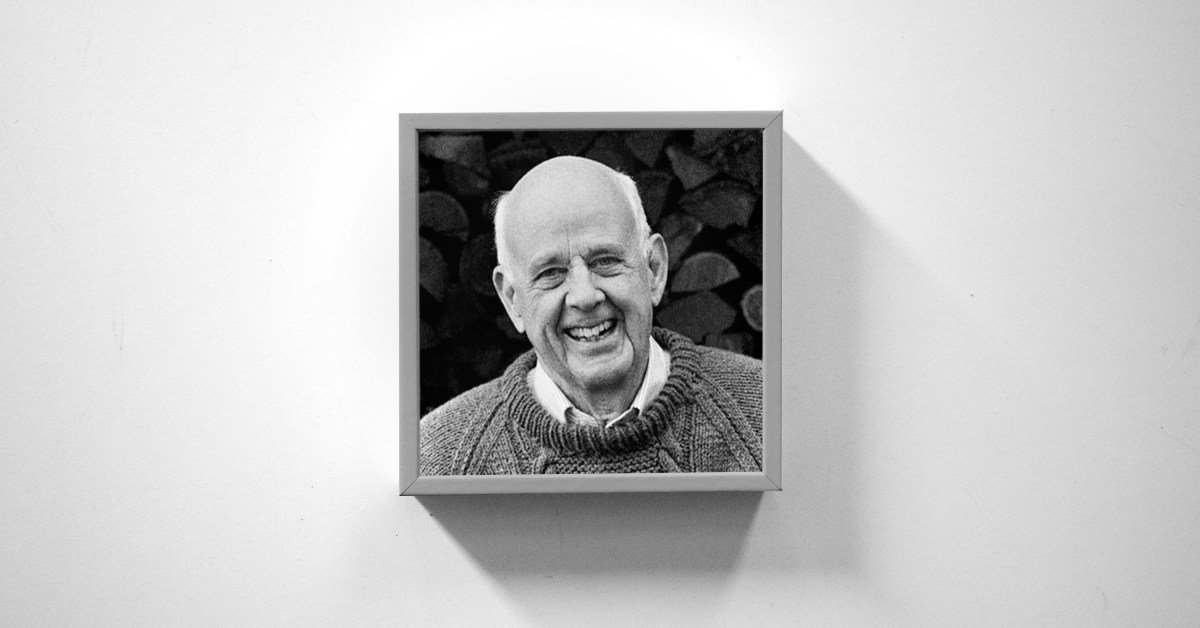
When Wendell Berry’s despair woke him in the night, he would go and lie down in the “peace of wild things,” he wrote. He’d find a wading duck, a feeding heron, and a stream of rushing water and “rest in the grace” of creation. To counter the world’s troubles, he engaged the earth itself.
Berry, the revered poet, novelist, and Kentucky farmer, died on Monday, August 31, at his home in Port Royal, Kentucky. He was 92.
He was a towering literary figure, authoring more than 50 books of poetry, fiction, and collected essays. His published works shared his heart for farming and rural communities—life rooted in real people and places. At the same time, he sharply critiqued what writer Jeffery Bilbro called America’s “restless mobility,” lamenting the industrial consumerism that put machines and money between families and neighbors.
In this way, many considered Berry an agrarian prophet. His “prescription for our transient, displaced culture is to stop somewhere and begin knitting ourselves into the warp and woof of our particular places,” wrote Bilbro, who has written several books on Berry.
Born in Louisville in 1934, Berry was later baptized at New Castle Baptist Church and attended Port Royal Baptist Church in his small town of fewer than 100 people. He joked about his erratic Sunday morning attendance, labeling himself a “marginal” or “forest” Christian who preferred to wander into the woods in nice weather than to plant himself in the pews.
Yet he drew directly from the Bible while championing environmental care, connecting his affinity for nature to God’s artistry, and challenging the church to join the cause.
His novels, which often featured the fictional town of Port William, doubled as parables as broken people tried to embody biblical truth in their daily lives. His poems, including Sabbath musings that he wrote while wandering his Kentucky land, positioned him “as a tree whose leaves derive their sustenance from God,” The Gospel Coalition wrote, echoing the prayerful meditations of the Psalms.
“Best of any song / is bird song / in the quiet, but first / you must have the quiet,” Wendell wrote in A Timbered Choir.
Amid his poetic arguments for a more communal, agricultural society, Berry practiced this way himself. After studying English at the University of Kentucky and creative writing at Stanford, he taught at New York University for two years before deciding to return to his home of Kentucky.
In 1965, he and his wife, Tanya, moved with their two children, Mary and Pryor, to Lanes Landing Farm, tending to more than 100 hillside acres in Henry County, west of the Kentucky River. Friends in New York warned him that moving there would be “literary suicide.” But Berry proclaimed his love for the land, where he grew tobacco, raised cattle, herded a flock of Highland sheep, and stayed for more than 60 years. He often penned his words from a rustic riverside cabin without electricity. For 20 years, he taught at his alma mater, the University of Kentucky.
“I began to see, however dimly,” he wrote, “that one of my ambitions, perhaps my governing ambition, was to belong fully to this place, to belong as the thrushes and the herons and the muskrats belonged, to be altogether at home here. … It is a spiritual ambition, like goodness.”
In his personal tranquility, Berry didn’t disengage from the culture at large or shy away from controversy. His 1977 book The Unsettling of America confronted “mechanized farming,” arguing that farming should be a unifying, culture-building endeavor, not a mass-scale business designed to consume the earth and outsource the responsibility of growing, preparing, and sharing food.
He promoted instead a “Christian economy,” Bilbro wrote, which “practices love by making our households centers of production and care.” Berry’s combination of “prophetic bite and Christian winsomeness” drew applause from Eugene Peterson and other theologians.
Berry also had captive audiences on both sides of the political aisle. He was “the rare writer and activist who can’t be claimed by a single party,” wrote Alissa Wilkinson: “beloved by the right for his localist pro-family traditionalism and the left for his localist anti-corporate activism.” In 2011, President Barack Obama presented him with the National Humanities Medal, honoring his work as a poet, novelist, and conservationist.
Berry took many other hard stances. He spoke out against the Vietnam War. He marched in protest of a Washington, DC, power plant. He publicly opposed “the taking of a human life” both before and after birth. And he outlined the Christian church’s failure to prevent the world’s destructive tendencies.
“Throughout the five-hundred years since Columbus’s first landfall in the Bahamas, the evangelist has walked beside the conqueror and the merchant,” Berry wrote in his 1993 essay “Christianity and the Survival of Creation.” Believers too often assume the world’s cause is “the same as theirs,” he continued. If only they looked more closely at their Bibles, they might see they are called to steward, not pillage, their land.
Later in life, Berry continued to point to Christ, avoiding strict labels about his faith or denomination but calling himself “a person who takes the Gospels very seriously.” He stated plainly, at Louisville’s Festival of Faiths, that Jesus’ way is not abstract but practical—and thus to be practiced in community.
“What Christians offer,” he once told CT, “is an understanding that the world is not ours, that we are not the ones that give things value.”
In A Timbered Choir, he wrote, “The seed is in the ground. / Now may we rest in hope / While darkness does its work.”
