
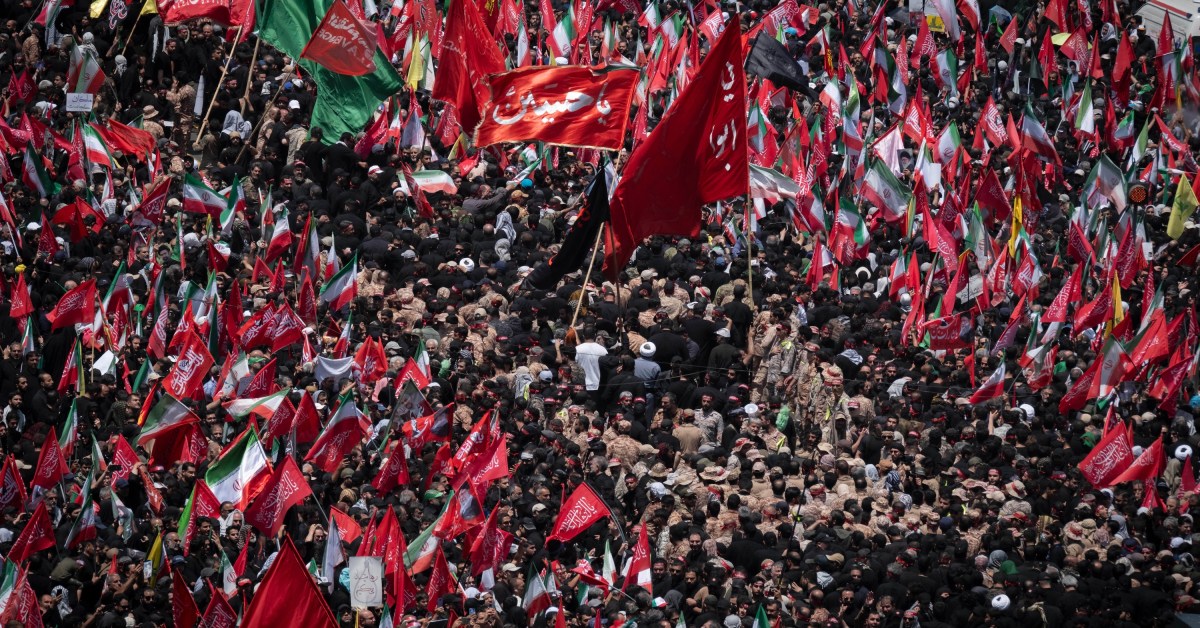
This week, as Iranians thronged for the delayed funeral of Supreme Leader Ali Khamenei and their government resumed trading airstrikes with the United States, a fragile cease-fire between the two countries crumbled—the latest turn in a conflict entering its fifth month with no clear end in sight.
Whatever happens next will be another test for the 14-point framework negotiated only weeks ago, underpinning talks between the two countries to end the war. When asked Wednesday about the state of the truce between the two countries, President Donald Trump said, “I think it’s over.”
Still, the president left the door open for negotiations. But whether or not the United States and Iran can come to terms, some critics say the framework fails to address the sources of conflict that led to the war in the first place, and in particular it ignores one of the biggest concerns of Christians around the world: religious freedom in Iran.
“This agreement throws the Iranian people under the bus,” said Jonathan Schanzer, executive director at the Foundation for Defense of Democracies.
Schanzer, like other foreign policy experts, is eager to see an end to hostilities. But he’s concerned that any truce would come at a cost to human rights.
The interim deal, for instance, includes a provision that both powers will “refrain from interfering in each other’s internal affairs.” That’s a dramatic shift from the lead-up to the war, when in January Trump publicly encouraged Iranians to rise up against the country’s regime. US negotiators now seem willing to overlook the regime’s continued abuses of its own people.
Religious freedom advocates called that particular provision catastrophic for religious minorities and opponents of the regime who had hoped the conflict would usher in political change for their countries.
“It’s been devastating,” said Charmaine Hedding, president of the nonprofit aid group Shai Fund. “What happens to religious minorities? Well, [the regime] understood that there’s very little care about that, and it’s given them license to understand that they can get away with it.”
Because of how negotiations have been handled, she added, “there’s been a fresh wave by the regime, a sort of a sense that they’ve gotten away with everything. And they certainly have.”
The Iranian government has continued persecuting churches. Last month, it demolished an evangelical church in Mashhad. Authorities are also intent on seizing a historic Presbyterian church in Tehran, St. Peter Evangelical Church, which is the place of both residence and worship for a group of Armenian and Assyrian Christians.
“It’s emboldened them to crack down on the churches, and they’re going for the evangelical churches first because they see those as mostly associated with the West and started by American missionaries,” Hedding said.
Shai Fund helps persecuted minorities who have fled Iran to nearby countries. Its projects include creating safe houses for vulnerable refugees, as well as providing SIM cards, food, and clothing. The organization also connects recent arrivals with the larger Iranian diaspora. For Christian refugees, that includes connections to local congregations with Iranian believers.
Hedding said she’s heard some refugees express hopes or concrete plans to return.
“A lot of them are such well-seasoned people of faith that have stood the test of time, and they could teach us so much. They said to me a lot of times, ‘Our faith is not in any man; it’s in God,’” Hedding said.
But hopes for a new Iran have seemed dimmer of late.
Knox Thames, director of the Everett Center for Global Religious Freedom at Dallas Baptist University, expressed disappointment that the Trump administration has continued a “bipartisan tradition” of setting aside humanitarian concerns in its negotiations with rogue powers like Iran.
The Obama administration’s deal with Iran, which focused on curbing the country’s nuclear ambitions, also took a hands-off approach toward Iran’s internal affairs, and Thames was not surprised to see the Trump administration follow suit.
“We’re working on the symptoms of a bigger problem that neither agreement attempts to touch, which is the regime’s commitment to repressing the beliefs of its citizens, both regarding democracy and religion, and doing whatever it takes to stay in power,” Thames said.
During the first Trump administration, officials like former vice president Mike Pence, former secretary of state Mike Pompeo, and former religious freedom ambassador at-large Sam Brownback took steps to promote religious freedom broadly. That included elevating the issue of religious freedom by hosting an international conference in Washington.
By contrast, the second Trump administration has done relatively little. The post for ambassador of religious freedom remains vacant, a year and some change after Trump’s second swearing in. The administration has advocated for the release of individual Christians imprisoned for religious activities, something previous presidents also did.
“The United States is the indispensable nation when it comes to promoting these important values—values important to Americans, values important to Christians—like religious freedom, human dignity, human rights,” Thames added. “And so when we’re not talking about it, no one else will either.”
Mindy Belz, a journalist who has long covered persecuted Christians in the Middle East, noted that the interim deal is supposed to be a starting point rather than an endpoint, but expressed concerns that the United States appears so willing to ignore Iran’s internal affairs.
The agreement, Belz said, is “shockingly devoid of anything that comes close to a concrete effort to protect average everyday people, average everyday believers, whether they be Muslims or Christians or the Bahá’i.”
Belz recalls meeting with faith leaders and the then-ambassador for religious freedom at the State Department as the Iraq War was drawing to a close, and pastors voiced concerns about the Constitution in the process of being drafted. Iraq’s 2005 Constitution includes an article pledging religious freedom to minorities such as Christians and Yezidi.
“This administration couldn’t put together a meeting like the one I went to at the State Department, because they don’t have a US ambassador for international religious freedom right now,” she said.
Belz and other foreign-policy experts pointed to past US diplomatic efforts to guarantee human rights after a conflict, including in postwar Japan, postwar South Korea, and Eastern Europe following the collapse of the Soviet Union.
Christians weren’t given special treatment, Belz noted, but “you create conditions in which they’re no longer being persecuted and they’re no longer having to meet in houses in order to survive.”
With the fresh outbreak of hostilities, the current Iranian government is further than ever from those kinds of conditions.
“The only way in which the regime has changed is that in some ways the regime has become even more—I don’t like using the term—but even more hard-line,” said Joel Griffith, a senior fellow at Advancing American Freedom.
Primarily, US negotiators have focused on ending the Iran conflict and reopening the Strait of Hormuz, a channel between the Persian Gulf and the Gulf of Oman through which around 20 percent of the world’s oil and natural gas travels by ship.
Mark Tooley, president of the Institute on Religion and Democracy, said the conflict that began with “soaring goals” has diminished to a “sputter.”
Trump outlined various aims at the war’s outset, from crippling Iran’s nuclear ambitions to encouraging Iranians eager for regime change. But the negotiations have distilled almost entirely to economics.
Tooley advocates pragmatism, and he sees the need for compromise and accommodation. But he doesn’t think the Iran war has been a success by those metrics either.
“There’s very little to celebrate,” he added. “The problem of Iran, which has persisted for 47 years now, is in no way diminished.”
