
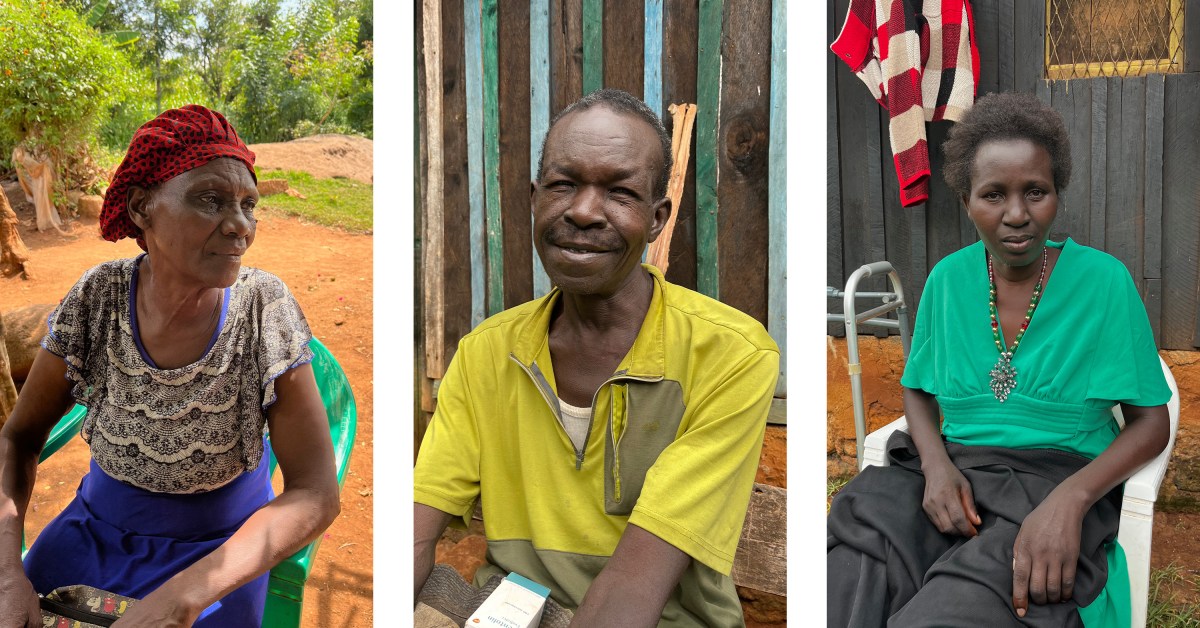
Florence Mwendwa, 49, proudly showed off her walker as she took unsteady steps up a rocky path surrounded by tea farms in rural Kenya. Her husband, Ashford Mutwiri, helped her walk, but the health workers who visit her regularly at home told her she was looking so much better than a few months ago, when she could not stand.
Before, Mwendwa was bedridden and seriously ill as a result of HIV. Now she is on antiretroviral treatment (ART)—the medications that keep HIV at bay—funded by the US government and delivered by a mission hospital.
ART drugs are flowing again to Africa through the President’s Emergency Plan for AIDS Relief (PEPFAR), an initiative that currently keeps 20.6 million people with HIV alive—after the Trump administration brought the program to a crashing halt last year.
But under the new “America First” strategy, everything in PEPFAR other than “commodities”—the drugs to prevent or treat HIV—has been vulnerable to cuts. That has reduced home visits like the one to Mwendwa and other community care like testing, a key strategy in ending HIV.
Chogoria Hospital, a mission hospital that is part of the Presbyterian Church of East Africa, provides Mwendwa’s HIV treatment through PEPFAR. Chogoria had one of the first HIV clinics in the region and now cares for most of the HIV patients in the county. The mission hospital has seen a 50 percent cut in PEPFAR funding, forcing it to cut staff and curtail community outreach.
Mwendwa lives in a remote community. Her home burned down this year, poverty and disaster compounding a life-threatening sickness. She and her husband, a tea farmer, don’t have money for transportation to the hospital.
So Chogoria Hospital staff—a physician’s assistant, nurse, and social worker—come to her, driving on rutted dirt roads through farms.
PEPFAR relies on many faith-based health partners in Africa to deliver HIV treatment. One lauded feature of the US program has been its outreach to rural areas, reaching HIV patients in the “last mile,” far from a health facility, with medications and other community support. The strategy has saved millions of lives in sub-Saharan Africa, where most of the population is rural.
But the administration has made deep cuts to this rural outreach, which funded staff and fuel for drug delivery, testing, and community-based support groups.
Chogoria used to have 20 community health workers under PEPFAR who would go into rural areas to find those who might need to be tested or those who had defaulted on treatment. Now they’re gone.
For now, a smaller number of the hospital’s staff is still driving out to HIV patients, thanks to support from a private donor. But other parts of what they used to do haven’t come back. They’re working with fewer staff to serve thousands of HIV patients, mostly the rural poor.
Before the cuts, the hospital had 29 total staff working on HIV care. Now there are 14 staffers and five others doing multiple jobs including HIV care.
“We’re used to receiving a 5 percent cut, a 10 percent cut,” said Rebecca Juma, who runs the HIV program at the hospital. “But a 50 percent cut—it came so drastically. It was a big hit.”
Juma laughed, though—the laugh of a rural physician accustomed to lack and uncertainty: “You have to maneuver somehow.”
CT visited four rural mission hospitals in East Africa, as well as an urban HIV clinic, to see the effects of US aid cuts a year later. Health workers, hospital administrators, and patients are finding ways to do more with less. One HIV patient at a rural hospital biked 14 miles to his appointment. Medical staff have taken on multiple jobs. Administrators restructured departments.
But doctors worry they are seeing a slow breakdown of the progress they spent decades making against HIV. Salaries for health workers, prevention efforts like circumcision, and training in HIV care have disappeared.
“[The United States] will still buy drugs. We’re happy about that. We are very, very grateful,” said Karen Sichinga, the head of the Churches Health Association of Zambia (CHAZ), who has been part of recent negotiations with US representatives, including a DOGE official, on health funding. “But any other activities that they did not consider lifesaving, they completely stopped.”
CHAZ is a consortium of the country’s faith-based health facilities that provide about 30 percent of the nation’s health care. It oversees 116,000 patients on HIV treatment, according to Sichinga. Zambian facilities, like Kenyan facilities, reported to CT that they were cutting back on outreach services.
In rural Zambia, Macha Mission Hospital has lost outreach staff, according to nurse Sydney Gutichilala, who does HIV care at Macha. The remote hospital provides treatment to about 2,000 HIV patients. Especially in the rainy season when roads are muddy, outreach staff would make sure patients had their drugs, or seek out patients who missed appointments—often on motorbike. After losing US funding, the hospital doesn’t do outreaches, Gutichilala said.
Gutichilala thinks patients will either find closer facilities or, if they can’t afford transportation, they’ll default on their medicine. That not only will make them sick, but it increases the risk of their spreading HIV as the viral load in their systems grows.
CHAZ is tracking all of this.
“Even though we are beginning to see that some people are defaulting, it’s not an alarming figure yet,” Sichinga said. “We are watching it. But we know lack of funding is contributing.”
In Kenya, the Chogoria Hospital staff are also continuing to track HIV patients, even deep in the countryside.
On one visit, they parked the hospital vehicle on a dirt road and walked half a mile across other small farms to reach Rosemary Mukwanjiru, 71. They had last visited her in March and brought her a three-month refill of her ART, so in June it was time to return.
Mukwanjiru’s daughter was killed in a robbery. Now she cares for her grandchildren and has little money for transportation to the hospital. She shared that she is depressed.
“These two ladies are like a miracle,” she said, pointing to the nurse Jackline Chepirui and social worker Charity Koki on the team. She sat under a passionfruit tree as chickens and a kitten wandered between her feet. “I would not be alive. Sometimes just a phone call [to check in] is enough.”
Chogoria’s patients do their own rural outreach, too. Caroline Mburia, 46, has been on lifesaving HIV medication at Chogoria for 19 years, thanks to PEPFAR. If Mburia ever missed an appointment, she said hospital staffers would call her to find out what was going on. If they didn’t get through to her on the phone, they would come find her in her village.
Now she works with Chogoria to convince others in the community to get treatment and is open about her HIV status to encourage others who feel stigmatized—an ongoing problem, even decades into widespread HIV treatment.
“This hospital, they love their patients,” said Purity Kawira, another longtime HIV patient at Chogoria who lost her husband to HIV. “They keep calling, wanting to know your progress.”
Kawire and Mburia have a support group for those with HIV in their village that used to receive some US funding. Now with the funding gone, they host the group as volunteers. Mburia worries now that someone will become sick but be unable to pay to get to the hospital.
“We pray every day that something bad will not happen,” said Mburia. “We feel scared because we have seen what happened before—seeing a person dying slowly.”
Joseph Naivasha, 64, is another Chogoria patient who is alive because of PEPFAR. He has a small plot for growing tea but leased it to other farmers to pay his bills. Now he smashes rocks and sells the gravel.
A pile of his work stands at the top of the steep hill from his house to the road. In addition to HIV, he was diagnosed last year with heart failure and COPD, which made climbing the hill to the road impossible. Neighbors had to carry him up to the road to get transportation anywhere.
It usually takes him two hours to walk to the hospital for his medications, but with his current heart condition, he said, it now takes five hours. He takes a motorbike taxi when he has the money.
When the Chogoria outreach team visited him in January, he wasn’t able to work or leave the house because of his heart and lung condition. He was alone, with little social or family support. Chogoria admitted him for a month and he improved significantly. Now, when the team came, he was standing outside his house waiting for them, as farm workers harvested tea leaves on his plot down the hill.
Chepirui, the nurse on the team, delivered his antiretroviral drugs. She checked his blood pressure. The team goes into remote areas with a bag filled with cream for bedsores, a scale to weigh patients, and a blood pressure cuff. Patients shouldn’t take antiretrovirals on an empty stomach, so they bring some food too.
Naivasha, speaking through a translator, said he wasn’t sure how he had lived all these years alone on this small farm—“me and God,” he said.
“I’m praying to God to grant me a long life,” Naivasha said. “I want to live more.”
