
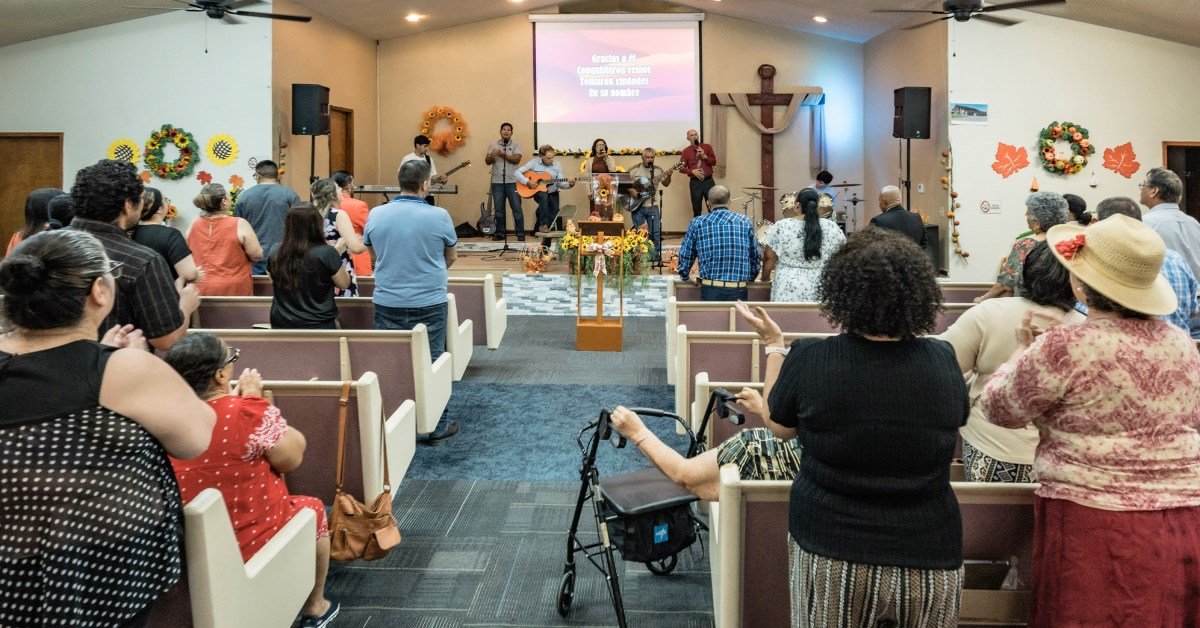
William Rodriguez has become accustomed to hearing immigration-related anguish.
A retired pastor, Rodriguez is currently a superintendent with the Assemblies of God and oversees nearly 340 congregations, most of which are Spanish-speaking and based in Southern California.
Rodriguez said most of the predominantly Hispanic churches in his district have seen someone from their congregation detained or deported during the Trump administration’s immigration crackdown.
In Rodriguez’s own church in Los Angeles, immigration officials recently deported an undocumented Mexican woman—who had lived in the US for three decades and has three American-citizen children—after detaining her during a scheduled immigration appointment.
Many Los Angeles churches have seen attendance plummet due to fear during enforcement raids. At least one Assemblies of God congregation switched its public lake baptisms to private house pools to curb anxiety. And leaders, as has been reported in other states, have not been immune to deportations: In his district, Rodriguez said two evangelical pastors without any criminal histories were deported to Guatemala and Honduras in recent months. The one pastor’s wife and the other’s adult son now lead those congregations.
“People do want to see things change,” Rodriguez said.
Yet how Latino evangelicals will vote during Tuesday’s midterms remains a murky topic.
In 2024, nearly two-thirds of Hispanic Protestants (most of whom are evangelicals) backed Donald Trump’s return to the White House. Trump lost the overall Hispanic vote, but by a small enough margin to clearly show that Republicans had made significant inroads with the voting bloc.
At the time, voters were economically dissatisfied. Hispanic Protestants also aligned more with Republicans on abortion, LGBTQ matters, and parental rights and were critical of the spike in border crossings under former president Joe Biden.
The landscape is now more favorable toward the Democrats, an erosion driven by pocketbook concerns like high gas prices. Health care, education, and democracy are high-ranking concerns, and immigration also remains a salient issue.
Polls show Democrats have regained some of the ground they’ve lost with Hispanic voters and are expected to do much better with them in the midterms.
Trump’s favorability among Hispanic Protestants in particular has also dropped, by 20 percent in two years according to one survey. But the same August-September survey, conducted by the Public Religion Research Institute, showed Republicans continue to maintain an edge, albeit diminished, with the religious group—44 percent said they would back a Republican in the midterms and 35 percent a Democrat. About a fifth of voters who will determine which party wins the majority of that vote remained undecided.
“Latino evangelicals, contrary to popular perception, are definitely a swing vote group,” said Gaston Espinosa, a professor of religious studies at Claremont McKenna College who studies Latino religion and politics.
At the same time, the survey found Hispanic Protestants are the least likely religious group to say they are “very excited” to vote in the midterms.
In this election, Latino evangelicals—like many others—“feel caught in between,” Espinosa said. On the one hand, they care about their communities and generally don’t support the excesses that have accompanied the immigration crackdown. But many do not want to vote Democrat due to the party’s social platform, especially on abortion and LGBTQ issues.
Republicans have been tapping into that social conservatism this year.
The Hispanic arm of the Faith & Freedom Coalition, a conservative outreach group led by Ralph Reed, has been partnering with some Hispanic churches who want to hand out documents about how specific candidates stand on particular issues (such as abortion and school choice).
The organization has been focusing on states with competitive seats, like Michigan, Ohio, Pennsylvania, and North Carolina. In Virginia, it is highlighting proposed amendments to enshrine a right to abortion and same-sex marriage in the state’s constitution.
“We’ve seen with the left that if you give them an inch, they take a mile,” said Nilsa Alvarez, the national Hispanic director for the conservative group.
Meanwhile, the National Latino Evangelical Coalition released its own voting guide in September called “With Love: A Christian Guide to Faithful Voting.” Before casting a ballot, the document asks congregants to look beyond party labels and ask themselves if a candidate demonstrates love of neighbor, shows trustworthy character, and will use power responsibly.
“No single issue tells us everything we need to know about a candidate,” the document said. “Christian voters should consider the full range of ways that public decisions affect our neighbors.”
Latino voters at large have historically leaned toward Democrats, but there have also been important distinctions between different ethnic groups.
Immigrants fleeing socialist or Communist regimes, such as Cuba, have been skeptical of left-leaning policies and have historically backed Republicans. On the other hand, Espinosa noted that Mexican Americans in the Southwest, for example, were intimately connected to America’s labor movement and have, along with Puerto Ricans, generally supported Democrats.
Those political preferences, however, have not been static.
Some research shows Mexican Americans have been embracing a more independent streak. Separately, Espinosa said his research indicates there’s been some limited movement of Mexican Americans towards the Republican party in recent years—a trend that tracks with the overall Latino vote and is primarily driven by Protestants. Cuban Americans, meanwhile, have been trending left, primarily due to the shifting political attitudes of younger generations born in the US.
Some Latino evangelicals just feel disillusioned.
In Minnesota, Héctor Andrade, pastor of Comunidad Cristiana Twin Cities, said he used to consider himself a Republican but doesn’t anymore.
He oversees 34 churches in the state for International Pentecostal Holiness Church, a charismatic denomination. Over the past 22 months, churches under his watch faced devastation: Some congregants were deported. Some chose to leave the country due to fear. And an undocumented member of his church was detained in another state and has been in immigration custody for five months.
Another congregant, a 70-year-old American citizen, was taken into custody and subsequently released, Andrade said. He suspects the man was racially profiled because of his accent, akin to other cases documented in Minnesota.
“They treat people like animals,” Andrade said. “It was very, very, very sad to see it.”
But even though he has thrown in the towel on the Republicans, Andrade says he is not moving to the left. He’s socially conservative, and family issues remain important to him.
“It is very confusing,” he said, “because you don’t know where to go.”
