
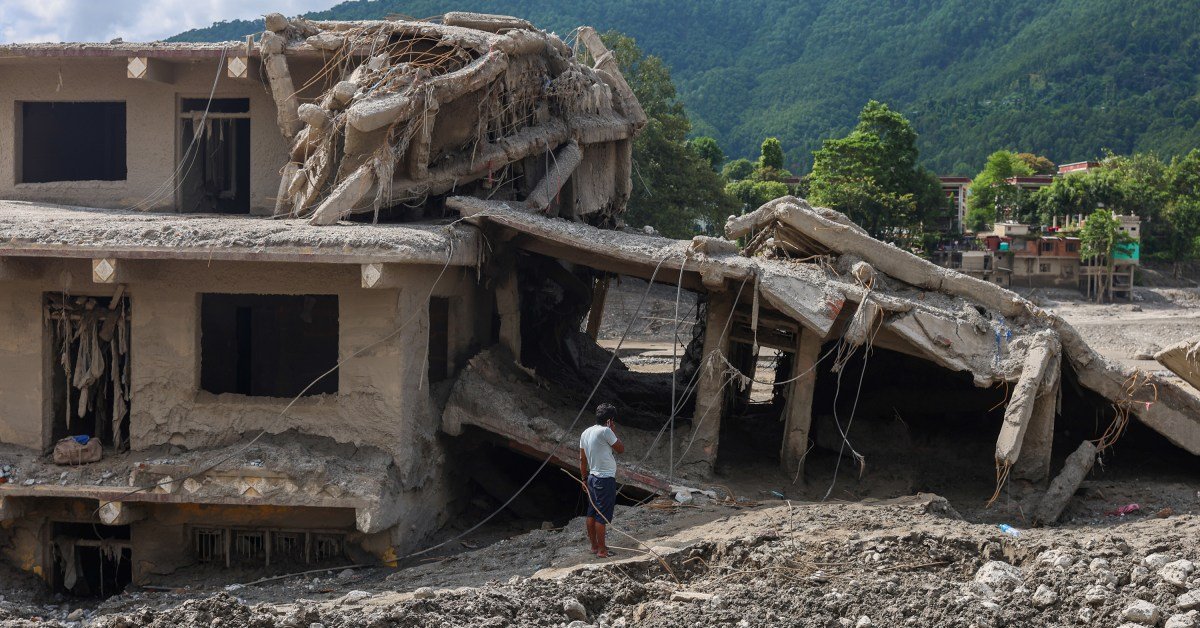
At 8:40 a.m. on August 26, pastor Rajan Guru was sitting with friends about a 30-minute walk down the slope from his house in Halde Kalika, a village in Nepal’s Nuwakot district, when police came warning people to evacuate.
“Most of the people near the riverside did not take the warning seriously,” said Guru, who was in the flood zone at the time, about 550 meters above sea level. “People never anticipated that it would be so big.”
Fifteen minutes later, a huge wave of water surged through Trishuli valley, carrying large stones that slammed into houses and buildings.
“I saw people running and being washed away by the waters. There were screams all over the place, and houses and buildings collapsed,” said Guru. The 42-year-old had stood frozen in panic for a few seconds before turning to run uphill toward his house. “I did not take out my mobile [phone] to film or stop for a second. It was terrifying. I have never seen something so dangerous so closely. I saw death so close.”
It took less than two minutes for the waters to sweep everything away, including several of the area’s schools and hospitals, he recalled.
Not everyone was caught off-guard. At one school in the area, a principal heeded the warning and evacuated 900 children minutes before the floods buried the school in mud, water, boulders, and debris.
Guru struggled to compare the flood to anything he’d lived through, including COVID-19. The pandemic, he said, at least gave people warning once they knew they were infected, time to isolate and protect themselves. This disaster came with such short notice and swept away so many lives in a single pass.
The deadly flash floods at the Nepal-Tibet border were caused when a massive section of rock and glacier ice near Langtang Lirung peak in the Himalayas collapsed into the valley below, gathering rock and debris as it fell. The impact registered as a magnitude 5.2 seismic event, according to the US Geological Survey, which initially read the signal as a small earthquake before concluding it had come from the landslide itself.
The resulting debris flow surged more than 62 miles down the Bhote Koshi and Trishuli river systems, tearing through the border towns of Timure and Syapru Besi in Rasuwa district, part of the mountainous stretch of northern Nepal that borders China’s Tibet Autonomous Region. Wider flooding continued downstream through Nuwakot, Dhading, and beyond.
As of September 2, the confirmed death toll is 1,114 people with more than 3,900 people still missing, according to Nepal’s disaster agency. Nearly 12,000 people have been rescued.
The day after the flood hit, Guru set out to check on his friend, pastor Bed Bahadur Khadka, who lived in Betrawati, one of the worst-hit towns about eight miles from Guru’s house. Khadka pastored Punaruthan Ecclesia, a small church with 65 weekly attendees. When Guru arrived at Betrawati, he found that the church had “completely disappeared,” along with the town’s houses and buildings. Khadka and many of the people living in the area—including the church members—were missing.
“Those who are missing are probably dead,” Guru said, still visibly shaken. “On one hand I feel I am blessed to have built my house at this height where the waves could not touch it, but then on the other I feel so sad that I have lost so many people.”
He grappled with how to tell Khadka’s wife, who is living in Kathmandu with their two children, that her husband was missing.
Meanwhile, Balkrishna Shrestha, pastor of Himalayan Christian Church, said their church plant in Timure near the Tibet border lost at least six members to the flood. Their bodies have not been recovered. The churchgoers, who were working at the local bazaar that morning, were swept away along with some of their family members, including children ages 2 and 3.
The fellowship’s leader survived: That morning as he headed down the hillside to work as a barber at the bazaar, he stopped for 10 minutes to speak with a friend, and because of that delay, he narrowly escaped the waters.
“It moved swiftly, like a hooded cobra, snapping up people and structures in its path,” Shrestha told CT, recounting what eyewitnesses had described to him.
Shrestha said he had “barely escaped” the catastrophe himself. He’d left his home in Chilime, a village in Rasuwa district, for Kathmandu before the flood hit. Yet his wife, Kumari, who runs a boarding school less than three miles from the river, had stayed behind.
When he heard about the flood through Facebook posts, “I quickly called my wife and found that she was safe but stuck in Chilime with 150 children,” Shrestha said. He continued messaging Kumari for the next two days until the cell towers and electricity in the area went down. Since August 31, he has heard nothing about her or the students.
When they last spoke, Kumari had rations to feed herself and the children for four more days. “After that, there is no food or water. There is no market to resupply from,” he said. “Everything has been wiped out.” He described a landscape stripped bare: no trees left standing, only rock on either side of what used to be the village.
Shrestha said the flood destroyed 4 out of the 42 churches in his district and killed roughly 400 believers. About 700 houses, including 100 Christian homes, were destroyed in Rasuwa alone, he said.
Two days after the flood, a barrier lake that had formed from debris left by the collapse broke its banks upstream, sending a second surge of water down the valley, briefly halting rescue operations in both Nepal and China due to fears of further flooding.
The danger, Shrestha said, still hasn’t passed: The area remains under an active flood warning, which is obstructing help. Helicopters that could otherwise fly in and pull survivors out, he said, are being held back due to the flood warning. What rescue work does get through is focused on the dead, the injured, and pregnant women.
Timothy Dangal, director of the relief group Himalayan Youth Transformation, said trucks loaded with rice have lined up on whatever roads remain open, waiting for a way through.
After losing his job as a music teacher during COVID-19, Dangal started cooking and distributing food to the hungry in Kathmandu. That effort led to the creation of Himalayan Youth Transformation, which he now directs. From his experience with disaster relief in the past five years, he knows how the next few months will likely play out.
“Everyone will rush to do relief at once,” Dangal said. “After a while, maybe after some weeks, everything will be normal, and everyone will forget about that, and no more relief organization will be there to help.”
His organization is deliberately holding back from the immediate all-out push and will be gathering data on who still needs help once the initial wave of attention fades. He expects recovery to take three to five years.
Dangal added that the relief they provide isn’t just reserved for Christians. “We focus on everyone because this is the time to show the love of Christ to everyone,” he noted.
Currently, Nepali authorities require churches, nonprofits, and private donors to funnel relief through the government rather than distribute it independently in the hardest-hit areas, as many towns are restricted due to ongoing flood risk.
“The most critical need I have seen is food,” Dangal said. Yet he also sees the need to care for the trauma that entire communities have experienced. “They have lost their family in front of their eyes. They have lost their friends. They have lost everything they built over years.” Counseling, therapy and spiritual care, he added, must come alongside food, water, sanitation, and medicine.
Himalayan Youth Transformation has about 25 staffers and volunteers working across Nepal and partners with groups including the Singapore Red Cross and a UK-based trust, but it still needs more funding to meet the immense needs of this disaster. His own informal tally—which he cautioned was incomplete, as large parts of the affected region remain unreachable—put losses at roughly a dozen churches damaged or destroyed and 200 to 300 Christian families still missing in Nuwakot district.
“What we have lost, it will take years to build up again,” Dangal said. “But the lives that have been lost, no one can compensate for that.”
