
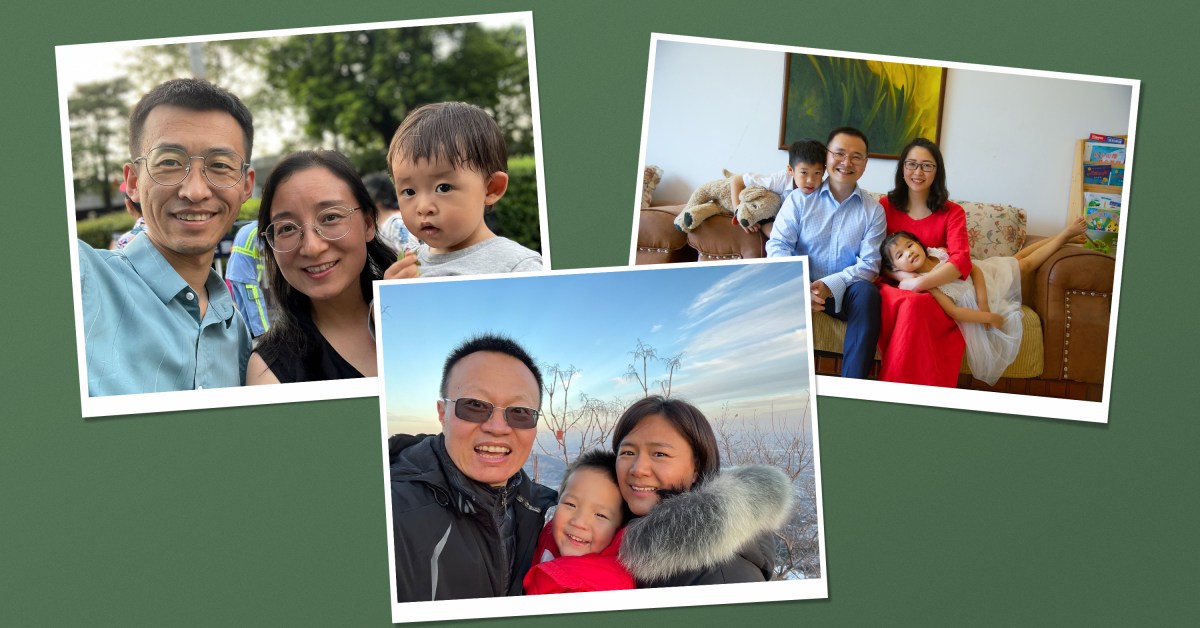
Around 9 p.m. on October 10, 2025, the power went out in the Beijing home of Ren Zhong and his wife, Wang Cong, leaving the couple and their 3-year-old daughter in darkness. Ren and Wang, who both minister at Zion Church, knew then that the authorities had come for them.
Their daughter, Song En, was terrified. Ren looked through the peephole of his door to find someone blocking it with a hand. The men outside claimed to be maintenance workers, but Ren and Wang stayed quiet, refusing to answer the door. Suddenly they heard the men prying at the door to get in. Ren urged his wife and child to stay back as he rushed to the door.
Seven plainclothes officers broke into the house, grabbing Ren by the collar and restraining him in a living room chair. They took Wang—an ordained pastor at Zion—into a separate room, while another officer confiscated their phones, computers, and IDs. Song En cried as they separated her from her mother. The police eventually allowed Ren to hold her in his lap.
Then they took Wang away, accusing her of “illegally using information networks.” Finally, when the men guarding Ren left, he picked up his daughter and ran outside in the rain, chasing after the police vehicle. Song En was crying, calling out for her mother. “Don’t be afraid,” Ren recalls telling her. “Daddy will definitely take you to Mommy.”
“I knew I couldn’t catch up, but I couldn’t stop, because I wanted to give my child hope. So I kept chasing,” he said.
Wang was one of nearly 30 leaders of Zion Church detained in a coordinated crackdown last October. A month later, authorities formally arrested 18 of them and have since released 9 leaders on bail. Most notably, on July 3, authorities unexpectedly led senior pastor Jin “Ezra” Mingri out of his jail cell and onto a flight to Los Angeles, where he reunited with his wife and children. The release came after President Donald Trump raised the pastor’s case in a meeting with Chinese president Xi Jinping in May.
Yet for the spouses of the eight pastors and church staff—including Wang—who remain in prison, their days are filled with worry. Authorities have charged the eight with more severe crimes: Two are charged with illegal business operations, and five with fraud. Wang “Franklin” Lin, longtime pastor and president of Zion Bible Institute and no relation to Wang Cong, is charged with both.
In recent days, the spouses-turned-advocates have escalated their push for their loved ones’ freedom, worrying they may be forgotten amid celebrations of Jin’s release. Jin mentioned them in a Wall Street Journal op-ed published Thursday: “These men and women, some of the most caring people I have met, are confined in cramped cells and sleep on floor mats in blistering heat. … I won’t rest until they see freedom.”
When Ren, also a full-time minister at Zion, heard news of Jin’s release, he recalled having complicated feelings. “I was shocked, then happy, but at the same time, I was saddened for my wife,” he said. “These two feelings … weren’t contradictory; they coexisted. After some time, the worry about my wife disappeared, leaving only happiness for Pastor Jin.”
The Zion case may have lasting implications for house churches in China that have long existed in a gray legal area. “This wasn’t just a matter for my family but for the entire church, not just our Zion Church. It involves two forces—the forces hostile to God and the forces that believe in God—and they will inevitably clash,” Ren said. “God is fighting this battle.”
Jin started Beijing’s Zion Church in 2007 with fewer than 20 people, and it quickly gained influence and numbers. By the time the Chinese government shut down the unregistered house church in 2018, the congregation had grown to about 1,500 people meeting at a large sanctuary inside an office building.
Geng “Cherie” Pengpeng joined Zion in 2008. She met her now-husband, Gao “Joshua” Yingjia, at the church. Like many members, Geng and Gao had advanced degrees at top Chinese schools—Geng a PhD in theoretical physics and Gao a PhD in plant genetics—but they felt God’s call to pursue full-time ministry. The two married in 2010, and Gao went on to be ordained at Zion. Meanwhile, Geng taught English as a means to evangelize.
On Sunday, September 9, 2018, Geng remembers returning home from a long day at church only to have a friend call her saying police were at the church. Gao and Geng drove back to Zion, where they found the streets closed off with about 100 police cars and buses in the area, along with both uniformed and plainclothes police. Authorities banned the church from gathering and took Gao and other pastors in for questioning. They were released later that night.
Without a central meeting place, Jin realized the church needed to split into smaller groups—defying the government ban—which required many group leaders. So, Jin and Wang Lin established a seminary called Zion Bible Institute to train young ministers. A small group began to gather at Jin’s home for discipleship classes and mentorship. The pastors also recorded courses to share online, and the number of attendees grew.
Meanwhile, the government continued to harass the church. Police raided meetings, temporarily detaining leaders and collecting information on others. When church members tried to rent meeting venues, police pressured landlords to reject their offers. Struggling to find a regular place to meet, they congregated where they could—guesthouses, teahouses, or even parks, where they listened to recordings of Jin’s sermon as they walked. Geng remembers that at the time, the back of their car was filled with snacks, stools, musical instruments, and cooking supplies so they could set up church at a moment’s notice.
When the COVID-19 pandemic hit in early 2020, Zion quickly moved its Sunday services, prayer meetings, and seminary classes to Zoom. With house churches closed throughout the country, many Christians heard about Zion’s online services and joined in.
Geng remembers their initial Zoom license accommodated 300 devices. The church upgraded to 500, then to 1,000, then to 3,000, and finally to 10,000. Some churches that lacked resources and capacity to continue their own meetings pointed congregants to Zion’s online services.
During the lockdown, Zion’s weekly meetings grew to include thousands of people in 40 cities across China, as well as abroad. One of them was Ren, who was stuck at home in the northeastern city of Harbin, unable to attend his house church. He had heard of Zion and, through participating in the online church, decided to pursue ministry and enrolled at Zion’s seminary.
To shepherd Zion’s new attendees, Jin visited different cities. Attendees within a city planned meetups and meals, which eventually became Zion church plants. Zion pastors oversaw different regions of China where local gatherings took place. Wang Cong handled northeast China, which included Harbin, and met Ren during a visit. In May 2021, they married and moved to Beijing.
Jin moved to Beihai in Guangxi province, shepherding churches in southern China. Gao stayed in Beijing, where he oversaw gatherings in the capital region, while Wang Lin supervised churches in the Yangtze River Delta region, which includes Shanghai.
Of all the pastors, Wang Lin and his family have faced the most intense persecution, said his wife, Su “Sarah” Ziming. She believes that is because of his influential role as the head of Zion Bible Institute and the rapid proliferation of churches in his region—between 2021 and his arrest, he planted 20 gatherings. Yet Su said she and her husband knew what they were getting into when they decided to return to China in 2017 from the US, where Wang Lin had earned his PhD in Old Testament and where their two children had been born.
“Walking on this path, we knew that we would one day experience this, but for the sake of God’s mission and calling, we still resolutely returned,” Su said.
In the past several years, Su, Wang, and their two children, now 9 and 10, have faced constant police harassment. Su said they had to move frequently—from Shanghai to cities in Zhejiang, Hubei, and Hunan provinces—as authorities monitored them and prevented them from renting or buying homes by intimidating landlords and sellers.
Police also raided church gatherings in their region. By June of last year, police were arresting ministers several times a month. In August, they detained 27 people—including babies—at the Sunday service in Jiaxing and sought to arrest Su on charges of participating in an illegal gathering. Su wasn’t there—while she had planned to attend the gathering, early that morning she had changed her train ticket to return to Jiaxing two days later. When she returned home August 5, police knocked at her door. She refused to open it.
Su said the most unbearable part of the persecution was its effects on her children. Authorities pressured school administrators not to enroll Su’s son and daughter. When they tried to homeschool, police raided the home where their homeschool co-op met. After Su and Wang moved to Changsha and sent their children to a new school for a week, the principal called Su to say they needed to withdraw. Leaving school that day, her kids asked why the teacher had told them to bring all their books and supplies home with them. “Mom, I really like this school. Please let me stay,” her daughter said. Su held back tears.
“The government has deprived children of their right to education,” she told CT. “It’s something you can’t fight against, something you can’t reverse, and even homeschooling isn’t allowed.”
Finally, the couple decided Su and the kids should move to Hong Kong and attend school there while Wang Lin stayed in mainland China to continue his ministry. In October, they decided to visit Hong Kong to look at schools. Wang Lin left for Hong Kong a day before her, on October 9. That day at 3 p.m., Wang stopped responding to Su’s messages. When Su’s call went straight to voicemail, she realized something was wrong.
Su alerted her Zion colleagues, asking for prayer and help. Around 7 p.m. officers rang her doorbell, but she and her kids stayed quiet, pretending no one was home. The officers stood guard outside their apartment building until the early hours of the morning. Once the police left, a fellow church member came and picked up Su and her kids to stay in a nearby city. When she called the public security bureau the next morning asking about her husband’s whereabouts, she learned police had arrested him at the airport and taken him to a detention center in Beihai.
In Beijing, Geng, the pastor’s wife and English teacher, initially thought the authorities were only targeting Wang Lin. But then around 4 p.m. on October 10, Geng heard police had encircled the Beihai apartment building where Jin and other church leaders lived. One by one, family members of church leaders shared accounts of police at their doors. “At that point, the atmosphere became increasingly tense,” Geng said.
Then she heard of Beijing pastors getting arrested. When a lawyer friend called her, urging her to leave, Geng and her husband, Gao, scooped their 5-year-old son out of bed and drove 10 minutes to a friend’s house. As she watched her son sleep, she monitored the church’s group text, where she learned police had raided a retreat for Zion’s elderly ministry in the Beijing suburbs. When officers showed up, one of the church women had a heart attack. Police took the woman’s son, pastor Sun Cong, in handcuffs.
At 1:30 in the morning, Geng heard someone banging on the door. Five or six men, claiming to be from the Beihai Public Security Bureau, entered, looking for Gao. Not wanting to cause trouble for the friends they were staying with, Gao left with police. When Geng later returned to their apartment, she found that authorities had broken in while they were gone, seizing electronics and 16 of her journals and changing the locks.
The next morning, Geng and other spouses of the detained met at a lawyer’s office to seek help. Most didn’t know their loved ones’ whereabouts, although one officer told Sun’s wife that Sun was being held in Beihai.
The following Monday, Geng and the other spouses—along with a gaggle of young children—flew to Beihai, where they met their lawyers and visited the public security bureau, asking to see their spouses’ arrest warrants. They were told the warrants had been mailed to their homes. To this day, Geng hasn’t received the official detention notice or arrest warrant.
Su and her kids attempted to leave the country on November 10, but authorities stopped them at the airport. She later found out they had a warrant for her arrest. But they didn’t detain her. Su believes they needed her as leverage to extract a confession from Wang.
After bringing her in for brief questioning on November 13, authorities released her and granted the family permission to leave the country. Within days, they flew to California, where they settled near friends and Zion Church members in Chino Hills. The kids no longer worry their mother will be taken from them.
A lawyer also recommended that Geng leave the country. Two weeks after her husband’s arrest, Geng and her son flew to South Korea, then moved to Thailand, where she has friends. She said it has been difficult to accept all that has happened.
“I often feel very disoriented, like it’s all unreal,” Geng said. “It feels like [Gao] suddenly disappeared, like you can’t see him or touch him, you can’t contact him on WeChat or by phone.” She tries to appear strong around her son, but when he’s out of the room, she cries.
Although her son was asleep when his father was seized, he still has nightmares where a group of men break in to take his mother. After arriving in Thailand, her son would get upset over little things—such as when Geng corrected him or a friend accidentally bumped him—and insist he wanted to go back home to Beijing.
Geng has bad days and good days. On the good days, her faith is strong, and she finds comfort in God’s Word. But on bad days, she bursts into tears after sending her son to school, worrying about Gao in prison.
The lawyers say her husband and the other inmates aren’t getting enough food—many have lost around 40 pounds. They sleep in a small cell with around 30 people. Yet the lawyers also report that Gao is exercising every day to keep healthy, and his daily regimen has encouraged other prisoners to join him.
Ren also worries about his wife’s condition in prison. Lawyers said she is covered with mosquito bites and has developed rashes in the hot and humid environment. When guards found her writing about spiritual topics, they ripped up her papers and gave her extra work.
Since his wife was taken, Ren has shouldered the duties of a single father, advocated for her release, and communicated with lawyers, all while still serving the church. With most of Zion’s leadership behind bars, Ren has taken on more church responsibilities as weekly gatherings continue.
He recalls a message his wife passed along to him through her lawyers that provided him great comfort. “She said, ‘Right now, you are the most devasted because your wife was taken, but in front of your congregants, you still need to comfort them and offer words of encouragement,’” Ren said. “I was wounded, but I had to keep going.”
As authorities release more of the pastors, Ren has been able to step back from his pastoral role to care for his daughter. Sometimes, Song En asks where her mother is, and he tells her she’s working in Beihai because people there also need the gospel and a pastor. Other times, Song En says, “The bad police took Mommy away,” and is fearful of people knocking on the door.
Under Chinese law, the formal investigation phase cannot exceed seven months, so on June 18, officials released nine Zion leaders on bail. While Geng tried not to get her hopes up, she still cried when Gao was not among them. She was happy to hear of her friends and colleagues being released, but when she saw pictures and videos of their reunions with family, she was shocked to see how much they had changed in that short time: They were skinnier, some were balding, and their backs were more stooped. “I felt very sad and angry that day because I also felt sorry for them, so I was really depressed.”
Ever since her husband was seized, Geng said she has woken up each morning with a worship song on her mind. That next morning, the song was “Grace,” which includes the lyric “Everything we take for granted in this life is God’s grace…Everything is grace.”
Now that Jin is free, Geng said she hopes the others will be immediately acquitted and change will come in China: “We hope to see a freer environment for faith in China and that justice would be more effectively manifested on earth.”
Su said that after authorities arrested Wang Lin, God told her to “look for my miracles.” She didn’t know what that meant, as all she saw were more arrests. Then, she said, she watched as God miraculously opened the doors of Jin’s jail cell and brought him to freedom. She felt God was saying he would do miraculous things not just for Jin but for all involved in the Zion Church cases.
“God can continue to perform miracles for the remaining eight people,” Su said. “This is something that gives me great comfort and strength. I feel like I’m in a good state because I know God is alive.”
