
Eleven minutes before the start of lunch service at Salem Lutheran Church Dining Hall, a woman inside the screened-in cafeteria orders a girl to make sure all six tables get a final scrubbing. “Get off your phone,” the woman says. “We are a church, so hospitality is top of the line for us.”
A few steps away, at the front of the little, blue-roofed building, four teenage boys take orders from a line that wraps down a sidewalk and into the grass. They sling to-go cups of Swedish egg coffee, a smooth black brew made with raw egg and crushed shells in the coffee grounds.
An older man in a Timberwolves T-shirt sidles past the line and opens the door to go in—whoops, he’s a few minutes early. The Salem volunteers are still turning things over from breakfast. The man retreats, smiles, and bides his time—taking a picture of the next-door Peachey’s Baking Co. trailer, which over the next 12 days will convert about 16,000 pounds of flour into oversized Amish donuts.
This is day one of the Minnesota State Fair.
The “Great Minnesota Get-Together” is a mild moniker for the festivities. This is the nation’s largest state fair by average daily attendance, bringing about 2 million total people to the 322-acre fairgrounds between Minneapolis and St. Paul. The economic impact compares to that of a Super Bowl. This year’s opening day set an all-time attendance record of more than 155,000.
Gates open at 7 a.m. Within minutes, families are hunting for corn dogs and Sweet Martha’s Cookie Jar, sinking their teeth into spam sandwiches, passing through the butterfly garden, or riding a boat through the dark tunnels of Ye Old Mill. They pass stands with names like “Sausage Express” and “Big Fat Bacon” to witness a cow giving birth or a dairy princess modeling for butter carving or a shirtless firefighter competing with a gopher mascot in a pushup contest.
It didn’t take long for the fair, which began in 1855, to explode from a small gathering for farmers and tractor dealers into its current form—part carnival, part farm show, all one last hurrah before Minnesota ices over again.
Churches were a big part of that growth, powering 89 different food stands or dining halls back in 1903. Part of their appeal was that they offered a quieter alternative to the bustling midway, which took off at the first Chicago World’s Fair and quickly migrated west.
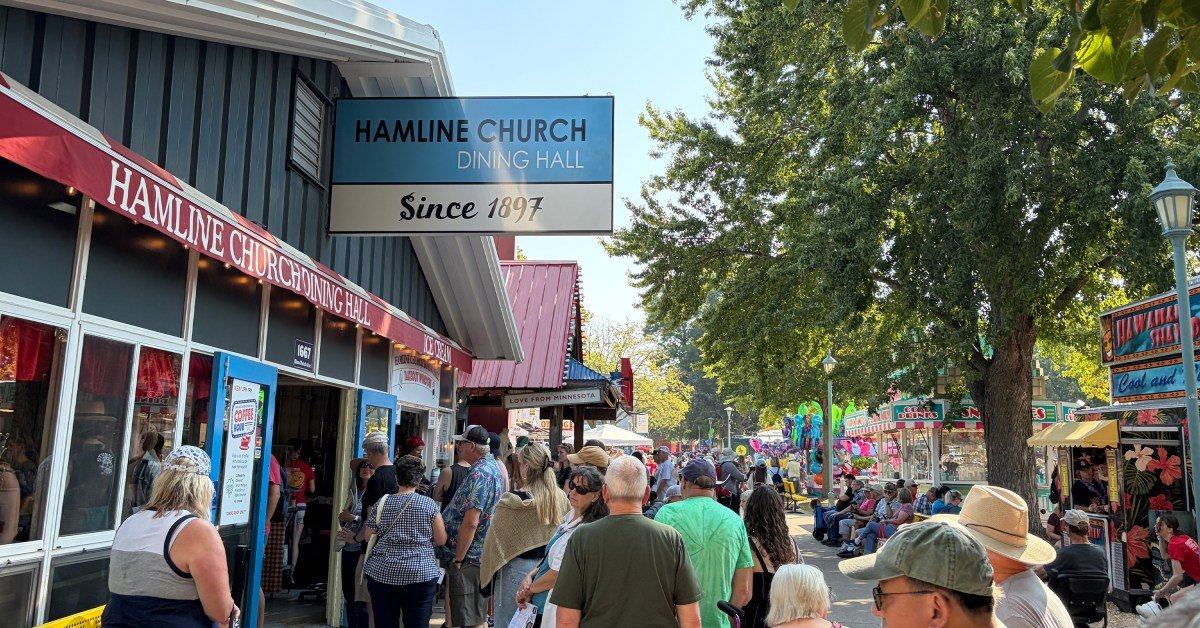
Today, only two church stands remain: Salem Lutheran, which has served its egg coffee since 1949; and Hamline United Methodist, which opened in 1897. Not only is Hamline the oldest concession stand in the entire fair, but it also boasted one of the fair’s longest lines on the first day of its 129th year.
Pete Theisen, who lives nearby, biked to the fairgrounds to work the first of his shifts for the Hamline stand that morning. Back at church, he helped judge new additions to the historic menu, like the mini donut espresso shake-up and dill pickle lemonade popsicle. He and his wife, Jennie, have been volunteers since 2010. Their church isn’t huge, they told CT, so it’d be pretty obvious if they didn’t sign up.
Still, they love it. “It’s a flashback to the ’50s and ’60s,” Pete said, when friends and family and even strangers sat down for literal table service. On opening day this year, both sides of the political aisle joined in. Tad Jude, a Republican candidate for Secretary of State, sat down for a bite; and Peggy Flanagan, a Democratic nominee for the Senate, visited to pour a few cups of joe.
Jennie Theisen bused Hamline’s tables, where many ordered the signature breakfast sandwich—ham loaf on toast with cheese, onions, a fried egg, and a tangy glaze. She wore a Dolly Parton T-shirt, days after the country legend died, wishing to model Dolly’s kindness with “radical hospitality.”
Sometimes Hamline has to strain to get such energetic help. Volunteerism has declined over the years, according to Mary Bloom, co-chair of the church’s dining hall committee. The state fair’s abundance of bigger, established brands—which often employ paid staff—doesn’t help.
Tradition is Hamline’s secret sauce. Its ham loaf recipe, which produced 680 pounds of the bestseller last year, dates back to the 1940s. Hamline added a takeout window in 2012, but what they really want is for busy bodies to come in, sit, and relax. “We have a history,” Bloom said, “of people coming and saying, ‘My grandpa used to bring me here every year and sit down with his ham loaf dinner, and this year I’m trying it in his honor.’”
Most stands work hard to get an official mention on the state fair’s annual list of new foods, which for 2026 included pickle pie, pumpkin bar funnel cakes, and brandy-flavored cookie dough on a stick. Hamline wasn’t worried about it, Bloom said, because people aren’t usually visiting them for novelty. “They love the atmosphere,” she said. “We grow on people.”
When people eat at Hamline, they benefit the church’s mission work. A portion of the dining hall’s profits are donated to Emma Norton, a St. Paul nonprofit that provides housing and mental health services to women and others experiencing homelessness. All of Hamline’s pastors also volunteer in the dining hall, but their approach isn’t to be evangelistic as much as available.
The Theisens, who started their day volunteering at Hamline, observed the same approach at Salem Lutheran’s dining spot a few blocks away. They ventured over on their lunch break just to get a look at it.
The Salem hall, run and organized by a North Minneapolis congregation, is even more compact. Red-painted wooden benches line six tables inside what could pass for a mashup of a church basement and school cafeteria, with old Swedish coffeepots hanging on the walls next to whimsical, vine-like paint strokes. A laminated sheet is strung above the silver coffee urn: “Bless us, oh Lord, and these, thy gifts, which we are about to receive. Amen.”
The tall brick building next to Salem’s stand is known as the Progress Center, evolving over the years to showcase poultry, technology, and now green energy exhibits. Salem, meanwhile, is still built on the “lost art” of giving visitors a place to rest, connect, and be served, according to pastor Eric Hoffer. “If they know we are a church, cool,” he told CT. “And if they don’t, they will still be fed.”
Salem goes through about 1,000 cups of coffee a day, meaning they serve close to 12,000 by the end of the fair. Pancakes are another hit from a decades-old recipe, which hasn’t been touched. Ditto for the Swedish meatballs, made from scratch. Salem also specializes in Swedish ice cream sundaes—topped with lingonberry jam and a pepparkakor ginger cookie—and a “Lutheran latte,” which is their egg coffee with a scoop of vanilla ice cream.
Their strategy is under constant review. Salem has cut underperforming foods, like homemade split pea soup, and still gets one or two visitors who want an explanation. Hot dogs were axed because “you can’t walk 25 feet without seeing a Pronto Pup stand,” said co-manager Steve Johnson.
“Every year since the pandemic,” Hoffer said, “we’ve had a debrief conversation where our core leadership has wondered, can we even continue? And every year we have said yes.”
But Salem is small, drawing only about 40 people on a regular Sunday morning. The church has required outside help to function like a full-service restaurant for 12 days a year—and keep the old dining hall intact during the off-season in Minnesota winters.
The work doesn’t pay very well, either. The fair takes 15 percent of Salem’s gross revenue, and other expenses take a toll. Whatever is left goes mostly toward other hospitality ministries, like weekly community meals and food shelf partnerships.
“If all the volunteers got part-time jobs at minimum wage and worked the same number of hours, it’d be way more money for the church,” Hoffer said. “Sometimes the scope and the history feel like a lot of pressure to keep this alive.”
Yet they press on. The fear of needing outside help became an invitation for outsiders to “come and see” their Christian hospitality, along with the thousands of others passing through. Steve Johnson, who grew up running the dishwasher, rolling meatballs, and “keeping the bacon moving” as a teenage volunteer in the 1960s, likes to stand in the doorway these days, absorbing the buzz—those red benches full of people who five minutes earlier didn’t know each other.
“We have a gentleman who comes every year,” Johnson said, “who is mute and deaf. He uses gestures and handwriting. And our waitresses fight to be the one who takes care of him.”
More than once a day in the dining hall, Hoffer added, somebody tells him they grew up in church and appreciate the welcome they felt in Salem’s space. Many express interest in trying a Sunday service again. Only about one in 12 actually follow through, Hoffer estimates. Those who do sometimes wonder where all the pancakes and meatballs are.
Still others have grieved loved ones over dishes inside the hall. While their chats aren’t long, Hoffer said, “for that moment it felt like I was their pastor.”
About a month before this year’s kickoff, Hoffer gave a sermon on the parable of the sower (Matt. 13). It basically defined Salem’s mission in the middle of the cheese curds and karaoke contests. “Really, our job descriptions don’t include state fair work,” Hoffer said. “But what a privilege to have this very unique soil to spread love. It’s not really up to us what happens after that.”
Others try to pour water on those seeds at the fair, just not with food. Right next to the Kidway, where mini swings fly and monster trucks roar, Crossroads Chapel operates exclusively during fair dates. Originally opened in 1954 as a gospel tent, it serves free Bibles, prayer, and kids crafts.
Director Robert Smith, an associate pastor in Corcoran and a chaplain around the Twin Cities, grew up in Chicago and had his fill of sweaty fair crowds along Lake Michigan. “It was not my deal,” he told CT. He preferred global missions, venturing to Germany, Honduras, Liberia, and Congo.
That is, until he was invited to preach at the Minnesota State Fair. Suddenly he saw “every walk of life,” shoulder to shoulder for 12 days. Thousands pass by Crossroads without a second thought, and some probably visit just for a cooldown—the chapel and its attached gift shop are one of the fair’s few air-conditioned vendors. Others, however, stop as spiritual seekers.
On Thursday, that included four ladies from the St. Cloud area. One of them grew up in church, she told CT, but never read Scripture on her own. She didn’t plan on stopping at Crossroads when her group walked through the fair gates, but her daughter had been interested in reading the Bible after hearing of friends doing the same. The group asked a volunteer to read some verses aloud from several translations at the table of free options. Before leaving, the woman told CT that she didn’t view their visit as a divine encounter. But her group walked away holding four new Bibles.
 Photo by Cody Benjamin
Clif and Joy Gustafson, of Minnetonka, also selected a pair of Bibles—gifts for two of their eight great-grandchildren. Clif, who wore a shirt from Franklin Graham’s “God Loves You” tour, chose the same kids Bible that another woman tossed into her toddler’s wagon, next to some donuts.
Another time, director Robert Smith said, two teenage girls approached him—drunk and tearful—to confess their hopelessness and ask for help. “Where else are people gonna get that at the fair?” Smith said. “It’s not gonna be at the beer garden. It’s not gonna be at the grandstand.”
Traditionally, Crossroads has partnered with 12 different churches, who supply volunteers for 12 days of the fair. They also hold four full chapel services. But Smith has been fighting to level up the whole operation. He expanded Crossroads’ list of church partners and incorporated more multicultural voices, including from Shiloh Temple, a historically Black Pentecostal church. Crossroads’ free Bible table also includes a section with Spanish-language options.
Inside the gift shop, Smith “had to rebuke” what was perceived as less welcoming material. Shortly after he took over, some complained that Crossroads had sold books by Scott Jensen, a former Republican candidate for governor. Smith, who is Black, wanted politics out of a space designed to favor Jesus: “A lot of people who look like me walked into the bookstore, and we lost them.”
The movement carries over to Crossroads’ mini outdoor worship stage, where the ministry—long focused on morning and afternoon sets—is now prioritizing evening crowds. Streets were all but blocked off for praise nights and baptism sessions after last year’s new partnership with Pulse Ministries, which began as a student-led movement at North Dakota State.
“They can’t deny the positive energy,” Smith said. “Would you rather be breaking up drunk fistfights or trying to prevent big crowds from raising their hands?”
By the time Pulse wraps up its first open-air worship session on Friday night, the Ferris wheel lights kick on to mark the dimming sky with color. Overstimulated tots cry out from the carnival. Some of the longest lines start to fizzle. And the last two church stands put the finishing touches on their late dinner orders, prepping batter, fryers, and coffee cups for the next sunrise.
“If Jesus were here,” Salem’s Johnson says, “he’d be flipping pancakes.”

