
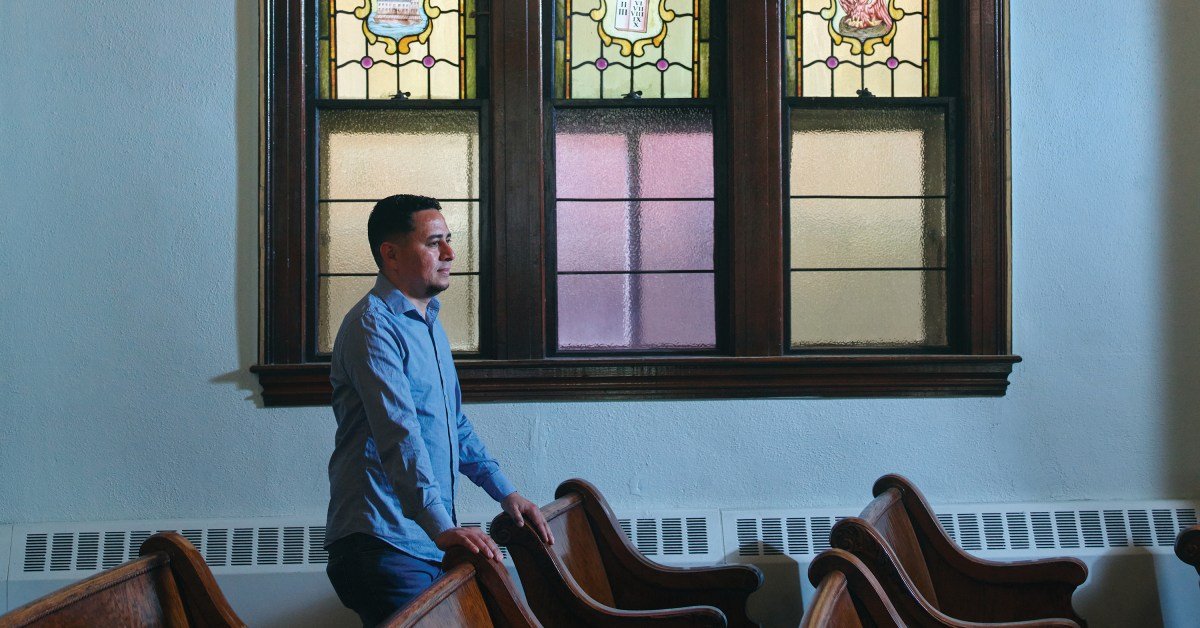
Raúl Hernández already knew, before the official sitting across a desk from him could say it, that he was going to be arrested.
Two weeks earlier, in October of last year, the email had arrived. It informed Hernández, then a 36-year-old from Honduras who had entered the country illegally in 2018, of new procedures requiring him to report in person for his annual check-in with Immigration and Customs Enforcement (ICE).
Raúl and his wife, Lilian, spent the following days agonizing. Theoretically there was nothing to fear—they had a pending asylum case and had been in contact with ICE for years, sending required address updates and any other information the government requested. Since the opening week of the second Trump administration, however, ICE had become more aggressive with routine appointments, summoning a growing number of people to its offices and detaining them on the spot.
At night, after tucking their three children into bed at their second-floor apartment in Chelsea, Massachusetts, Raúl and Lilian stayed up debating what to do. Raúl could skip the appointment, an infraction that might doom his chances for receiving asylum. But then they could leave the country on their own terms, return to Honduras, and spare Raúl the misery of deportation.
Their lawyer and their pastor thought Raúl should take his chances at the check-in.
“How are we going to pay the bills if they detain you?” Lilian asked. They had $200 in their bank account.
On Friday, November 7, the entire Hernández family drove, along with their pastor and several members of their church, to the ICE field office in Burlington, Massachusetts. An officer checked Raúl’s documents, said something about talking with his supervisor, and told Raúl to return after the weekend.
That Sunday in church, Raúl rose from the pew and asked for prayer. “I feel a growing weight inside me, like something is going to happen,” he told them, crying. “I don’t know what, but I am afraid.”
The next morning, the family and another crew from the church again drove the 40 miles out to Burlington, where Raúl soon found himself sitting in a windowless room with his lawyer, listening as an ICE agent announced that he was going to be deported.
Raúl heard the fast-talking lawyer rattle off objections: He wasn’t unlawfully present. He was party to an asylum petition. He was a leader at his church, some of whose congregants were waiting just outside with his wife and children.
But already another officer was fastening cuffs around Raúl’s hands and moving him toward a door.
The lawyer was raising her voice, demanding he at least be allowed to say goodbye to his wife.
The last thing Raúl remembers saying to the lawyer, before she slipped from sight and someone strung chains to his belt and ankles: “Don’t worry. God told me this was going to happen.”
The truth was, in ways he did not understand until later, Raúl had prayed for it to happen.
Roughly eight years ago, Raúl and Lilian Hernández crossed the US-Mexico border with their two young sons, ages 5 and 6 at the time, and surrendered to Border Patrol officers. They requested asylum in the United States, hoping to leave behind the gang killings and drug crime endemic to their hometown in western Honduras.
During their intake into the federal immigration system, the Hernándezes suffered a paperwork error, a technicality they knew nothing about. According to their lawyer, ICE and Border Patrol filed papers in immigration court—the usual protocol—for Lilian and one son. But they never submitted papers for Raúl and their other son.
The result was that, after the Hernándezes left detention at the border and went about their lives, Lilian’s case moved into the country’s glacial asylum system. Raúl’s was lost in a state of legal limbo.
The slip-up would lie in wait for years, with an eventual twofold consequence. The government seized upon it as pretext to detain Raúl. But it was also the first in a series of events that would redefine a Boston church.
The Hernándezes settled in Chelsea, just outside Boston, where Lilian has a sister. Raúl painted houses. Lilian worked as a night cook before finding a kinder schedule as a nanny.
At the recommendation of a friend, the family visited Resurrection Church in neighboring East Boston in 2021. After one Sunday they didn’t want to go again. The Christian Reformed congregation appeared to be evangelical, but it laced its worship with liturgy and seemed overrun by men with long, unkempt beards—things that reminded Raúl and Lilian of the Catholicism they had forsworn a decade earlier in Honduras when they converted to Protestantism.
Raúl talked it over with his recommending friend, who was a pastor. Try it again, his friend told him. It will be good for you.
 Photo by Douglas Levy
The family returned for another Sunday, and the church stuck.
From its beginnings just before the COVID-19 pandemic, Resurrection was a church that asked people to “get your body in the game,” said Kaitlin Ho Givens, the lead pastor.
When pandemic shutdowns hit East Boston’s mostly Latino population especially hard, the church responded. It worked with donors and local officials to pass out thousands of restaurant vouchers. It organized to help immigrant neighbors navigate government rent relief programs.
The church’s culture seemed to fit the Hernándezes, and they volunteered to serve here and there. Raúl, a man of many words, and Lilian, a woman of few, helped lead a small group of English and Spanish speakers that toggled between languages.
Raúl was usually the first to greet visitors on Sunday afternoons, when the church meets to worship in a sanctuary it rents from another congregation. The Hernándezes always sat in a front row. When their daughter was born in 2024, they moved to a pew in the back to manage the infant; Raúl sometimes felt he needed to apologize for the relocation.
The Hernándezes gave of themselves, and the church gave back. Raúl did jobs for church members. When the family needed a new immigration lawyer, Kaitlin connected them with Tina Colón Williams, an old friend from her college days who also happened to be a professional worship artist.
Kaitlin and other leaders encouraged Raúl to explore vocational ministry. Soon Raúl set out to earn an associate degree in theology, enrolling in an online program. He began preaching occasionally; he would lecture in Spanish while Kaitlin, who’d learned Spanish while doing ministry in the Dominican Republic, translated. “Raúl is abnormal in faith,” Kaitlin said.
Yet for all that faith, Raúl contended with insecurities. He was self-conscious about his voice and didn’t like singing. Whenever he preached, he would tell Kaitlin beforehand that maybe he shouldn’t. Who was he, a painter, to be teaching a roomful of Boston lawyers and engineers and doctors?
“Every single time, it’s the same conversation,” Kaitlin said.
On October 26—12 days before his ICE check-in—Raúl preached about resting in Jesus. But he was stressed. He descended the pulpit feeling like an imposter. That week he told God he didn’t want to preach anymore. “Maybe I’m not meant to be here,” he prayed. “If it’s possible, Father, give me the opportunity to go and preach maybe in prisons or hospitals.”
Raúl heard God answer within a few days, when he was praying again. Across his mind rolled the words of Matthew 21:5, “See, your king comes to you, gentle and riding on a donkey.”
“I don’t know if it was a voice,” Raúl said later. He didn’t quite understand—he was no king, and there were no jails in the text—but he felt a prophetic instinct: God would send him to prison.
“God wanted to do this,” Raúl said. “He was going to go in with a person who did not have legal status, a person who did not have legal protection, a person who looked like he might be deported—and he was going to use this person.”
What he didn’t think God wanted was to ensnare the rest of his family in America’s immigrant detention edifice.
On the morning of his final check-in on Monday, November 10, Raúl dressed and prayed: “Please don’t let them detain my wife. Don’t let my children be alone.”
Sarah Stuntz took the day off work to accompany the Hernándezes to the Burlington ICE office. She was in their small group and had eaten too many meals with them to count. Sarah, like others who drove along that morning, thought that perhaps her presence—a Harvard-educated white woman, a high school principal in East Boston—might dissuade federal agents from doing something drastic.
But in contrast to the protests against immigration raids that eroded public support for ICE in 2025 and early this year, Sarah had entered a more veiled arena of immigration enforcement—one essential to what many observers say is the quieter future of the government’s mass deportation campaign. In ICE’s own offices, the Department of Homeland Security enjoys broad freedom to arrest immigrants, often with little cause or explanation, away from the media and other witnesses.
After Raúl and Tina, the lawyer, disappeared down a hallway for his check-in, Sarah waited in the lobby with Lilian and Kaitlin and another church member, trying to lighten the mood. (“Picture a DMV,” she said later.) Someone from the church delivered Chick-fil-A for the three children, who had stayed out in the cars with other parishioners.
Then, the sequence that will forever adhere in Sarah’s memory: A plainclothes ICE officer crossing the floor toward Lilian, Tina following behind and shaking her head. The officer handing Lilian a clear plastic bag containing Raúl’s phone and other effects, then turning away without a word as the woman burst into tears.
“Even if you believed that this was justice,” Sarah said, “I wonder if people really understand this is how it’s being executed and this is what it looks like.”
Outside in the rain, the group stood under umbrellas as Tina explained legal options in Spanish. Kaitlin remembers desperately grasping what technical terms she could, noticing that Lilian seemed to be shutting down.
“You have to listen right now,” the pastor told Lilian. “You must understand what she’s saying.”
When they walked back to the cars in the parking lot, Sarah saw the boys’ faces through the rain-spattered windows, the situation dawning on them before anyone could speak.
Before Raúl’s detention, Resurrection was well involved with immigration issues. Church members had seen ICE agents everywhere in East Boston and Chelsea during an enforcement surge in early 2025. The church had facilitated know-your-rights talks, helped parents prepare powers of attorney in case they were separated from their children, and invited a guest preacher last September to speak on “migration and the mission of God.”
But witnessing Raúl’s severance from his family turned immigration suddenly and intensely personal for the congregation. “We knew it was happening,” Sarah said. “But it hadn’t happened to us.”
Kaitlin wasn’t sure how long she could sustain a fight, but she knew a fight had begun. Oh, this was a bad choice for you guys, she remembers thinking, because our church is ready.
After everyone had returned home that afternoon, Kaitlin’s phone rang. Raúl was calling from Burlington. She told him that Lilian was safe, that he didn’t need to worry—the church would see to everything for his family. “Don’t be fooled by the stupid prison clothes they give you,” the pastor told him toward the end of the brief call. “Remember who you are.”
That night, in group messages and in person, people at Resurrection kept repeating the word miracle.
It was a miracle that someone at the church knew another lawyer who could help Tina file a habeas corpus petition—an appeal to release a defendant from detention—with the federal district court in Massachusetts. It was a miracle that the two lawyers could file late Monday night, within hours of Raúl’s arrest, while dozens of church members prayed together over Zoom.
It was a miracle that a judge happened to be working at 10:33 p.m., when she received the request and ordered ICE to keep Raúl in Massachusetts while the court considered it.
Kaitlin had felt a terrifying helplessness when Raúl never came out of that ICE office. But she saw the miracles as a lesson in the power of advocacy. She never considered herself an activist—the thought of attending protests makes her uncomfortable—but the early victories emboldened her. “The thing we do so much as humans—which is to say, ‘Wow, this is so hard,’ and we kind of give up—that is not helpful right now. You need to move in some way.”
Resurrection moved in many ways. The church circled around Lilian and the children. The boys, now ages 12 and 13, weren’t eating; they stopped going to school. Kaitlin’s husband took several days off work to help care for them. He tried little games to entice them to drink or have a snack. They hung out, played chess, went to the park to play soccer.
Others in the church took off work so they could take Lilian to buy groceries or go with her to the bank. People brought meals. The church’s youth arranged hangouts. Women texted Lilian little prayers and Bible verses—especially in the evenings, when she and the boys struggled to sleep.
“The nights were the worst,” said Kaitlin, who spent hours with Lilian every day.
Raúl knew nothing of this; neither Lilian nor Kaitlin could bring themselves to tell him. One morning, Kaitlin was with Lilian and the children at their home when Raúl called.
Are you guys okay? Kaitlin heard him ask his sons.
Yes, Papá, we’re good. How was he?
Yeah, yeah, I’m good.
Kaitlin sat and quietly cried. No one is okay here, she thought.
Tina had told Kaitlin and Lilian that, if the federal court granted the habeas petition, the next step would be for Raúl to have a bond hearing at which a judge would decide whether to release him. To prepare for the hearing, Tina said, it would help to provide the court with character references—notarized letters.
The lawyer could not have thrown a slower pitch.
Kaitlin put out a call to current and former parishioners—anyone who knew Raúl—to write. She also reached out to Daniel Montañez, a friend and scholar well connected within Boston’s immigrant churches. Would he gather a letter with lots of signatures?
In total, around 50 letters arrived. A local nonprofit stayed open late one night to host church members—some of whom were so wrapped up with the Hernándezes that they hadn’t showered in days—for a little “notary party.”
The letter delivered by Montañez bore more than 200 signatories. From pastors in Cambridge and New York City. From professors at Duke, and at Gordon-Conwell and North Park seminaries. From Pentecostals and Nazarenes and Catholics and Presbyterians.
In a matter of days, church people everywhere in greater Boston seemed to know about Raúl. When Resurrection created an online fundraiser to help with the family’s living expenses and legal costs, the GoFundMe quickly raised more than $56,000.
Resurrection is neither a large nor a wealthy congregation—by Bible Belt standards it would be a quaint church plant. But the congregation is an unusual American space, one in which recent immigrants and urban elites intimately share life together. In the wake of Raúl’s detention, Resurrection became like a keyhole through which a roomful of saints awash in social capital peered to the other side of a door in God’s house.
“It’s a very rare case where that many people just came behind and mobilized behind one particular person in the church,” Montañez said. “Word spread very quickly.”
Raúl would struggle later to explain it, how the last place on earth he wanted to go became a place he didn’t want to leave.
After his arrest in Burlington, he spent a day and a half in a 12-by-20-foot holding room where the lights never turned off and where roughly 30 men slept on the hard floor with foil emergency blankets. (The ICE facility has drawn protests and scrutiny from local officials for routinely holding immigrants for days, despite its own guidelines that it could not keep detainees overnight.)
Raúl greeted men around the room, asking if he could pray for them. What fear he felt retreated once he heard from Kaitlin that his family was safe. “I had a lot of peace,” he said.
After his lawyers filed the habeas petition, Raúl was put on a bus and driven 60 miles south to the Plymouth County Correctional Facility, a county jail that rents several of its cell blocks to ICE. It housed a daily average of 500 immigrant detainees when Raúl arrived in mid-November. More than 80 percent of them, like Raúl, had no criminal record.
His cell was a small room with five beds—one just for him. Men in Burlington had told him that if you had to be locked up, Plymouth was the place to be, and now Raúl saw why: He could shower, eat three hot meals a day—nothing like the horrors he’d heard about in other detention centers. There was even a large meeting room where, he soon discovered, some of the men held church services.
All of it felt like a reassurance from God: He’d provide Raúl with everything he needed so that, in turn, Raúl could care for the men around him.
Most nights, the church met in the large room, which never seemed used for much else, and as many as 50 detainees would squeeze in to read Scripture, sing, and pray, mostly in Spanish.
Raúl felt a renewed urge to preach. He asked God to forgive him for saying he didn’t want to teach anymore in church—he realized that here too was the church. He sought a jail supervisor’s permission to instruct the men, then began to preach every couple of nights.
The topics varied. He taught about Jacob’s vision of angels ascending a ladder, telling the men that this jail was like a gate to heaven: “The enemy thought he would use this place to destroy. In reality, it’s a workshop God is using to rebuild our lives, our faith.”
“You are important to God,” Raúl would tell them.
Around him spun a constellation of heartbreaks. Men who had been inside for months. Men who realized no one was coming to help, forgotten by their families or ill-equipped lawyers.
Some of them sought out Raúl, inviting him to their cells for prayer or to read the Bible or show them how to become Christians. Others deposited on him their heaviest regrets: If only I’d been faithful as a husband. If only I’d been a better son.
His response was always, Your story doesn’t end in this place. “God can restore your life,” he would say. “God has forgiven you. He’s going to get you out of here so you can become everything you want to become.”
Inside Plymouth, “I lost my shame about everything,” Raúl said. Even his insecurities about his voice evaporated. Once, Raúl and his cellmates held an all-night vigil, praying and singing nearly until breakfast was served. (“It was like a retreat.”) They sang a Vineyard song recorded by Tina, “Dios del Descanso”—a favorite at the jail church.
During his first week in Plymouth, Raúl never once prayed to be free. He didn’t want to pressure God. “If they deported me, I wanted God to know that I was okay, that I knew it was his will,” he said.
But being separated from his family played with his mind and emotions in ways that scared him. A few days after arriving at the jail, Raúl tried and failed to imagine his daughter’s face. The harder he focused, the more his daughter’s features vanished. “God,” he prayed in his cell, “why can’t I remember?”
Still, Raúl told the other men without any irony that he was happy to be there.
Every day he asked for a sign that God was still with him. And every day he would see birds flying past a small window high in his cell, sunlight streaming in from above the trees.
“You can feel the joy of God,” he told someone. “It’s miraculous that you can wake up in the morning with a smile on your face, even knowing that you’re in this place.”
Andrés Tobón, a 29-year-old from Colombia who had also been detained during a check-in at Burlington, was in his second week at Plymouth when Raúl arrived. The two hit it off.
“You know those people who are just special?” Andrés said later during an interview. “Ever since he came, I felt he was one of them.”
Andrés told Raúl he’d meant to find a church, but life was busy and he never got around to it. Raúl told him about Resurrection, how it was not far from where Andrés lived.
When they got out, Raúl said, he would introduce Andrés to the church.
Except, Raúl said later, “There was something in me that wanted to stay there.”
On the seventh day of his detention, a Monday, Raúl was on the phone with Kaitlin, getting notes from her sermon the day before so he could adapt it for his own preaching. He told her about all he thought God was doing in Plymouth.
“Raúl, we need you out here,” Kaitlin blurted. “The boys are having a hard time.”
It was a theme with them. Kaitlin had tried to convey before that it wasn’t unfaithful to acknowledge both that God brought you to a valley and that you’d like to climb out.
During that same call, according to Raúl, Lilian was on the phone and told him for the first time: The kids were always crying. She couldn’t seem to help them.
The conversation left Raúl shaken. After they hung up, he wept. He prayed right then, “God, give me a way to get out.”
On November 19, court records show, the judge granted Raúl’s habeas petition. She ruled, in brief, that federal law allowed Raúl to be held indefinitely only if he were a national security threat, which he clearly was not.
Five days later, Raúl sat on the other side of a video feed from another judge presiding over his bond hearing. On the screen, Raúl could also see Kaitlin, who had dialed into the hearing, and the names of perhaps 50 others who had vouched for him in letters and were attending remotely. It seemed as if his entire church was there.
There was little deliberation. “Raúl is very Rosa Parks-y,” Kaitlin said. “It’s hard to find anything to blame on him.”
He walked out of Plymouth around 6 p.m. on November 25, two weeks after his arrest. Before he left, Raúl asked the other detainees to forgive him. It was not fair that he would be free before them, most of whom had been there vastly longer. “It’s unjust that the system is like this,” he told them.
Kaitlin’s husband drove Raúl home to Chelsea. They pulled up to the curb after dark near the Hernándezes’ apartment, where their 1-year-old daughter was waiting on the sidewalk. Raúl got out of the car, hazards blinking behind him, and the toddler began to run, bobbing in a marshmallowy pink jacket. Her father dropped to his knees and pulled her into his chest.
For days, Raúl’s mind seemed stuck behind at Plymouth.
He would wake in the night beside Lilian, startled, thinking she was someone else. His phone lit up constantly as men on the inside rang him for favors or for prayer. He fretted over missed calls.
One afternoon, Kaitlin was at the Hernándezes’ home, sitting with them around the table, when Tina called to discuss their case. During the conversation, Raúl asked if she would sing, over the phone, “Dios del Descanso”—her song he had clung to in detention. The lawyer hesitated. Raúl asked again; he’d always wanted to hear her sing it in real life.
Tina started into the song and Raúl began to cry. Kaitlin and Lilian exchanged looks.
Kaitlin told Raúl and Lilian they needed to get outside for a minute, touch the ground. “Raúl, you are here right now,” she said.
People leaving incarceration often experience symptoms reminiscent of post-traumatic stress. But Raúl wrestled with something deeper. Others at Resurrection described him as seeming out of his body.
The days in Plymouth had stirred in Raúl a newfound sense of purpose. “God made that place holy for me,” he said. After leaving, “there was something inside me that turned off.”
But while the memory of Plymouth burdened him, his church took it up like a gift.
Resurrection began welcoming people connected to the jail. Andrés Tobón won his release from Plymouth on December 8. On a snowy Sunday afternoon two weeks later, Raúl bumped into Andrés while walking into church. Both men were surprised—Andrés hadn’t told him he was coming. “It wasn’t a coincidence,” said Andrés, who was soon bringing his girlfriend to Resurrection. “God wanted it like that.”
A handful of new faces appeared in the pews, people who told Kaitlin they were drawn there after seeing the church’s GoFundMe.
Kaitlin grew nervous that everything they’d walked through with the Hernándezes might overshadow the rest of church life. “I don’t want only justice warriors,” she said. She wanted to keep the church focusedon Scripture and attentive to other needs.
But something deep within the congregation had shifted. People wanted to do more. “This is what God has awakened,” Raúl said.
Resurrection organized a team to send Christmas gifts to the church in Raúl’s old cell block, a little money the men could use to buy soap or ramen or a sweatshirt from the jail commissary. Kaitlin drove to Plymouth to gather names and identification numbers. Some parishioners navigated the logistics of sending $35 each to roughly 50 detainees. Others spent evenings searching for books in Spanish and Portuguese and learning how to purchase them through Plymouth’s system.
The experiment morphed into a year-round effort. The church continued sending money into the spring. And Resurrection now has a dedicated letter-writing team; it gathers and updates names at multiple cell blocks in Plymouth, collects letters from congregants, and mails them to detainees every week. At least one other Boston-area church has joined the letters project.
Church members also began showing up to court hearings for other detainees. In February, they dialed into a residency hearing for a man ICE had arrested while he had a green card pending. (He won his case.) In March, some parishioners joined an asylum hearing for a man who had received a letter from the church and had become a Christian in jail. (He lost.)
 Photo by Douglas Levy
That same month, Raúl sat before a different group of judges—a panel of three examiners from the Christian Reformed Church interrogated him onstage at a church near Hartford, Connecticut, evaluating his fitness to teach in the denomination. He had preached a few more times since leaving Plymouth; earning his “license to exhort” would allow him to fill pulpits beyond his own church.
He passed the exam—becoming the only native Spanish speaker on the denomination’s roster of free-agent preachers in New England.
One more judge to go. After Tina resolved the government error that had nearly led to Raúl’s deportation, Raúl and Lilian got a date for their final asylum hearing. On June 10, they would finally attempt to persuade a Boston immigration judge that they should stay in the United States.
One night in early May, the couple stayed up past midnight on the phone with Tina, preparing their testimony. This hearing would be different—no one from their church would be allowed in.
“It’s hard and difficult, our case,” Raúl said. “The chances of losing are high.”
It was some comfort that they would not have to appear in person. The judge had granted them a video hearing, meaning there would be no ICE agents waiting outside the court should the decision go against them.
The Sunday before the hearing, nearly 20 church members gathered in the morning to play soccer at East Boston Memorial Stadium, a public field pinched into a fold of freeways near the airport. Andrés played, ribbing Raúl incessantly. (“A way the community can be together without words in very difficult things,” Kaitlin said.)
On Tuesday, Raúl and Lilian had another long preparation call with Tina. They appeared briefly at an evening prayer meeting on their behalf, before excusing themselves to keep reviewing their notes and texting about childcare logistics—a group from the church offered to watch the kids during the hearing.
The next morning, Raúl, Lilian, Kaitlin, and her husband piled into a minivan and drove nearly three hours down to Tina’s office in New Haven, Connecticut, where they could be in the same room as their lawyer for the court appearance. One of the boys rode along too.
As traffic stalled in the tunnels beneath Boston, Raúl and Lilian huddled in the back seat, squinting at pages of typed notes and mouthing the words.
Lilian exhaled. “I’m feeling better now.”
Beyond Boston, on the open road of the Massachusetts Turnpike, Raúl stared out at the blur of trees. “When we were crossing Mexico, we were in a small bus like this,” he said. “Someone shot at us. Stopped us for a couple of hours and made everyone pay. I was just thinking now what a different environment this is here. This is how God wants it to be. Safe and peaceful.”
At the entrance to the offices of Esperanza Law, in a century-old brick home a stone’s throw from Yale University, Raúl crossed himself. Inside, he and Lilian sat against one wall of the waiting room while in another corner their son read a book.
A woman appeared and called Raúl to a room for practice. “I feel faint,” he said as he walked out. He returned in less than an hour, appearing shaken. A few minutes later, he and Lilian rose together and climbed a set of stairs to Tina’s office.
The hearing lasted nearly two hours. In the waiting room, Kaitlin would stand, pursing her lips and exhaling, then sit again and pull a Bible onto her lap.
At 3:17 p.m., someone deep in the building clapped and cheered. Tina descended the stairs with Raúl and Lilian, who had tears in their eyes.
“Continued! Continued!” Tina said.
What did that mean? Raúl’s testimony had gone long, the lawyer explained, and they ran out of time before the judge’s next appointment. But the judge seemed into Raúl’s story, a positive sign. He scheduled a follow-up hearing for the next available date—in June 2028.
“Two years?” Kaitlin said. “In two years you’re going to come back to the same judge and, like, just continue the conversation?”
“It’s good news.” Tina beamed as Raúl and Lilian hugged. “It’s technically not done, but it’s a victory all the same. This is a victory under this administration.”
The victory meant Raúl and Lilian would, in theory, be protected from deportation. They would hold on to their work permits, opening the door for another possibility that leaders at Resurrection had been discussing with Raúl: hiring him as an assistant pastor.
As the group stepped out into the afternoon sunshine and walked toward the van parked on the street, Raúl laughed.
“I talk a lot. But today it served me well,” he said. “God is good.”
On the drive back, Lilian and Raúl regaled everyone with stories from their hearing. The celebration dimmed only once, when Raúl reminded Kaitlin of something else they needed to prepare for: Lilian too has her next ICE check-in later this year.


