
When Sammy Perez was released from federal prison, his worldly goods amounted to “a $25 check and a bus ticket, and pretty much a ‘good luck.’”
He was a changed man from the 19-year-old whose grand larceny conviction had landed him a sentence of 11.5 years. His cellmate, Clarence, consistently shared the gospel with him, and one day, Perez accepted it.
At the age of 26, Perez earned an early release. He faithfully clocked in to work at Popeyes, where he made $7.25 an hour to pay off outstanding debts.
It was only after he was in the clear that he did something he doesn’t remember seeing either his parents—or any of the adults in his tumultuous upbringing—doing. He registered to vote. Or, more accurately, he applied for his rights to be restored. It took an act by Virginia’s governor to make that a reality.
Many states prevent those convicted of felonies from voting during the duration of their sentences. But only three states permanently disenfranchise people with felony convictions. While a couple of states—Kentucky and Tennessee—have limited pathways to restore voting rights, Virginia is the most stringent. It bars those with felony convictions from voting for life. Only the governor can restore an individual’s voting rights.
Past Virginia governors, particularly GOP governor Robert McDonnell, streamlined the process of restoring civic rights, something subsequent Democratic governors expanded. But approvals slowed to a crawl under the last administration when former GOP governor Glenn Youngkin restricted the process.
While grateful that his own rights were restored, Perez, who is senior director of reentry at Prison Fellowship, the nation’s largest Christian prison ministry, doesn’t think someone’s ability to reintegrate fully into society should depend on the whims of one person, however well intentioned.
In November, voters have a chance to amend Virginia’s constitution to take the restoration process out of the governor’s hands completely. Virginia Question 3 would allow for automatic voter rights restoration upon someone’s release from incarceration, along with the restoration of other civic rights: serving on a jury, running for office, and becoming a notary public.
Christian advocates for the ballot measure say it’s an opportunity for people of faith to show grace to those who have paid their debt to society.
“As Christians, of course, we understand crime tears at the fabric of society, and there is a need for proportional accountability to those who harm our communities,” Heather Rice-Minus, head of Prison Fellowship, told CT. But “what’s beautiful about being a Christian is you step into a new identity with Christ, and that’s what we want for people who have a criminal record. We don’t want that to be their permanent identity. We want them to provide for their families, to pay taxes, and yes, to vote.”
Rice-Minus added that the ministry advocates only for barriers “that are truly relevant to public safety” once someone has completed a punishment. “We need people, when they leave prison, to be able to live as good citizens,” she said. “There really is no public safety benefit to denying people the right to vote.”
Patricia Jjemba, a Christian, attorney, and criminal justice advocate, practices in Illinois, a state where civic rights are automatically restored to the formerly incarcerated. She’s seen how much of a struggle it can be for those with criminal records to get hired, secure housing, and feel welcomed back into society.
“What can we do to help people feel that they also have a vested stake in the community that they’re going back to?” Jjemba asked. “Access to voting and that right is one of the tangible ways we can do that. It really shows someone that my voice, my experience, my perspective matters.”
The measure to put Question 3 on the ballot passed on a narrowly bipartisan basis. State Delegate Mike Cherry, a Republican who represents Virginia’s 74th district, was one of a handful of “yes” votes in his party.
“If the court system doesn’t impose a life sentence, why should we as a society impose a life sentence?” Cherry asked.
Cherry is an Air Force veteran with a booming voice that serves him well in his other profession: He’s an ordained Baptist pastor. When he’s not wrangling with other legislators, he serves as a staff pastor at Life Church, an Assemblies of God congregation.
He tied his support to his beliefs.
“As a pastor, it’s kind of a job requirement that we believe in redemption,” Cherry said. “If I believe that in a spiritual sense, I also have to believe that in a governmental sense.”
Cherry, who was elected in 2022, introduced a version of the bill his first year. But constitutional amendments have to pass two legislative sessions before making it onto the ballot as statewide referendums. While the version that did finally pass is not identical to his—he would have added a couple more requirements rather than automatically restoring votes—he ultimately voted for it earlier this year.
“It’s my belief that rights should be very durable, that they should be hard to take away, and we should get them back as quickly as possible,” he said.
Not all Christians agree with him. He’s heard constituents question his decision, and even a former professor from his alma mater, Liberty University, reached out to ask how he’d decided to vote yes.
“I think that’s a safe place for us as Christians and as believers to land, on protecting our very sacred constitutional rights,” Cherry said. “Because that’s what gives us the freedom to espouse our religion and to talk about our faith.”
One of Cherry’s constituents also happens to be one of the ballot measure’s most ardent supporters. Shawn Weneta spent 16 years behind bars for embezzling $60,000. In 2020, the governor pardoned him, and in 2021, his right to vote was restored.
Now a Virginia lobbyist at Cavalier Consulting, Weneta has lobbied for years on this issue in spaces both sacred and secular, from churches to the halls of the General Assembly in Richmond.
He told lawmakers this was the only way he could make himself heard.
Weneta, who is Episcopalian, compared the idea of full civic restoration to the parable of the Good Shepherd. “If we believe that people are created in the image of Christ and that they can go astray, then the Shepherd leaves the flock to find the one who has wandered and [brings that person] back into the community. If we believe that, and I think we do, then we should welcome these people back,” Weneta said.
He recalls the bitter disappointment of seeing the bill die in committee in past years. But now he hopes the finish line is just a few months away.
Throughout the years, the legislation has drawn a strange coalition of bedfellows: In 2022, Americans for Prosperity Virginia and the American Conservative Union signed on to a letter with Prison Fellowship. This year, prominent supporters include the American Civil Liberties Union and The Sentencing Project.
The Virginia Catholic Conference is also supporting the ballot measure.
“We’re each called to participate in the political process to promote the common good, and that is really part of what it means to love God and neighbor through our actions,” Jeff Caruso, executive director of the Virginia Catholic Conference, told CT. He said support for the measure was grounded in Catholic teaching. “We’ve all received many chances in our life, especially when we receive Christ’s forgiveness.”
The issue has also made its way through the court system: Earlier this month, a US District Court judge ruled that Virginians with felony convictions from certain crimes should have never been disenfranchised and should have their civic rights restored. The case was sparked over laws that date back to the 1870s, when Confederate states were rejoining the Union and were forbidden to deprive Black people of their voting rights except in the case of “common-law” felonies. The judge’s ruling grants relief to people who committed any of the 284 statutory felonies, except for Virginians with convictions from 11 common-law felonies.
Perez has come a long way since he was just trying to get back on his feet with only a few dollars in his pocket.
“God doesn’t define any of us by the worst mistake that we made,” he said. “We are a people of second chances. Each of us has received one from the Lord, and we should work to live that out … [for] our brothers and sisters in Christ who are attempting to be released from incarceration and to begin to live a life of full flourishing.”
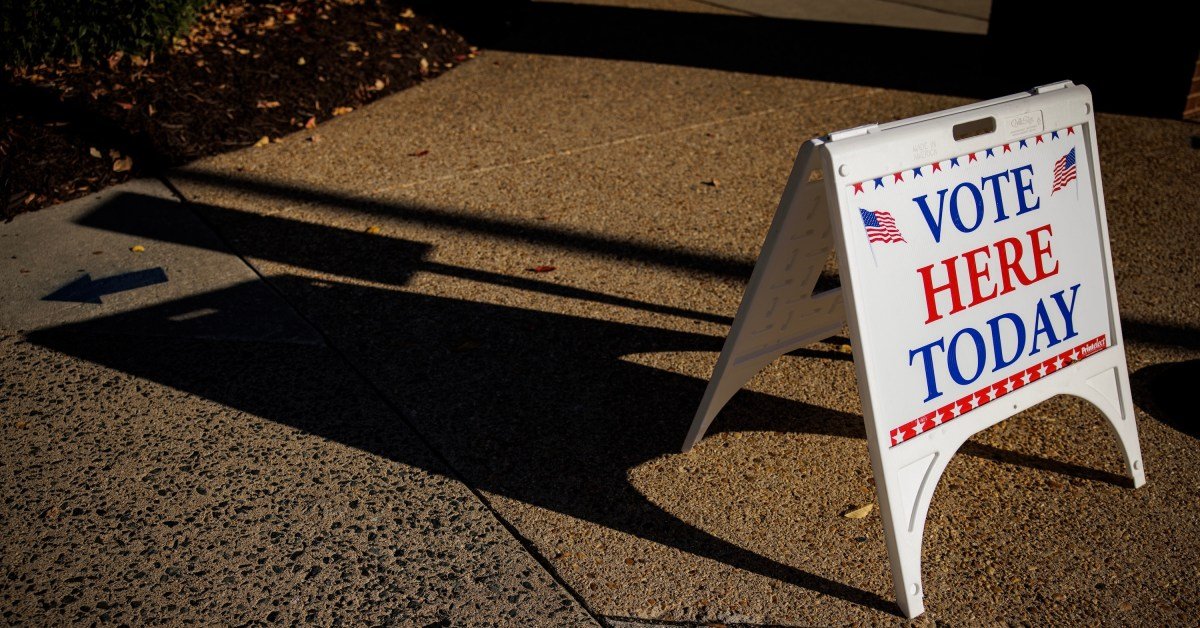
For him, flourishing looks like taking his youngest children with him whenever he votes, something that would have been unimaginable 15 years earlier. Now, they watch him thank the poll worker and cast his ballot.
And he wears his “I Voted” sticker with pride.
